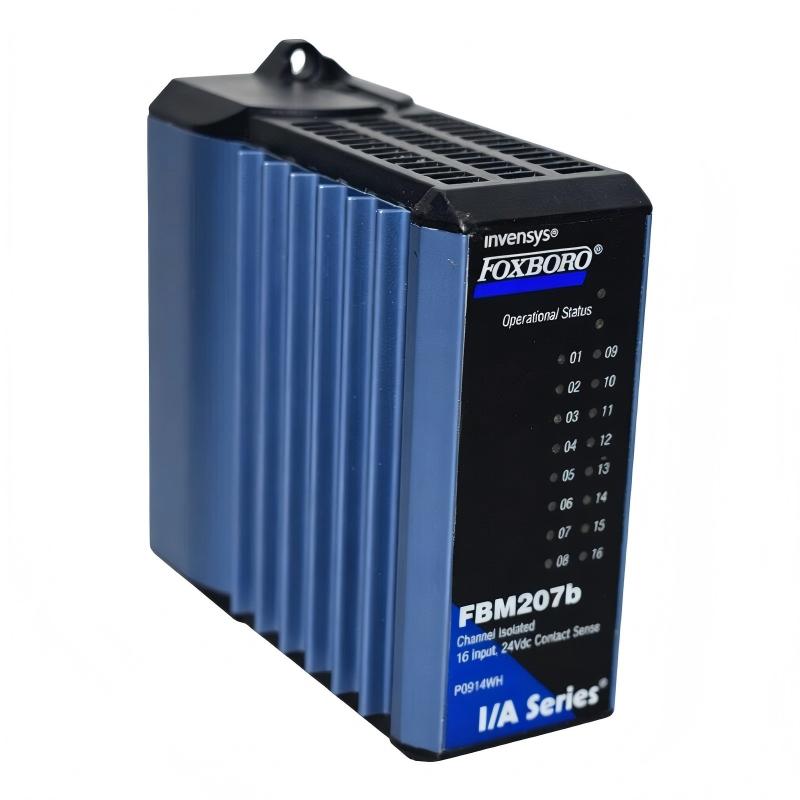
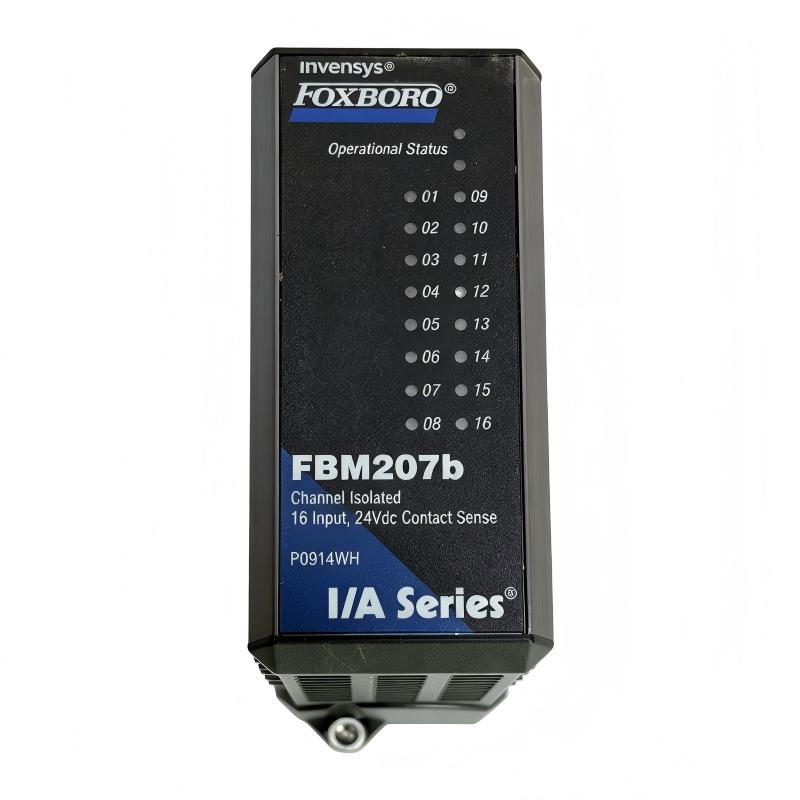
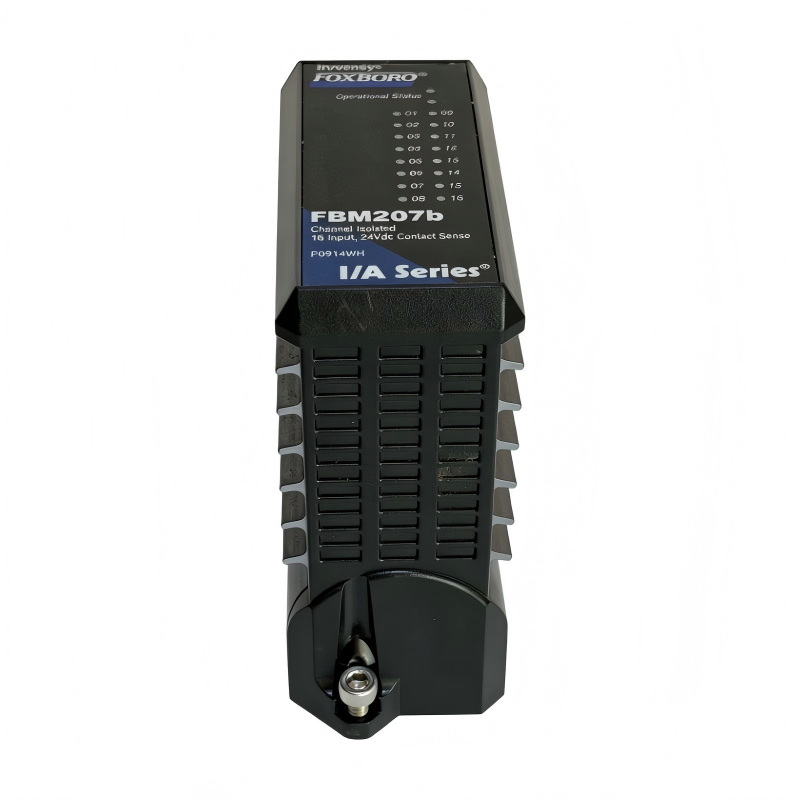
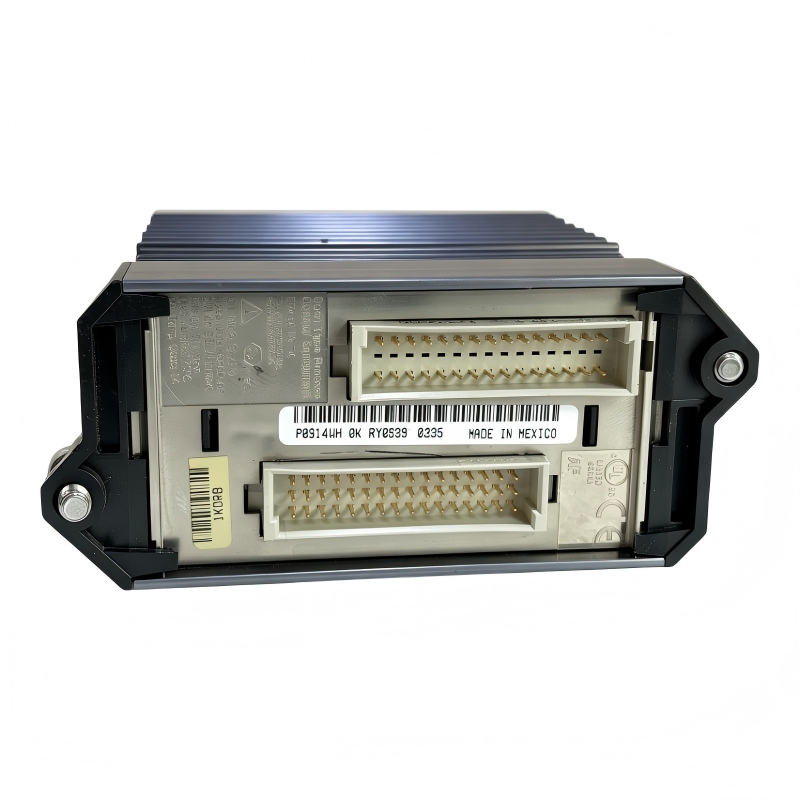
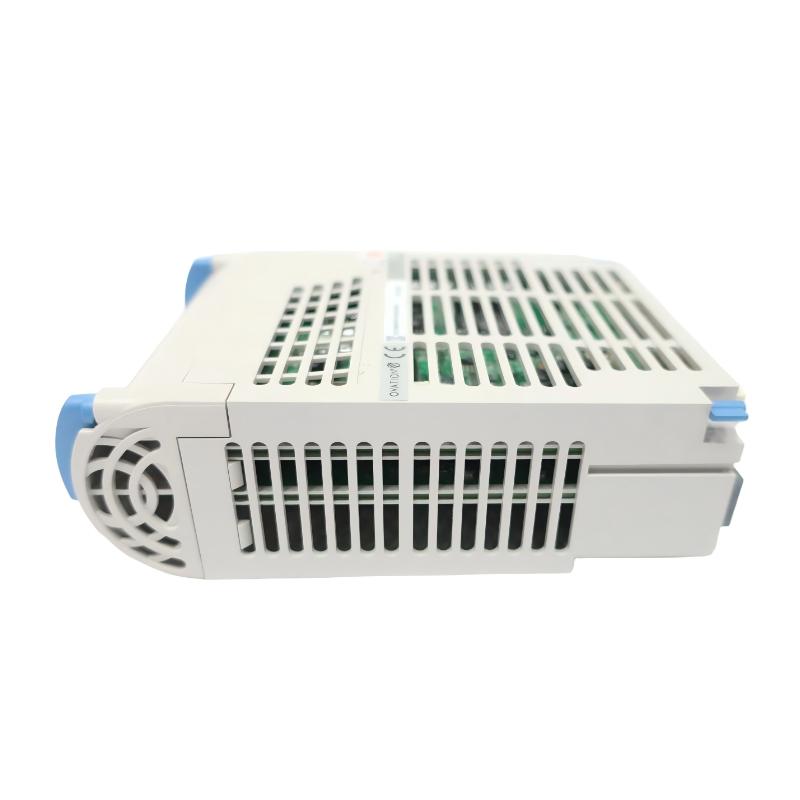
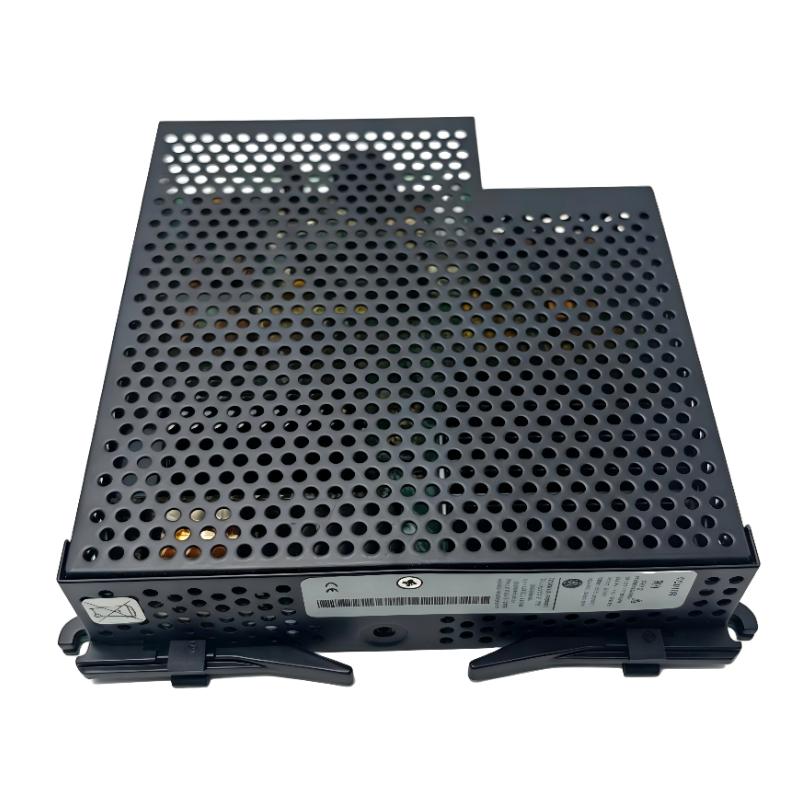
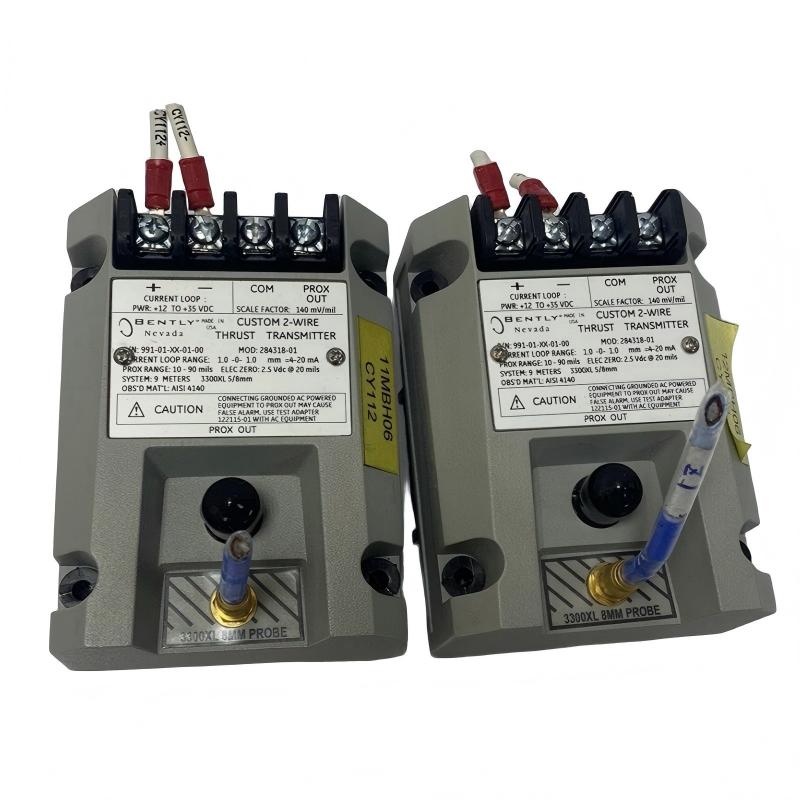
Brand:Foxboro Module Item No.:FBM207b Product Origin:USA Product Dimensions:114 x 45 x 104 mm Product Weight:0.284 kg Payment:T/T, Western Union, Credit Card Goods_stock:15 Shipping Port:Xiamen, China Lead Time:1-3 Days Condition:Brand New And Original Warranty:1 Year Certificate:COO
Discrete field signals are fundamental to industrial control. A simple contact can tell a DCS whether a motor is running, a valve has reached its position, a machine guard is closed, or an alarm condition has occurred. The Foxboro FBM207b P0914WH Contact Sensor Input Interface Module is designed to provide this type of field-status interface within a compatible Foxboro automation system.
Unlike analog instrumentation, contact devices communicate information through defined states rather than continuously changing process values. This makes them particularly useful for equipment-status monitoring, position indication, alarm detection, and interlock-related applications.
The FBM207b P0914WH provides an organized approach to bringing these discrete field conditions into the control architecture. For process plants and manufacturing facilities, dependable contact-state acquisition can improve visibility of equipment operation and support more effective plant monitoring.
Its compact format also makes it a practical component for control cabinet maintenance and replacement work. When the correct module variant is matched to the existing Foxboro architecture, it can help maintain the consistency of an established I/O system.
Technical Specifications
Specification
Details
Brand
Foxboro
Model
FBM207b P0914WH
Product Type
Contact Sensor Input Interface Module
Module Category
Discrete Input Interface
Input Type
Contact Sensor / Discrete Contact
Primary Function
Field Contact Status Acquisition
Typical Applications
Status, Alarm, Position and Contact Monitoring
System Application
Foxboro Process Control / DCS
Installation
Industrial Control Cabinet
Typical Field Devices
Switches, Relay Contacts, Position Contacts
Dimensions
114 × 45 × 104 mm
Weight
0.28 kg (0.63 lb)
Application Environment
Industrial Automation
Recommended Related Models
Model
Product Type
Application
Foxboro FBM204 P0914SY
Isolated I/O Module
Isolated process signal interfacing
Foxboro FBM205 P0914XG
Isolated I/O Module
Industrial process I/O
Foxboro FBM206 P0916CQ
Isolation Pulse Input Module
Pulse and frequency signal acquisition
Foxboro FBM207 P0916PH
Compressed Terminal Components
Field wiring termination
Foxboro FBM207 P0916AL
Compressed Terminal Components
Field connection and termination
These models can be considered when working with related Foxboro I/O and field-interface equipment. The correct selection should be based on the required signal type and the existing system architecture.
Popular Related Models
Model
Product Type
Typical Application
Foxboro FBM204 P0914SY
Isolated I/O Module
Process signal interfacing
Foxboro FBM205 P0914XG
Isolated I/O Module
Industrial automation
Foxboro FBM206 P0916CQ
Isolation Pulse Input Module
Pulse-based monitoring
Foxboro FBM207 P0916PH
Compressed Terminal Components
Field wiring organization
Foxboro FBM207 P0916XN
Compressed Terminal Components
Control cabinet termination
For replacement projects, the complete FBM207b P0914WH model designation should be verified before ordering. Contact-input modules should be matched to the required field signal type, wiring arrangement, and compatible Foxboro system configuration rather than selected solely by the FBM family name.
Applications
The Foxboro FBM207b P0914WH Contact Sensor Input Interface Module is designed for industrial automation systems that need to monitor contact-based field signals and transfer their status into a compatible Foxboro control architecture. It provides a practical interface for applications where equipment conditions are represented by discrete contact states such as open/closed, on/off, or normal/alarm.
Typical applications include motor and pump status monitoring, valve position indication, limit-switch detection, equipment interlocks, alarm contacts, and general machine-status supervision. These functions are common throughout oil and gas, chemical processing, refining, power generation, water treatment, and manufacturing facilities.
For maintenance and control-system engineers, the FBM207b P0914WH can be valuable where dependable contact-state monitoring is required without introducing unnecessary complexity into the field interface.
Advantages
Dedicated contact-signal interface — Designed for monitoring discrete contact conditions from compatible field devices.
Reliable status acquisition — Supports the collection of equipment and process status information by the control system.
Versatile field applications — Suitable for switches, contacts, position devices, interlocks, and alarm circuits.
Clear discrete-state monitoring — Helps control systems distinguish between defined contact conditions.
Industrial automation focused — Appropriate for demanding process and manufacturing environments.
Compact cabinet installation — Supports efficient control-panel layouts where space is limited.
Maintenance-friendly architecture — Makes it practical to inspect and troubleshoot discrete field circuits.
Useful for system replacement — A suitable option for compatible Foxboro installations requiring contact-input interface hardware.
Technical FAQs
1. What is the Foxboro FBM207b P0914WH used for?
The FBM207b P0914WH is a contact sensor input interface module designed to receive discrete contact signals from compatible field devices and provide their status to the Foxboro control system.
2. What types of field devices can provide contact inputs?
Typical sources include limit switches, auxiliary contacts, relay contacts, valve position switches, equipment status contacts, and alarm contacts.
3. What does a contact input represent in a control system?
A contact input normally represents a discrete state, such as open or closed, which the control system can interpret as equipment running/stopped, valve open/closed, normal/alarm, or another configured status.
4. Is the FBM207b P0914WH intended for analog measurement?
No. A contact sensor input interface is intended for discrete contact-state monitoring rather than continuously variable analog measurements.
5. Can contact inputs be used for equipment interlocks?
Contact signals are commonly used as part of interlock schemes. However, the actual safety or control function depends on the complete system design, logic, and applicable engineering requirements.
6. What should be checked before connecting a field contact?
Verify the contact type, wiring arrangement, electrical characteristics, required input configuration, field device specifications, and the applicable Foxboro system documentation.
7. What can cause a contact input to remain in the wrong state?
Potential causes include a faulty field switch, damaged wiring, loose terminals, incorrect contact configuration, electrical interference, or an issue with the input interface or system configuration.
8. How can a technician troubleshoot a contact input that does not change state?
Check the field device first and manually verify its contact operation where appropriate. Then inspect wiring and terminals before checking the input channel and corresponding control-system status.
9. Can mechanical switches generate unreliable contact signals?
Yes. Mechanical contacts can experience wear, contamination, oxidation, or contact bounce. The effect on the control system depends on the device and application, so appropriate signal handling and configuration should be considered.
10. Does replacing the input module require changes to the control logic?
A direct replacement with the correct compatible module may not require changes to the control strategy. Nevertheless, the I/O configuration and channel assignments should be verified after replacement to confirm correct operation.