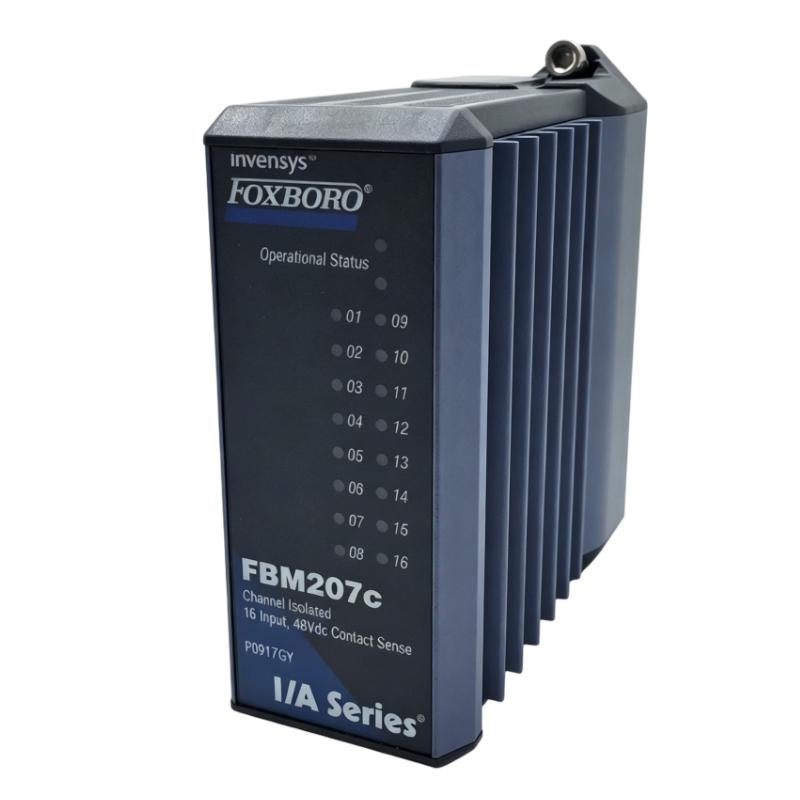
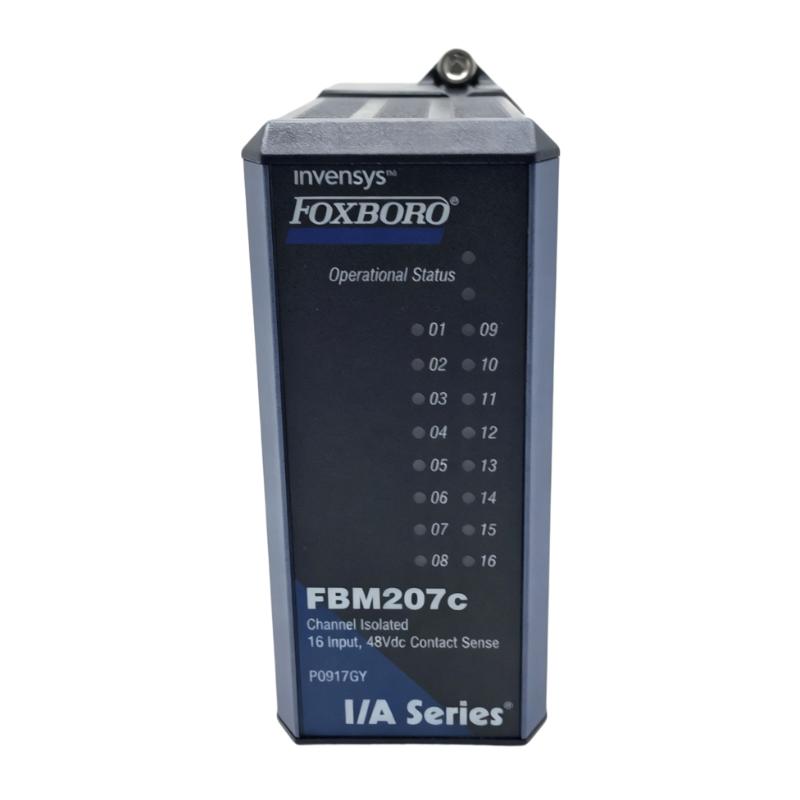
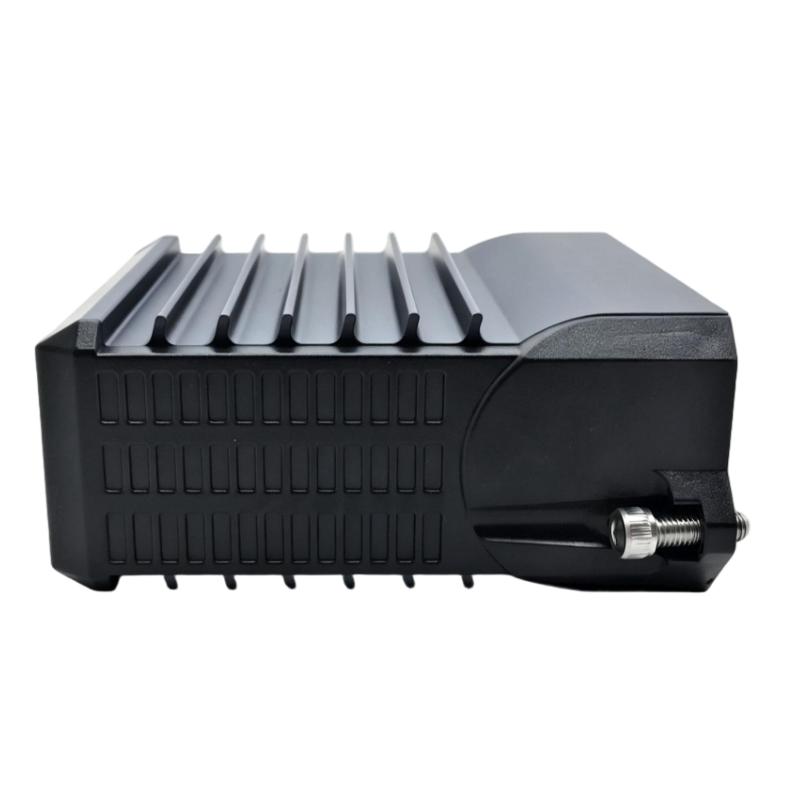
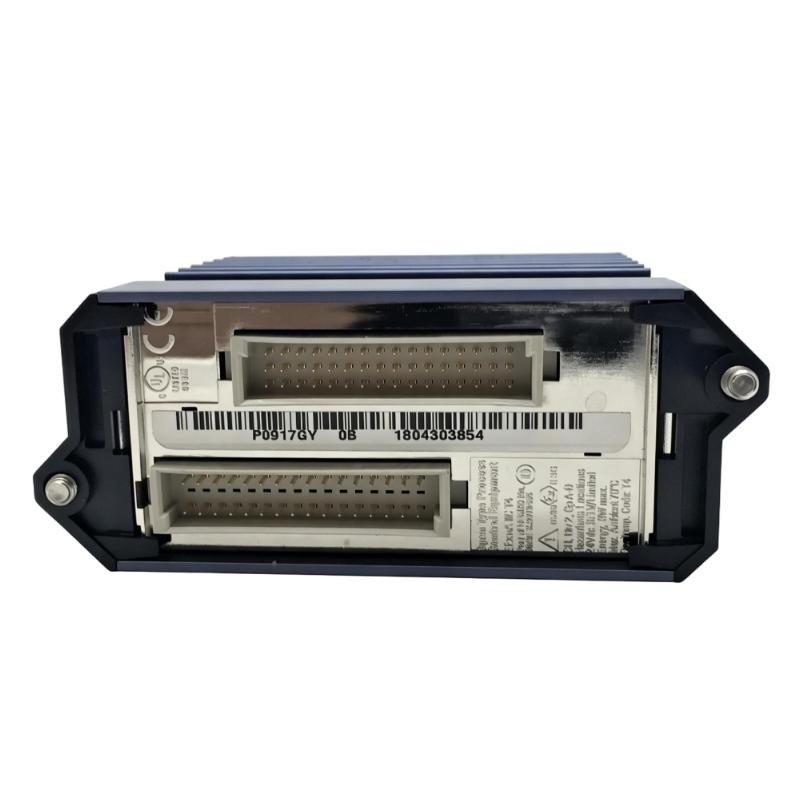
Brand:Foxboro Module Item No.:FBM207c P0917GY Product Origin:USA Product Dimensions:114 x 45 x 104 mm Product Weight:0.284 kg Payment:T/T, Western Union, Credit Card Goods_stock:15 Shipping Port:Xiamen, China Lead Time:1-3 Days Condition:Brand New And Original Warranty:1 Year Certificate:COO
The Foxboro FBM207c P0917GY Contact Sensor Input Interface Module is a field-interface component designed to acquire discrete contact information in industrial process-control environments.
Many automation decisions depend on simple binary information. A valve position may need to be confirmed, a pump may report a running status, a limit switch may indicate that a mechanism has reached its travel position, or an alarm contact may signal an abnormal condition. Reliable acquisition of these signals is therefore an important part of overall control-system performance.
The FBM207c P0917GY provides a dedicated interface for this type of contact-based field information. Once properly integrated, the resulting discrete states can be used by the control system for equipment monitoring, alarm handling, sequencing, permissives, and process supervision.
Its 114 × 45 × 104 mm form factor supports compact control-system installations. For maintenance teams, the module also provides a logical diagnostic point when investigating missing or unstable field indications.
When troubleshooting, technicians should avoid assuming that an abnormal input necessarily means the module itself has failed. The field device, wiring, terminal connections, channel configuration, and control-system logic should be checked systematically.
For replacement applications, use the complete catalog number FBM207c P0917GY and verify compatibility with the installed control architecture before commissioning.
Technical Specifications
Parameter
Specification
Brand
Foxboro
Model
FBM207c P0917GY
Product Type
Contact Sensor Input Interface Module
Module Function
Discrete Contact Input Interface
Signal Type
Contact / Discrete
Application
Industrial Process Control
System Architecture
Distributed Control System
Field Signal
Contact Sensor Input
Dimensions
114 × 45 × 104 mm
Weight
0.28 kg (0.63 lb)
Dimensions: 114 × 45 × 104 mm Weight: 0.28 kg (0.63 lb)
During installation, ensure that the module is mounted securely and that field wiring is correctly identified and terminated. Before commissioning, verify the control-system configuration and test the associated field contacts individually.
Recommended Related Models
Model
Product Type
Application Relationship
FBM207c P0917GY
Contact Sensor Input Interface Module
Primary model
FBM207b P0916JS
Contact Sensor Input Interface Module
Closely related contact-input configuration
FBM207b RH914WH
Contact Sensor Input Interface Module
Related FBM207-series configuration
FBM201
Discrete Input Interface Module
Related discrete input application
FBM203
Contact Input Interface Module
Related contact monitoring application
The related models may differ in hardware configuration and intended system application. Verify the complete model number and required signal characteristics before using any model as a replacement.
When selecting a replacement or related module, compare the complete catalog designation and confirm the field-signal requirements, control-system compatibility, wiring arrangement, and channel configuration before installation.
Process Contact Signal Applications
The Foxboro FBM207c P0917GY Contact Sensor Input Interface Module is designed for industrial process-control systems that need dependable acquisition of discrete contact signals from field devices.
In a distributed automation environment, contact information can represent valve positions, equipment states, alarm conditions, limit positions, permissives, or interlock inputs. The FBM207c P0917GY provides a practical interface for bringing these field conditions into the control system for monitoring and logic processing.
Typical applications include:
Process equipment status monitoring
Valve position feedback
Pump and motor status monitoring
Limit switch acquisition
Alarm contact monitoring
Interlock and permissive signals
Industrial sequencing
Field device status detection
Distributed process-control systems
Plant automation and instrumentation
A dependable discrete input path is especially important in process applications where a single contact state can influence equipment sequencing or operator alarms.
Designed for Reliable Field Integration
Dedicated contact input interface
The FBM207c P0917GY is intended for applications requiring contact-based field signals to be incorporated into an industrial control architecture.
Clear discrete-state monitoring
Field contacts can provide straightforward ON/OFF information that the control system can use for equipment status, alarms, permissives, sequencing, and monitoring.
Distributed control compatibility
The module is suitable for structured distributed control installations where field-level signals are collected and integrated into broader process-control functions.
Compact installation format
With dimensions of 114 × 45 × 104 mm, the module can be incorporated into control assemblies where efficient use of installation space matters.
Simplified fault isolation
When an input does not behave as expected, technicians can trace the signal path from the field contact through wiring and terminals to the input channel and control-system configuration.
Useful for plant maintenance
A clearly identified input interface can help maintenance personnel isolate whether a problem originates from the field device, wiring, module, or control logic.
Reliable industrial integration
The module is intended for professional automation environments where stable acquisition of discrete field information is essential to process visibility and equipment control.
Precise replacement identification
The full designation FBM207c P0917GY should be used when sourcing replacement equipment to distinguish this configuration from other FBM207-series modules.
Technical FAQs
1. What is the primary function of the FBM207c P0917GY?
It provides an interface for acquiring discrete contact signals from compatible field devices and making their status available to the associated process-control system.
2. What types of field devices can provide contact signals?
Common examples include limit switches, position switches, alarm contacts, equipment-status contacts, mechanical switches, and other compatible discrete devices.
3. How does the control system interpret a contact signal?
The input circuit detects the electrical state of the field contact and presents the corresponding discrete condition to the control system. The application logic then determines what that state means operationally.
4. What should be checked when an input remains permanently ON?
Inspect the field contact for a stuck or failed mechanism, check the field wiring for unintended continuity, verify terminal connections, and then examine the corresponding input channel and software configuration.
5. Why could an input remain OFF even though the field switch is closed?
Possible causes include an open circuit, damaged field cable, loose terminal, defective switch, incorrect wiring, channel failure, or incorrect input configuration.
6. How should an intermittent contact signal be investigated?
Operate the field device while observing the input status and inspect the switch mechanism, cable, terminals, and associated connections. Mechanical contact bounce or degraded contacts may also cause unstable signals.
7. Can long field cables affect discrete contact monitoring?
Long cable runs can introduce electrical interference or increase the susceptibility of low-level signals to unwanted disturbances. Appropriate cable routing, grounding, shielding, and installation practices should be considered according to the system design.
8. What should technicians verify before replacing the module?
Check field-device operation, cable continuity, terminal connections, channel configuration, module status, and system diagnostics. A structured signal-path test can prevent unnecessary hardware replacement.
9. Can this module be used for safety-critical interlocks?
A standard control-system input should not automatically be treated as a safety-rated input. Safety functions require the appropriate safety architecture, certified components, and engineering practices for the specific application.
10. What is a suitable commissioning sequence after installation?
Confirm correct module identification and system configuration, inspect field wiring, verify each contact circuit individually, operate the associated field devices, and confirm that the control system displays the expected input states.