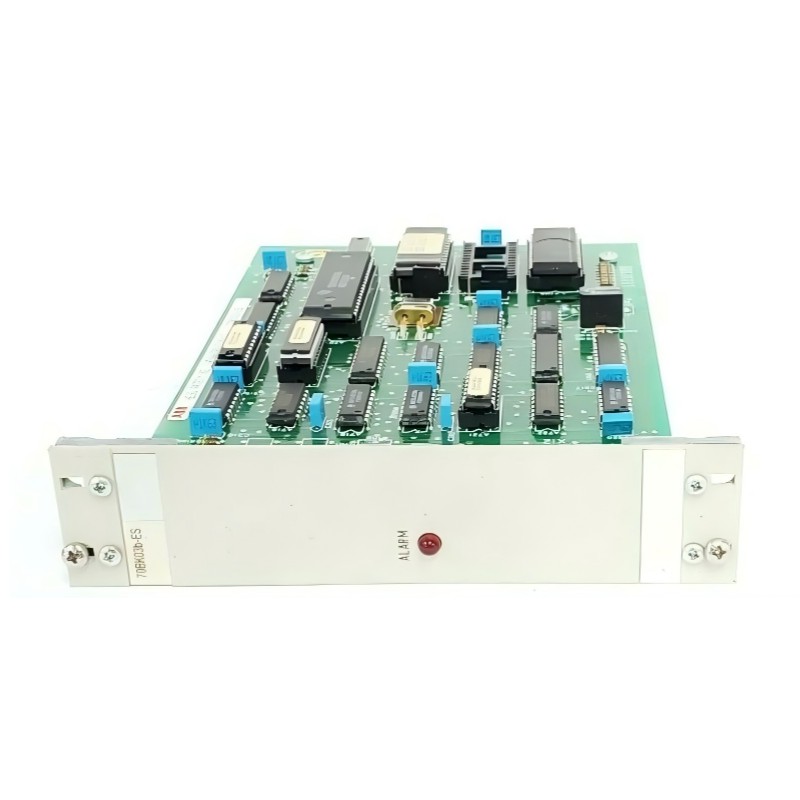
Brand:Emerson Module Item No.:KJ3002X1-BB1 Product Origin:USA Product Dimensions:107 x 41 x 105 mm Product Weight:0.31 kg Payment:T/T, Western Union, Credit Card Goods_stock:15 Shipping Port:Xiamen, China Lead Time:1-3 Days Condition:Brand New And Original Warranty:1 Year Certificate:COO
The Emerson KJ3002X1-BB1 Analog Output Module is a dependable automation component designed to convert controller instructions into precise analog signals for industrial process control. Engineered for compatibility with advanced distributed control systems, it enables stable communication between the control platform and field equipment such as valves, drives, and actuators, helping maintain accurate and efficient plant operations.
Technical Specifications
Parameter
Specification
Product Type
Analog Output Module
Manufacturer
Emerson
Model Number
KJ3002X1-BB1
Output Signal Type
Analog (4–20 mA typical)
System Compatibility
DeltaV Distributed Control System
Mounting Method
I/O Carrier Installation
Operating Environment
Industrial Automation Systems
Dimensions
107 x 41 x 105 mm
Weight
0.31 kg
Recommended Related Models
Model
Description
KJ3001X1-BB1
Discrete Input Module
KJ3003X1-BB1
Analog Input Module
KJ3004X1-BA1
Digital Output Module
KJ3002X1-BA1
Analog Output Module Variant
Popular Related Models
Model
Description
KJ3222X1-BA1
Analog Input Card
KJ1501X1-BC2
System Power Module
KJ4010X1-BF1
Power Supply Module
KJ4001X1-NB1
I/O Interface Module
KJ2201X1-BA1
Control I/O Module
Typical Industrial Applications
Distributed control systems used in oil & gas production and refining
Chemical and petrochemical process control environments
Power generation and turbine monitoring systems
Industrial utilities including water and wastewater treatment
Automated manufacturing lines requiring stable analog signal control
Core Performance Advantages
Precise Analog Signal Output – Ensures stable 4–20 mA signal delivery for accurate process control.
Seamless DeltaV Integration – Designed to operate efficiently within Emerson DeltaV automation platforms.
Industrial-Grade Reliability – Built for continuous operation in demanding plant environments.
Consistent Control Loop Performance – Supports stable regulation of valves, drives, and other field equipment.
Flexible System Expansion – Easily integrates into existing control cabinets and I/O infrastructures.
Technical FAQs
1. What role does the KJ3002X1-BB1 module play in a control system?
It converts digital commands from the controller into analog output signals used to operate field devices such as control valves and variable frequency drives.
2. What signal standard is typically used by this module?
The module commonly outputs industry-standard 4–20 mA analog signals used in process control instrumentation.
3. How does the module maintain signal accuracy?
It uses high-resolution digital-to-analog conversion and internal calibration mechanisms to ensure stable signal output.
4. Can this module be integrated into redundant control architectures?
Yes, it is designed to function within redundant control systems to support high-availability automation environments.
5. What types of field devices can it control?
It can operate a wide range of equipment including control valves, actuators, drives, and analog-controlled instrumentation.
6. Does the module support system diagnostics?
Yes, the control system can monitor the module status, enabling early detection of faults or signal irregularities.
7. How does it contribute to process efficiency?
Accurate analog signal output allows precise adjustment of process variables, helping optimize production stability.
8. Is the module suitable for continuous plant operations?
Yes, it is engineered for long-term, uninterrupted operation in industrial automation systems.
9. What type of system architecture commonly uses this module?
It is typically used in distributed control systems where analog signals are required to regulate process equipment.
10. How does the module interact with the main controller?
It receives digital commands from the controller through the system backplane and converts them into analog output signals.