


Allen Bradley PLC

  1. Home
  2. Products
  3. Allen Bradley PLC
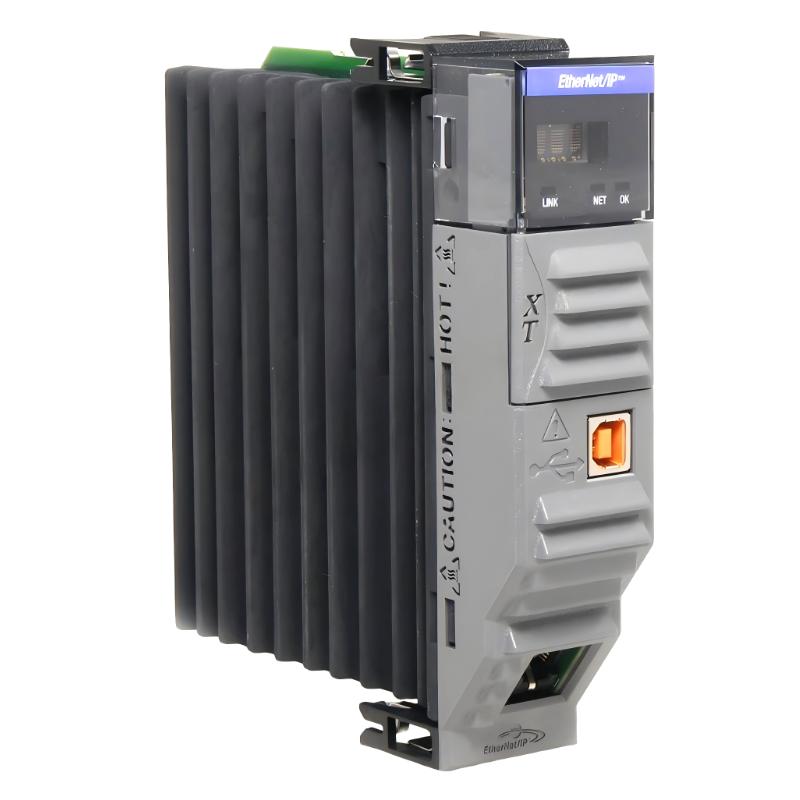
  4. Allen-Bradley 1756-EN2TXT EtherNet/IP Communication Module
Allen-Bradley 1756-EN2TXT EtherNet/IP Communication Module

Allen-Bradley 1756-EN2TXT EtherNet/IP Communication Module

0.0
Points

Brand:Allen Bradley PLC
Item No.:Allen-Bradley 1756-EN2TXT
Product Origin:USA
Product Dimensions:145 mm × 35 mm × 140 mm
Product Weight:0.5 kg
Payment:T/T, Western Union, Credit Card
Goods_stock:15
Shipping Port:Xiamen, China
Lead Time:1-3 Days
Condition:Brand New And Original
Warranty:1 Year
Certificate:COO

Add to cart

1756-EN2TXT-21756-EN2TXT-11756-EN2TXT-41756-EN2TXT-3

The Allen-Bradley 1756-EN2TXT is an extended temperature EtherNet/IP communication module used in the ControlLogix-XT system from Rockwell Automation. It provides high-speed industrial Ethernet connectivity for ControlLogix controllers and is designed for harsh environmental conditions where wider operating temperature ranges are required.

This module is part of the XT (Extreme Environment) series, making it suitable for oil & gas, offshore, chemical plants, and other demanding industrial applications.

It supports standard EtherNet/IP communication for integration with PLCs, HMIs, SCADA systems, drives, and remote I/O.


Technical Specifications

ParameterDetails
Product TypeEtherNet/IP Communication Module
Model1756-EN2TXT
System CompatibilityAllen-Bradley ControlLogix-XT
Network TypeEtherNet/IP
Communication Speed10/100 Mbps
Ports1 × RJ45 copper Ethernet
Channels2 logical communication channels
ProtocolsEtherNet/IP, TCP/IP
Max TCP Connections128
Max CIP Connections256
Special FeatureExtended Temperature (XT series)
Backplane InterfaceControlLogix chassis backplane
Power Consumption~5–6 W
Installation TypeChassis slot-mounted module
Operating Temperature-25°C to 70°C


Physical Dimensions & Weight

  • Dimensions (H × W × D): 145 mm × 35 mm × 140 mm
  • Weight: ~0.3–0.5 kg

Designed for standard ControlLogix XT chassis installation in industrial control cabinets.


Function in ControlLogix System

The 1756-EN2TXT is used to:

  • Provide EtherNet/IP communication in harsh environments
  • Connect ControlLogix controllers to plant Ethernet networks
  • Enable communication with PLCs, SCADA, HMIs, and drives
  • Support real-time industrial data exchange
  • Operate reliably in extended temperature conditions

Recommended Related Models

  • Allen-Bradley 1756-EN2T (standard Ethernet module)
  • Allen-Bradley 1756-EN2TR (dual-port DLR Ethernet module)
  • Allen-Bradley 1756-EN2F (fiber Ethernet module)
  • Allen-Bradley 1756-L7x / L8x ControlLogix controllers
  • Allen-Bradley 1756-AxXT XT chassis series 

Applications

The Allen-Bradley 1756-EN2TXT is used in:

  • Offshore oil & gas platforms
  • Petrochemical processing plants
  • Power generation stations
  • Harsh environment industrial automation
  • SCADA and distributed control systems
  • Large-scale process control networks


Advantages

  • Designed for extended temperature environments (-25°C to 70°C)
  • Reliable EtherNet/IP communication (10/100 Mbps)
  • Industrial-grade robustness for harsh conditions
  • High connection capacity (TCP and CIP support)
  • Seamless integration with ControlLogix systems
  • Suitable for mission-critical automation systems


Technical FAQs

1. What is the main function of 1756-EN2TXT?

It provides EtherNet/IP communication for ControlLogix systems in extended temperature environments.


2. What does “XT” mean?

XT stands for Extreme Environment / Extended Temperature design.


3. What is the temperature range?

Approximately -25°C to 70°C.


4. What communication speed does it support?

It supports 10/100 Mbps EtherNet/IP communication.


5. How many connections does it support?

Up to 128 TCP and 256 CIP connections.


6. Where is it installed?

Inside a ControlLogix XT-compatible chassis slot.


7. What makes it different from EN2T?

EN2TXT supports harsh environment operation (XT rating).


8. Does it support redundancy?

No, it is a single-port module (no built-in network redundancy).


9. What industries use it?

Oil & gas, petrochemical, offshore, and heavy industrial sectors.


10. Why is it important?

It enables reliable Ethernet communication in extreme industrial environments where standard modules cannot operate safely.


Look forward to your comments!Comment
Latest comments
Tags:
Need Assistance? Chat with Us on WhatsApp!
Need Assistance? Click to Inquire
Back to top