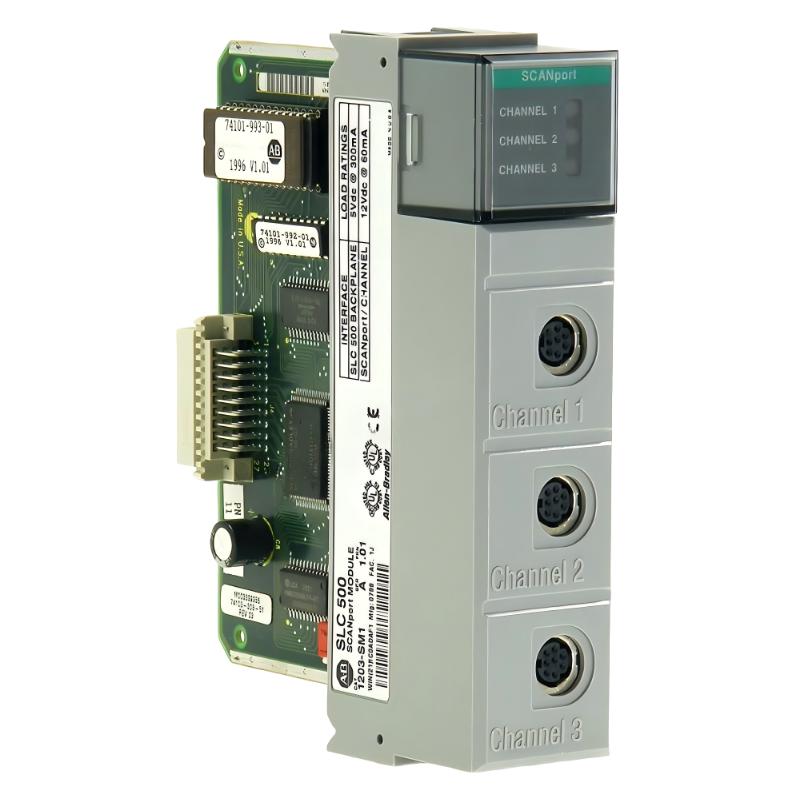
Allen-Bradley 1203-SM1 Communication Module Troubleshooting Guide (SCANport Fault Diagnosis)
Allen-Bradley 1203-SM1 communication faults are commonly caused by SCANport connection instability, incorrect SLC data configuration, or incompatible drive communication settings rather than a failed communication module. In troubleshooting situations, engineers should analyze the complete PLC-to-drive communication path before replacing hardware.
This guide describes a field troubleshooting case involving intermittent loss of SCANport communication between an SLC controller and AC drive system.
Allen-Bradley 1203-SM1 Communication Fault Symptoms Observed in the Field
A production line reported the following failure:
- Motor drive randomly stopped
- PLC remained in RUN mode
- Drive displayed communication loss
- Restart temporarily restored operation
Initial observations:
- 1203-SM1 module powered normally
- SLC processor showed no major fault
- Drive occasionally disappeared from PLC status data
The maintenance team suspected an aging communication module.
However, experienced troubleshooting requires separating:
- module failure
- cable failure
- configuration failure
- external electrical noise
Allen-Bradley 1203-SM1 Fault Diagnosis Thinking Process
The diagnostic approach followed the communication chain:
SLC Processor
      ↓
Backplane Communication
      ↓
1203-SM1 Module
      ↓
SCANport Cable
      ↓
Drive Interface
Engineers checked each layer individually.
Observation 1: PLC Backplane
Result:
- No module dropout
- No SLC rack fault
Conclusion:
The module was correctly recognized by the controller.
Observation 2: SCANport Signal Stability
Communication monitoring showed:
Normal operation:
- Update cycle: stable
During fault:
- Data interruption: 1–3 seconds
This indicated the issue was between the 1203-SM1 and the drive.
Allen-Bradley 1203-SM1 SCANport Communication Failure Root Cause Analysis
The final root cause was a damaged SCANport cable installed near a motor feeder.
Field findings:
- Cable insulation damage near cable tray
- Shield grounding inconsistent
- Noise spikes during motor acceleration
Recorded data:
Normal condition:
- Communication errors: <5/hour
Fault condition:
- Communication errors: >150/hour during motor startup
The module was replaced temporarily, but the failure remained.
This confirmed that replacing hardware would not solve the problem.
Allen-Bradley 1203-SM1 Troubleshooting Repair Procedure and Recovery
Corrective actions:
Cable Replacement
Old cable:
- Length: 25 m
- Damaged shielding
New cable:
- Industrial SCANport cable
- Proper separation from power wiring
Configuration Verification
Checked:
- Channel enable settings
- Drive node assignment
- PLC data table mapping
System Restart Test
After repair:
- 24-hour continuous operation completed
- No communication interruption
- Drive status remained stable
Allen-Bradley 1203-SM1 Fault Prevention and Maintenance Strategy
For long-term reliability:
Monitor Communication Quality
Record:
- Drive fault history
- Communication retry count
- Module status words
Inspect SCANport Wiring
During maintenance:
- Check connectors
- Verify shielding
- Inspect cable bending points
Avoid False Hardware Replacement
A practical engineering rule:
“If the PLC still recognizes the 1203-SM1 module, investigate communication path integrity before replacing the module.”
Allen-Bradley 1203-SM1 Long-Term Reliability Engineering Notes
The 1203-SM1 remains widely used in legacy Allen-Bradley SLC installations where SCANport-compatible drives are still operating.
Successful troubleshooting depends on:
- understanding PLC communication architecture
- reading status data correctly
- analyzing failure timing
- separating electrical noise problems from hardware faults
In industrial environments, the fastest repair is usually achieved by diagnosing the complete communication system rather than replacing individual components blindly.