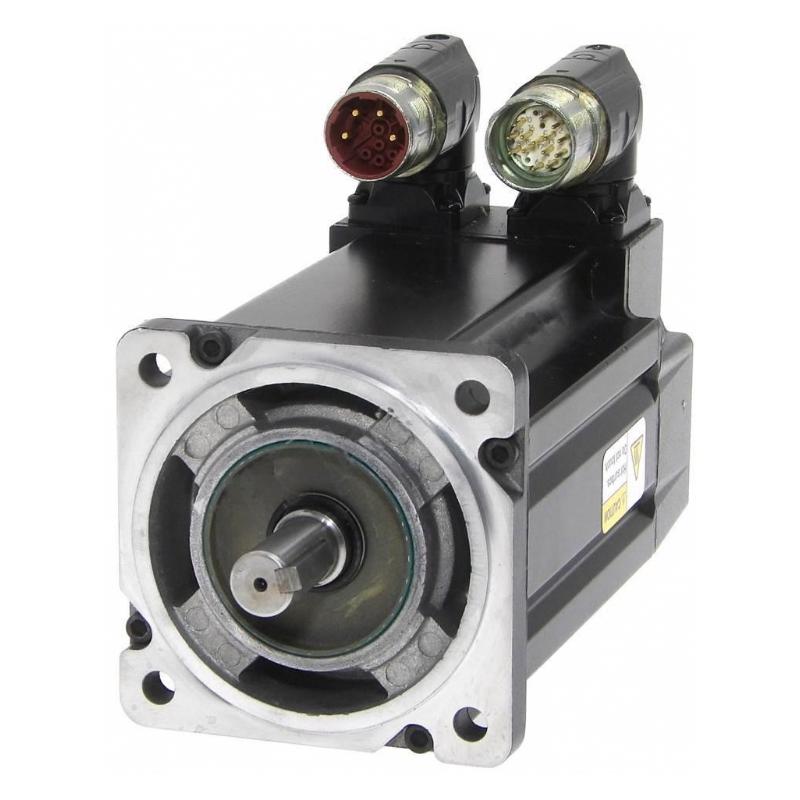
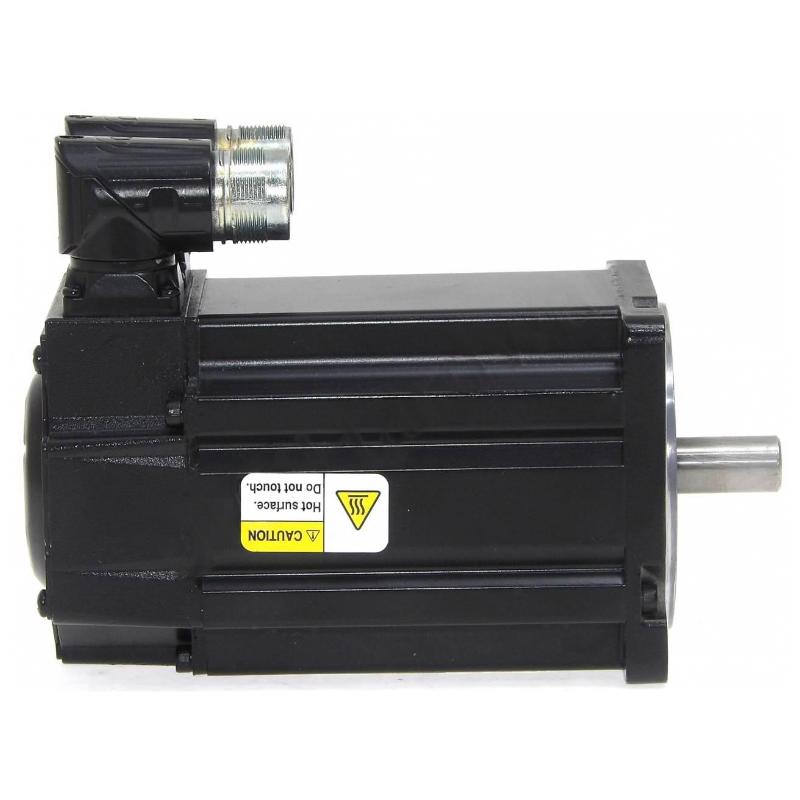
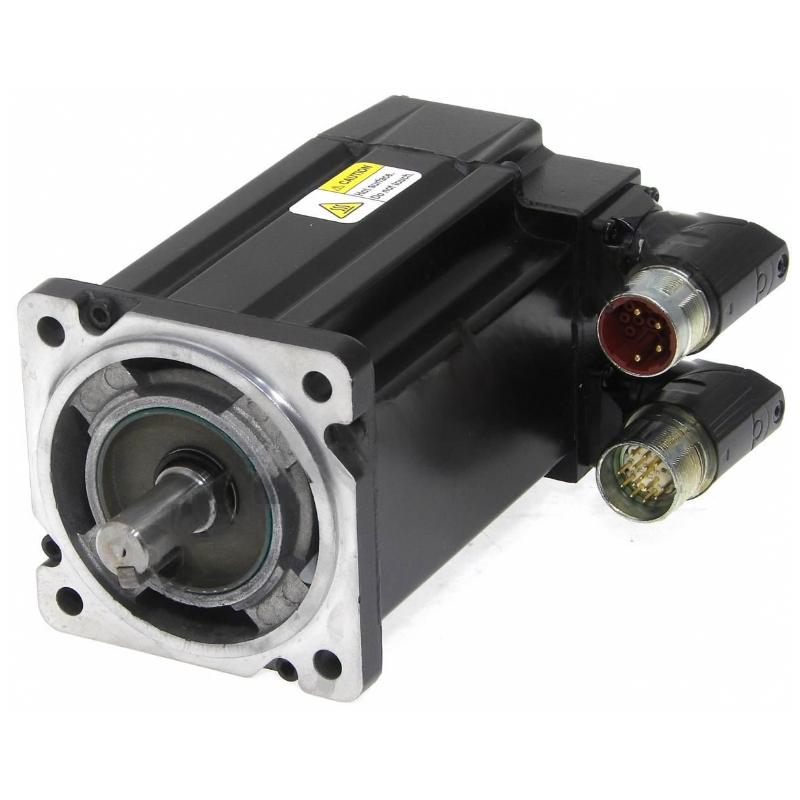
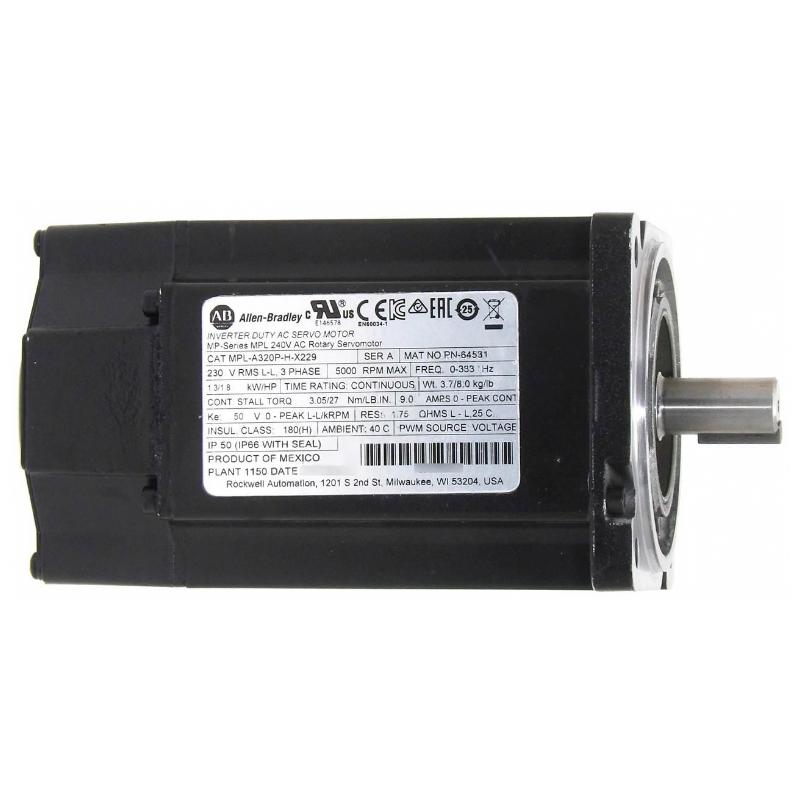
Brand:Allen Bradley PLC Item No.:MPL-A320P-H-X229 Product Origin:USA Product Dimensions:Frame Size: 100 mm Product Weight:3.63 kg Payment:T/T, Western Union, Credit Card Goods_stock:15 Shipping Port:Xiamen, China Lead Time:1-3 Days Condition:Brand New And Original Warranty:1 Year Certificate:COO
The Allen-Bradley MPL-A320P-H-X229 belongs to the MP-Series MPL family of low-inertia servo motors. It is intended for industrial motion systems where controlled rotary movement and repeatable machine performance are more important than the characteristics of a conventional induction motor.
Its 100 mm frame provides a compact mechanical platform that can be incorporated into automated machinery, while the low-inertia construction supports responsive changes in motor speed. These characteristics make the motor appropriate for machine axes that operate through repeated positioning cycles.
The MPL Series was developed for use with closed-loop servo control. In a properly engineered system, the servo drive receives feedback from the motor and continuously regulates its operation. This allows the machine controller to coordinate motor movement with other axes, sensors, actuators, and production sequences.
For OEM machine builders, correct motor selection should include more than physical dimensions. Electrical ratings, feedback technology, mechanical interface, brake requirements, and the compatible servo amplifier all influence system performance.
During installation, mechanical alignment deserves particular attention. A poorly aligned coupling can introduce additional radial or axial loading, vibration, and positioning problems. Cable routing is equally important because feedback signals should be protected from avoidable electrical interference.
The 3.63 kg motor weight makes the MPL-A320P-H-X229 relatively easy to handle during machine assembly while still providing a robust industrial servo package. For replacement work, confirming the complete catalog number before installation is recommended to avoid incompatibility between the motor and existing motion-control hardware.
Technical Specifications
Parameter
Specification
Brand
Allen-Bradley
Manufacturer
Rockwell Automation
Model
MPL-A320P-H-X229
Product Family
MP-Series MPL
Product Type
AC Rotary Servo Motor
Motor Design
Low-Inertia Servo Motor
Frame Size
100 mm
Application
Industrial Motion Control
Mounting
Metric Industrial Servo Mounting
Feedback
Servo Feedback System
Product Series
MPL
Dimensions
100 mm Frame
Weight
3.63 kg (8.00 lb)
The 100 mm frame provides a compact installation format for automated machinery. When installing the motor, engineers should verify mounting dimensions, shaft compatibility, coupling requirements, cable routing, grounding, and the associated servo-drive configuration before commissioning.
Recommended Related Models
Model
Product Type
Relationship
Allen-Bradley MPL-A320P-HH72AA
MP-Series Servo Motor
Related high-speed 100 mm configuration
Allen-Bradley MPL-A320P-HJ72AA
MP-Series Servo Motor
Related high-speed MPL configuration
Allen-Bradley MPL-A320P-HJ74AA
MP-Series Servo Motor
Related brake-equipped configuration
Allen-Bradley MPL-A320P-HK72AA
MP-Series Servo Motor
Related 100 mm high-speed configuration
Allen-Bradley MPL-A320P-HK74AA
MP-Series Servo Motor
Related brake-equipped high-speed configuration
For replacement projects, the complete catalog number should always be compared with the existing motor. Feedback, speed, brake, shaft, connector, and electrical characteristics can vary between models even when the frame size is identical.
Popular Related MP-Series Servo Motors
Model
Product Family
Typical Application
Allen-Bradley MPL-A320H-SK72AA
MP-Series MPL
Low-inertia positioning
Allen-Bradley MPL-A320H-SK74AA
MP-Series MPL
Motion axes requiring holding capability
Allen-Bradley MPL-A320P-HH72AA
MP-Series MPL
High-speed machine motion
Allen-Bradley MPL-A320P-HJ72AA
MP-Series MPL
High-speed positioning and indexing
Allen-Bradley MPL-A320P-HJ74AA
MP-Series MPL
High-speed motion with brake
Allen-Bradley MPL-A320P-HK72AA
MP-Series MPL
High-speed no-brake applications
Allen-Bradley MPL-A320P-HK74AA
MP-Series MPL
High-speed motion with holding brake
The Allen-Bradley MPL-A320P-H-X229 MP-Series Servo Motor provides a compact 100 mm-frame solution for industrial motion systems requiring responsive servo operation and dependable machine integration. Its low-inertia architecture makes it well suited to repetitive positioning, indexing, packaging, assembly, and other automated applications where controlled and repeatable rotary movement is essential.
Industrial Applications
The Allen-Bradley MPL-A320P-H-X229 is an MP-Series low-inertia AC servo motor designed for automated machinery that requires responsive motion, reliable feedback, and consistent positioning performance. Its 100 mm frame provides a compact mechanical format for machine axes where installation space and dynamic response both matter.
This servo motor is suitable for a range of motion-control applications, including packaging equipment, automated assembly machinery, indexing systems, material-handling equipment, printing and converting machines, and general-purpose production automation. Its low-inertia design is particularly beneficial in applications involving frequent acceleration, deceleration, and directional changes.
The motor is intended to operate as part of a closed-loop servo system. When paired with a compatible Allen-Bradley servo drive, the motor's feedback system allows the controller to monitor actual shaft movement and adjust motor operation according to the programmed motion profile.
For equipment manufacturers and maintenance teams, the MPL-A320P-H-X229 provides a compact MP-Series solution for machine axes where repeatability, dynamic response, and dependable integration are important considerations.
Motion-Control Benefits
The MPL-A320P-H-X229 uses a low-inertia motor design, allowing the rotor to respond quickly to changes in speed and position commands. This characteristic is valuable in high-cycle machinery where the motor may repeatedly accelerate, stop, reverse, and reposition.
Its 100 mm frame size offers a practical balance between motor capacity and machine-space requirements. This makes the motor easier to integrate into compact automated equipment without requiring an unnecessarily large motor package.
The MP-Series architecture also provides a familiar solution for industrial motion systems built around Allen-Bradley controllers and servo drives. When correctly configured, the motor and drive can operate as a coordinated closed-loop system for controlled machine-axis movement.
Mechanical integration is another important consideration. The motor's mounting arrangement and shaft interface allow it to be incorporated into appropriately designed machine assemblies, while proper coupling alignment helps maintain smooth operation and reduce unnecessary mechanical loading.
For replacement applications, the complete MPL-A320P-H-X229 catalog number should be matched against the existing motor and drive configuration. Servo motors that share the same frame size can still differ in feedback, speed, brake, shaft, or electrical characteristics.
Technical FAQs
1. What type of motor is the MPL-A320P-H-X229?
The MPL-A320P-H-X229 is an Allen-Bradley MP-Series MPL AC rotary servo motor designed for closed-loop industrial motion-control applications.
2. What is the purpose of the low-inertia design?
Low rotor inertia allows the motor to respond rapidly to changes in the commanded motion. This is especially useful for indexing, positioning, and high-cycle machinery.
3. Can this motor be used with an Allen-Bradley servo drive?
The motor is intended for use within a compatible Allen-Bradley servo system. The exact drive selection must be verified against the motor's electrical, feedback, and application requirements.
4. What should be checked before replacing an MPL-Series motor?
Check the complete catalog number, voltage requirements, motor ratings, feedback arrangement, shaft configuration, brake status, connector arrangement, and servo-drive compatibility. Matching the 100 mm frame alone is not sufficient.
5. Why is encoder feedback important in a servo system?
Encoder feedback allows the servo controller to determine the motor's actual position and speed. The controller can then compare actual movement with the commanded motion and make corrections as necessary.
6. What can cause a servo motor to hunt or oscillate around its commanded position?
Possible causes include inappropriate servo tuning, excessive mechanical compliance, load inertia, backlash, coupling problems, or incorrect feedback configuration. Both the control parameters and mechanical system should be evaluated.
7. How can excessive following error be investigated?
Start by checking motor and drive configuration, then examine acceleration settings, load inertia, mechanical alignment, coupling condition, and feedback signals. A following error should not automatically be attributed to the motor itself.
8. What installation factors are important for servo motor reliability?
Proper shaft alignment, secure mounting, correct coupling installation, suitable cable routing, reliable grounding, and protection from excessive vibration are all important. Feedback wiring should also be protected from unnecessary electrical interference.
9. Can a servo motor be operated continuously at its maximum speed?
Maximum speed is an operating limit rather than an indication that the motor should continuously run at that speed under every load condition. Continuous operation must be evaluated according to torque, thermal conditions, duty cycle, and the complete servo-system configuration.
10. What should be done if the motor does not respond after commissioning?
Verify the drive enable condition, motor power connections, feedback connection, control commands, drive configuration, and fault status. If a brake-equipped configuration is involved, the brake circuit should also be checked before attempting repeated starts.