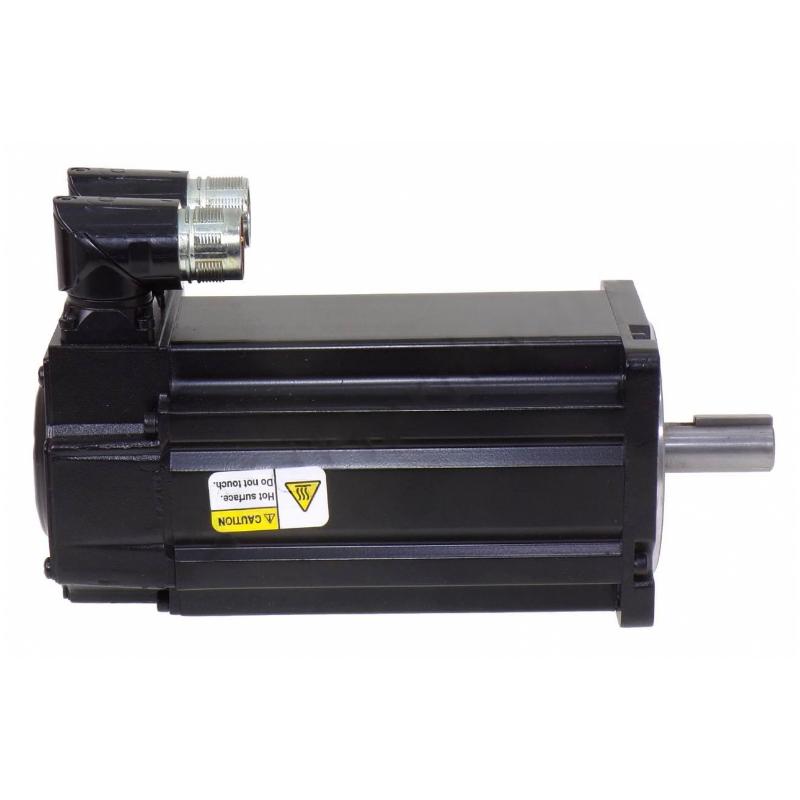
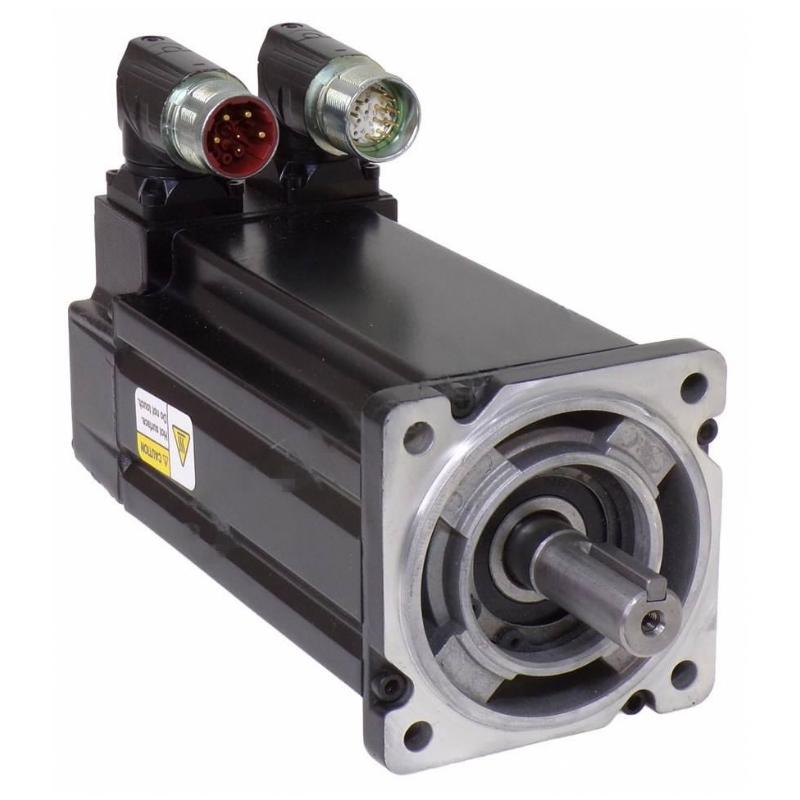
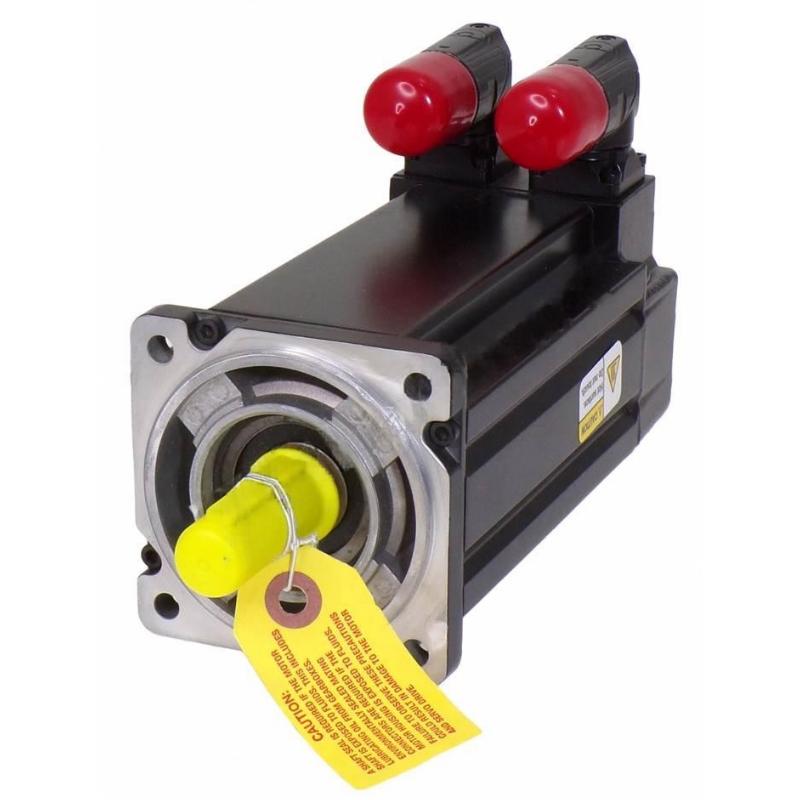
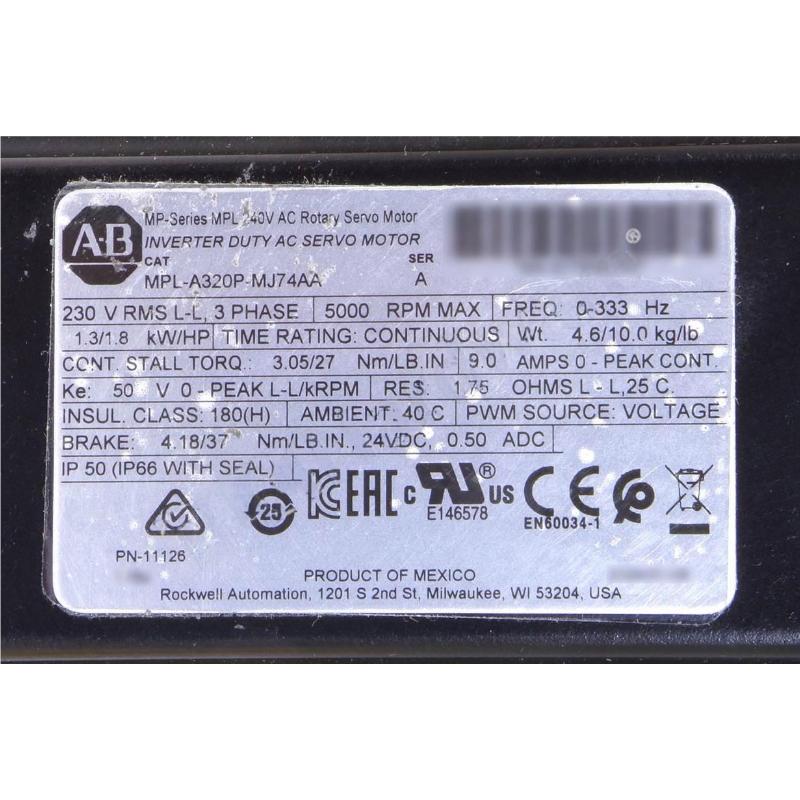
Brand:Allen Bradley PLC Item No.:MPL-A320P-MJ74AA Product Origin:USA Product Dimensions:Frame Size: 100 mm Product Weight:3.7 kg Payment:T/T, Western Union, Credit Card Goods_stock:15 Shipping Port:Xiamen, China Lead Time:1-3 Days Condition:Brand New And Original Warranty:1 Year Certificate:COO
The Allen-Bradley MPL-A320P-MJ74AA belongs to the MP-Series MPL family of low-inertia servo motors and is intended for automated machinery requiring responsive and repeatable motion. Its 100 mm frame makes it particularly suitable for machine designs where space is limited but a dedicated servo axis is still required.
The low-inertia rotor allows the motor to respond efficiently to changes in the commanded motion. In a packaging or indexing machine, for example, the axis may need to accelerate quickly, move to a precise position, stop, and then immediately repeat the sequence. A responsive servo motor is well suited to this type of operating profile.
The motor operates as part of a closed-loop system. Encoder feedback allows the compatible servo drive to determine actual shaft movement and continuously regulate the motor according to the programmed position, velocity, and torque requirements.
The holding brake is the key feature that distinguishes this configuration from comparable no-brake motors. When properly controlled, the brake can mechanically hold the shaft after servo torque has been removed. This makes the configuration more flexible for machine axes where maintaining position during a power-off condition is important.
Brake control should be properly coordinated with servo enable and motor torque. Applying or releasing the brake at an inappropriate point in the motion sequence can introduce unwanted mechanical stress or axis movement.
Mechanical installation also deserves attention. Servo motors can transmit substantial dynamic forces through their shaft and mounting interface, especially during rapid acceleration and deceleration. Correct coupling alignment and secure mounting help maintain smooth operation.
For OEMs and maintenance engineers, the MPL-A320P-MJ74AA offers a useful combination of compact construction, responsive servo characteristics, and mechanical holding capability, making it a strong candidate for demanding industrial automation systems.
Technical Specifications
Parameter
Specification
Brand
Allen-Bradley
Manufacturer
Rockwell Automation
Model
MPL-A320P-MJ74AA
Product Family
MP-Series MPL
Product Type
AC Rotary Servo Motor
Motor Design
Low-Inertia Brushless Servo Motor
Frame Size
100 mm
Application
Industrial Motion Control
Feedback
Encoder Feedback
Shaft Configuration
Servo Motor Shaft
Brake
Integrated Holding Brake
Mounting
Metric Industrial Servo Mounting
Product Series
MPL
Frame Dimension
100 mm
Weight
3.70 kg (8.16 lb)
For installation, verify the mounting interface, shaft coupling, feedback connections, brake wiring, grounding, and compatible servo-drive configuration. The brake circuit should be tested before the machine is operated under its normal load.
Recommended Related Models
Model
Product Type
Relationship
Allen-Bradley MPL-A320P-MJ72AA
MP-Series Servo Motor
Closely related no-brake configuration
Allen-Bradley MPL-A320P-HJ72AA
MP-Series Servo Motor
Related 100 mm high-speed configuration
Allen-Bradley MPL-A320P-HJ74AA
MP-Series Servo Motor
Related high-speed brake-equipped configuration
Allen-Bradley MPL-A320P-HK72AA
MP-Series Servo Motor
Related high-speed no-brake configuration
Allen-Bradley MPL-A320P-HK74AA
MP-Series Servo Motor
Related high-speed brake-equipped configuration
When selecting a replacement motor, do not rely only on the 100 mm frame size. Feedback type, motor speed, brake configuration, shaft arrangement, electrical characteristics, and servo-drive compatibility should all be verified.
Popular Related MP-Series Servo Motors
Model
Product Family
Typical Application
Allen-Bradley MPL-A320H-SK72AA
MP-Series MPL
Low-inertia positioning
Allen-Bradley MPL-A320H-SK74AA
MP-Series MPL
Servo axes requiring holding capability
Allen-Bradley MPL-A320P-HH72AA
MP-Series MPL
High-speed machine motion
Allen-Bradley MPL-A320P-HJ72AA
MP-Series MPL
High-speed positioning and indexing
Allen-Bradley MPL-A320P-HJ74AA
MP-Series MPL
High-speed motion with holding brake
Allen-Bradley MPL-A320P-HK72AA
MP-Series MPL
High-speed no-brake applications
Allen-Bradley MPL-A320P-HK74AA
MP-Series MPL
High-speed motion with holding brake
Allen-Bradley MPL-A320P-MJ72AA
MP-Series MPL
Compact motion applications without brake
The Allen-Bradley MPL-A320P-MJ74AA MP-Series Servo Motor provides a compact 100 mm-frame solution for industrial motion systems requiring responsive servo operation and mechanical shaft holding. Its low-inertia architecture and brake-equipped configuration make it particularly attractive for automated packaging, indexing, assembly, material handling, and other applications where accurate motion and controlled stopping are essential.
Industrial Applications
The Allen-Bradley MPL-A320P-MJ74AA is an MP-Series MPL low-inertia AC servo motor designed for automated machinery where fast response, repeatable positioning, and controlled rotary motion are essential. With a 100 mm frame, it provides a compact solution for machine axes that need dependable servo performance without occupying excessive installation space.
This motor is well suited to packaging machines, automated assembly equipment, indexing systems, material-handling machinery, printing and converting equipment, and other production systems with frequent positioning movements. Its low-inertia construction is particularly useful when the axis must accelerate and decelerate repeatedly during each production cycle.
The integrated feedback system allows the motor to operate as part of a closed-loop servo architecture. A compatible servo drive can monitor actual motor movement and regulate speed, torque, and position according to the machine's motion commands.
Unlike the corresponding no-brake configuration, the MJ74AA version incorporates a holding brake, giving machine designers an additional option for applications where the shaft needs to remain mechanically held when servo power is removed.
The motor's compact 100 mm frame, servo feedback, and brake-equipped configuration make it a practical choice for OEM machinery and replacement applications where controlled motion and mechanical holding capability are both important.
Why This Configuration Works Well in Motion Systems
The MPL-A320P-MJ74AA is built around a low-inertia servo motor design, allowing the rotor to respond quickly to changes in commanded speed and position. This characteristic is valuable in machines where production cycles contain frequent starts, stops, indexing movements, or reversals.
Its 100 mm frame offers a compact mounting solution for machine builders. This can be advantageous when the motor must be positioned near a gearbox, belt system, ball screw, rotary table, or other mechanical transmission.
A major advantage of the MJ74AA configuration is its integrated holding brake. The brake can hold the motor shaft when the motor is not generating torque, provided the application remains within the brake's intended operating conditions. This can be particularly useful for certain vertical or load-holding axes.
The motor also uses encoder-based feedback as part of the servo control system. Accurate feedback enables the drive to monitor actual shaft movement and correct deviations from the commanded motion profile.
For mechanical integration, the motor's shaft and mounting arrangement are designed for use with suitable industrial couplings and machine structures. Correct alignment is especially important when the motor operates at high speed or when the axis experiences frequent dynamic changes.
The combination of low inertia, closed-loop feedback, compact construction, and holding-brake functionality gives the MPL-A320P-MJ74AA a strong position in demanding automated motion applications.
Technical FAQs
1. What is the MPL-A320P-MJ74AA?
The MPL-A320P-MJ74AA is an Allen-Bradley MP-Series MPL low-inertia AC rotary servo motor intended for industrial closed-loop motion-control applications.
2. Does the MJ74AA configuration include a holding brake?
Yes. The MJ74AA configuration includes a holding brake. The brake provides mechanical shaft holding when used within its specified operating conditions.
3. Why would an application require a brake-equipped servo motor?
A brake can be useful when an axis needs to remain stationary after motor torque is removed. This is especially relevant to certain vertical axes, lifting mechanisms, and machines where uncontrolled shaft movement could create a mechanical problem.
4. Can the holding brake be used as the machine's emergency stopping device?
The integrated holding brake should not automatically be treated as the complete emergency stopping system. Emergency stopping should be designed through the machine's safety architecture, considering the servo drive, braking method, load, and applicable safety requirements.
5. What is the advantage of a low-inertia servo motor?
Low rotor inertia enables faster acceleration and deceleration. This can improve the response of an axis that performs frequent positioning movements and helps reduce unnecessary delay during rapid motion cycles.
6. What type of control system is normally used with this motor?
The motor is intended for use with a compatible servo drive and motion controller. The drive regulates the motor while encoder feedback provides information needed for closed-loop motion control.
7. What should be checked if the brake does not release?
Check the brake power circuit, control sequence, wiring, connector condition, drive configuration, and brake-related parameters. Mechanical loading should also be considered because excessive load can affect brake operation.
8. What can cause a servo axis to lose position during operation?
Potential causes include excessive load, incorrect tuning, mechanical backlash, coupling slippage, encoder feedback problems, excessive acceleration, or an unsuitable motion profile. The mechanical and electrical systems should be evaluated together.
9. What is important when installing the motor coupling?
The coupling should be correctly matched to the motor shaft and load. Proper alignment, allowable shaft loads, torsional stiffness, and operating speed should be considered to prevent vibration and premature component wear.
10. How should the servo motor be commissioned after installation?
First verify mechanical installation and wiring. Then confirm motor and drive compatibility, feedback operation, brake sequencing, grounding, motor parameters, and motion limits. Initial testing should be performed at controlled speed before placing the machine into normal production.