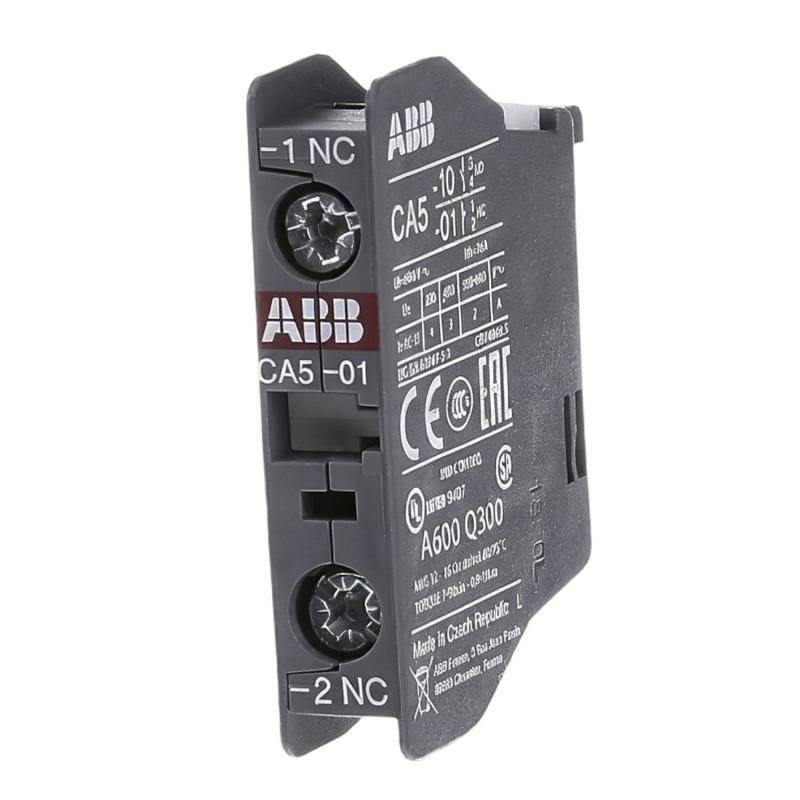
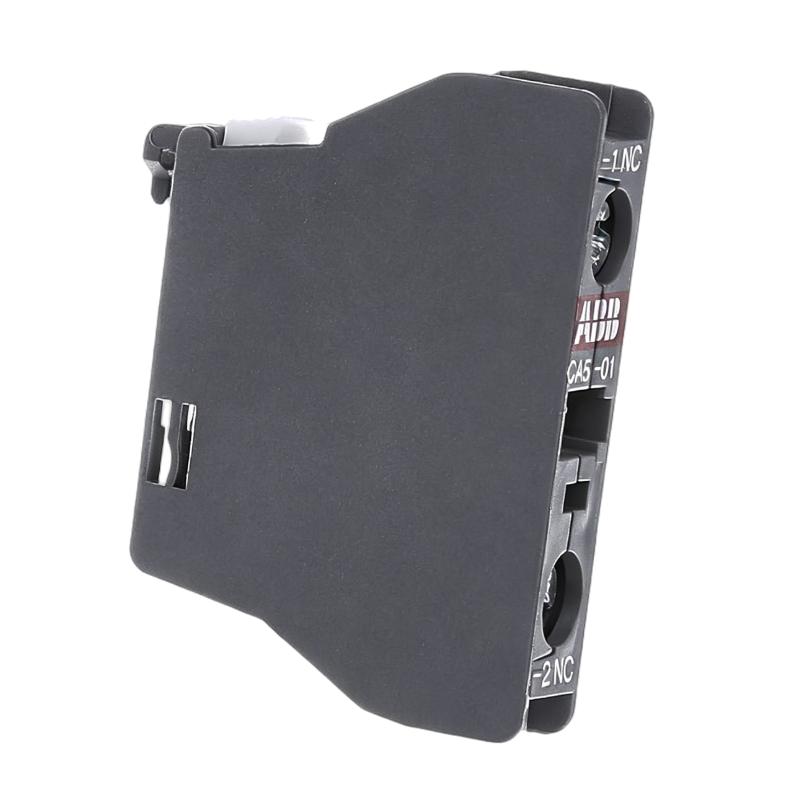
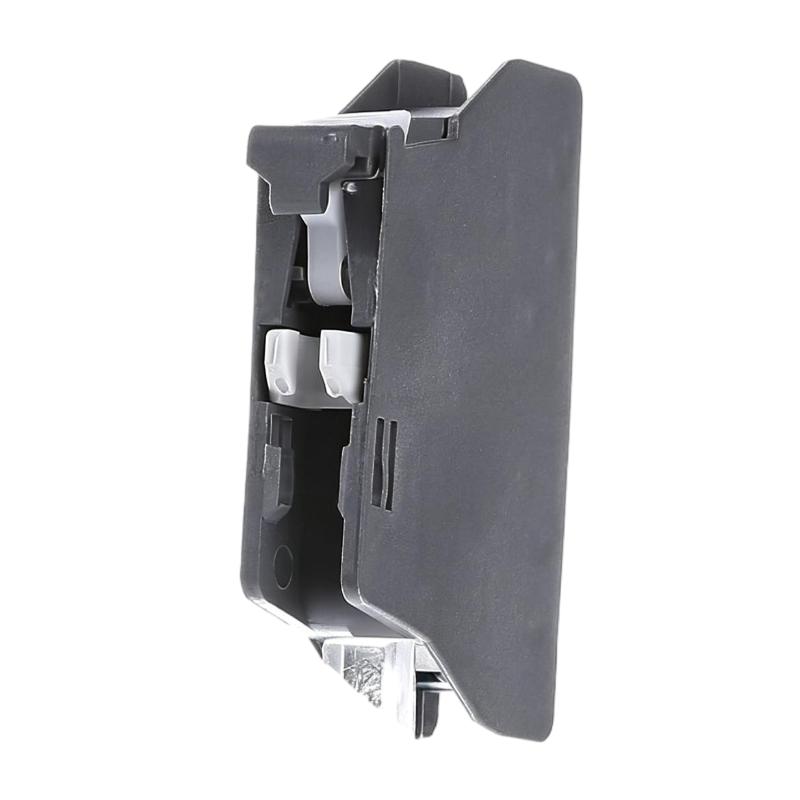
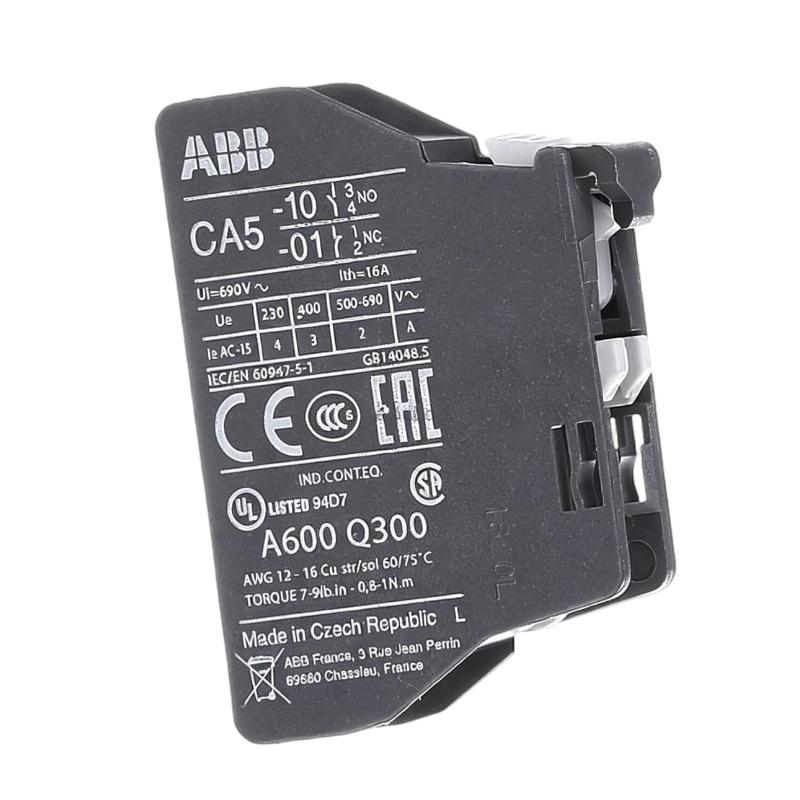
Brand:ABB PLC Item No.:CA5-01 Product Origin:Sweden (SE) Product Dimensions:47 × 11 × 32.5 mm Product Weight:0.014 kg Payment:T/T, Western Union, Credit Card Goods_stock:15 Shipping Port:Xiamen, China Lead Time:1-3 Days Condition:Brand New And Original Warranty:1 Year Certificate:COO
Product Introduction and Auxiliary Contact Function
The ABB CA5-01 1SBN010010R1001 Auxiliary Contact Module is a small but functionally important component used to extend the control capabilities of compatible ABB contactors.
In an industrial motor starter, the primary contactor contacts carry out the main switching operation. The auxiliary contacts provide additional information or control paths that can be used by the automation system. The CA5-01's normally closed configuration is particularly useful for interlocking and status-monitoring arrangements.
For example, an N.C. auxiliary contact can be incorporated into a control circuit so that another operation is permitted only while the associated contactor remains in the required state. It can also be used as part of a feedback circuit where a change in contactor state needs to be detected by a PLC or relay system.
The CA5-01 uses a front-mounted design, making it possible to add auxiliary functionality directly to a compatible contactor without installing a separate control relay. This helps simplify panel layouts and can reduce the number of components required within a motor-control assembly.
Its compact form factor also makes it attractive for modern control cabinets where high component density is common. Despite its small size, the module can play an important role in machine sequencing and electrical interlocking.
For maintenance applications, the 1SBN010010R1001 identification should be retained when ordering a replacement. The contact arrangement is particularly important because an N.C. auxiliary block cannot automatically replace an N.O. version without considering the control-circuit logic.
Technical Specifications
Parameter
Specification
Brand
ABB
Model
CA5-01
Product ID
1SBN010010R1001
Product Type
Auxiliary Contact Module
Component Type
Auxiliary Contact Block
Number of Poles
1 Pole
Auxiliary Contacts
1 N.C.
Normally Open Contacts
0
Contact Operation
Instantaneous
Mounting Type
Front Mounting
Terminal Type
Screw Terminals
Product Range
ABB A Contactors
Compatible Contactor Range
A9 ... A75
Rated Insulation Voltage
690 V
Rated Frequency
50 / 60 Hz
AC-15 Operational Current at 24 / 127 V
6 A
AC-15 Operational Current at 220 / 240 V
4 A
AC-15 Operational Current at 380 / 440 V
3 A
AC-15 Operational Current at 500 V
2 A
AC-15 Operational Current at 690 V
2 A
DC-13 Operational Current at 24 V
6 A
DC-13 Operational Current at 48 V
2.8 A
DC-13 Operational Current at 72 V
1 A
DC-13 Operational Current at 125 V
0.55 A
Dimensions
47 × 11 × 32.5 mm
Weight
0.01 kg (0.03 lb)
Application
Auxiliary and Control Circuits
Installation
Industrial Contactor Assembly
The supplied product weight of 0.014 kg is expressed as 0.01 kg (0.03 lb) when rounded to two decimal places as requested. The product dimensions are 47 × 11 × 32.5 mm.
Recommended Related ABB Models
Model
Product Description
Relationship
ABB CA5-10 1SBN010010R1010
Auxiliary Contact Module
N.O. counterpart to CA5-01
ABB CC5-10 1SBN010011R1010
Auxiliary Contact Module
Related N.O. auxiliary configuration
ABB CC5-01 1SBN010011R1001
Auxiliary Contact Module
Related N.C. auxiliary configuration
ABB CA5-22E 1SBN010040R1022
Auxiliary Contact Module
Multi-contact alternative
ABB CA5-31E 1SBN010040R1031
Auxiliary Contact Module
Expanded contact arrangement
ABB CA5-40E 1SBN010040R1040
Auxiliary Contact Module
Multiple N.O. contacts
When selecting a related auxiliary contact, engineers should verify both the contact arrangement and the compatibility of the module with the installed contactor.
Popular Related Models for Motor Control
Model
Product Description
Typical Application
ABB CA5-01 1SBN010010R1001
1 N.C. Auxiliary Contact Module
Interlocking and feedback
ABB CA5-10 1SBN010010R1010
1 N.O. Auxiliary Contact Module
Contactor status signaling
ABB CC5-01 1SBN010011R1001
1 N.C. Auxiliary Contact Module
Auxiliary control
ABB CC5-10 1SBN010011R1010
1 N.O. Auxiliary Contact Module
Auxiliary switching
ABB CA5-22E 1SBN010040R1022
4-Pole Auxiliary Contact Module
Multi-contact control
ABB CA5-31E 1SBN010040R1031
4-Pole Auxiliary Contact Module
Control and signaling
ABB CA5-40E 1SBN010040R1040
4-Pole Auxiliary Contact Module
Multiple N.O. auxiliary circuits
The ABB CA5-01 1SBN010010R1001 Auxiliary Contact Module is a compact solution for adding a dependable normally closed auxiliary circuit to compatible ABB contactors. Its front-mounted design, screw-terminal connection, instantaneous operation, and small footprint make it well suited to motor control, PLC feedback, electrical interlocking, machine sequencing, and industrial maintenance applications.
Applications and Control Integration
The ABB CA5-01 1SBN010010R1001 Auxiliary Contact Module is a compact, front-mounted auxiliary contact block designed for compatible ABB contactors and contactor relays. It provides one normally closed (N.C.) instantaneous auxiliary contact, giving control systems an additional switching point for interlocking, feedback, signaling, and sequence-control functions.
In a motor-control cabinet, the main contactor is responsible for switching the primary circuit, while an auxiliary contact can communicate the contactor's operating condition to the control circuit. This makes the CA5-01 useful in applications where a reliable N.C. signal is required without adding a separate relay.
The module is suitable for a variety of industrial control applications, including:
Motor starter circuits
Industrial automation panels
Contactor interlocking
PLC feedback circuits
Motor status monitoring
Machine-control systems
Electrical sequence control
Alarm and indication circuits
Contactor control assemblies
Industrial equipment maintenance
The CA5-01 is designed for front mounting and can be installed on compatible ABB A-series contactors and N-series contactor relays. Its compact construction is especially beneficial in control cabinets where every millimeter of panel space matters.
Key Advantages for Industrial Motor Control
One dedicated normally closed contact
The CA5-01 provides a 1 N.C. auxiliary contact, making it an effective choice for control circuits that require a closed contact in the normal state and an open signal when the associated contactor changes state.
Compact front-mounted construction
The module is designed to mount directly to the front of compatible contactors. This integrated arrangement keeps the control assembly neat and minimizes additional cabinet space.
Instantaneous auxiliary operation
The auxiliary contact follows the operation of the associated contactor without an intentional time delay. This makes it suitable for real-time interlocking and status-related control functions.
Screw-terminal connection
The screw-terminal arrangement provides a familiar connection method for panel builders and maintenance technicians, allowing straightforward wiring inspection and servicing.
Suitable for control and auxiliary circuits
The CA5-01 is intended for auxiliary and control applications rather than primary power switching. This makes it useful for transmitting contactor status to PLCs, relays, indicators, and other control equipment.
Easy replacement during maintenance
If an auxiliary contact becomes worn or unreliable, the individual contact block can be replaced instead of unnecessarily replacing the complete contactor assembly.
Space-efficient solution
With a compact profile of 47 × 11 × 32.5 mm, the CA5-01 adds auxiliary functionality while maintaining a highly space-efficient control-panel arrangement.
Technical FAQs: CA5-01 Auxiliary Contact Module
1. What is the ABB CA5-01 1SBN010010R1001 used for?
The CA5-01 is an auxiliary contact block used with compatible ABB contactors and contactor relays. It provides an additional electrical contact for control, monitoring, interlocking, and signaling circuits.
2. How many auxiliary contacts does the CA5-01 have?
The CA5-01 has one normally closed auxiliary contact and is configured as a 1-pole auxiliary contact block.
3. Is the CA5-01 normally open or normally closed?
The CA5-01 provides 1 N.C. contact. In its normal condition, the auxiliary circuit remains closed. When the associated contactor operates, the auxiliary contact changes state.
4. Where is the CA5-01 installed?
The CA5-01 is a front-mounted auxiliary contact block. It is fitted directly onto compatible ABB contactors or contactor relays.
5. Can the CA5-01 be used for PLC feedback?
Yes. The auxiliary contact can be incorporated into a suitable PLC input circuit to provide contactor status information, provided that the PLC input circuit is electrically compatible with the contact rating and control voltage.
6. Can the CA5-01 switch a motor's main power circuit?
No. It is an auxiliary contact component and is not intended to replace the main power contacts of a motor contactor. Its function is primarily related to auxiliary control and signaling.
7. What are typical failure symptoms of an auxiliary contact?
A defective contact may result in incorrect PLC feedback, failed electrical interlocking, incorrect status indication, intermittent control signals, or a machine sequence that stops unexpectedly.
8. How can the CA5-01 be checked during troubleshooting?
The module should first be inspected for physical damage, loose terminals, contamination, and incorrect mounting. After the circuit has been safely isolated, the N.C. contact can be tested for correct continuity and state change during contactor operation.
9. Can the CA5-01 be replaced by the CA5-10?
They have different contact configurations. The CA5-01 provides an N.C. contact, while the CA5-10 provides an N.O. contact. They should therefore not be treated as direct electrical substitutes unless the control-circuit design specifically permits the different contact arrangement.
10. Does installing the CA5-01 require PLC software changes?
A direct replacement of an existing CA5-01 normally does not require software modification. However, the complete control sequence should be tested after installation to verify that the auxiliary signal is being received correctly.