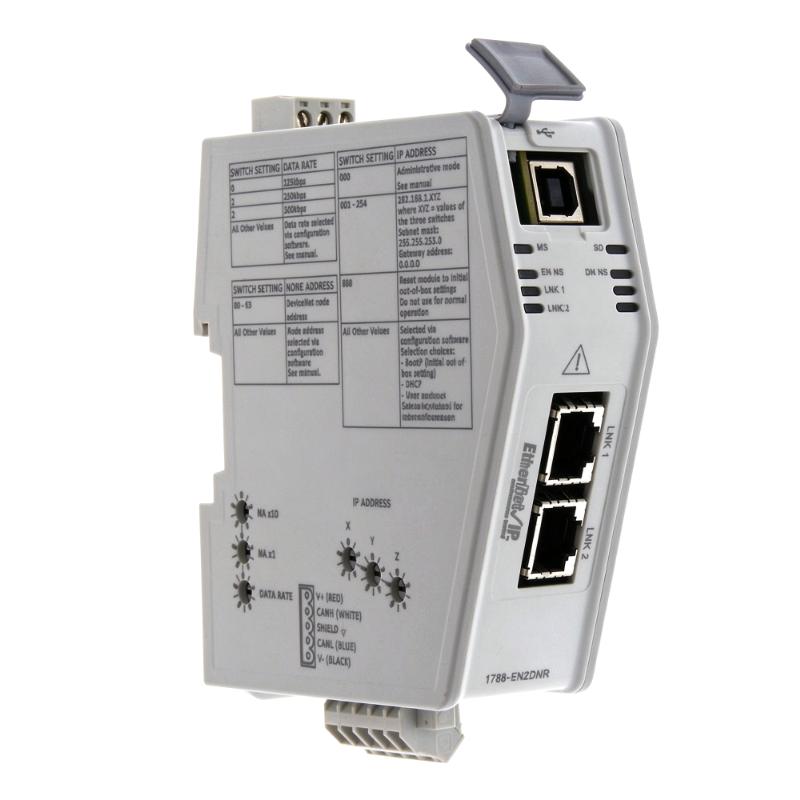
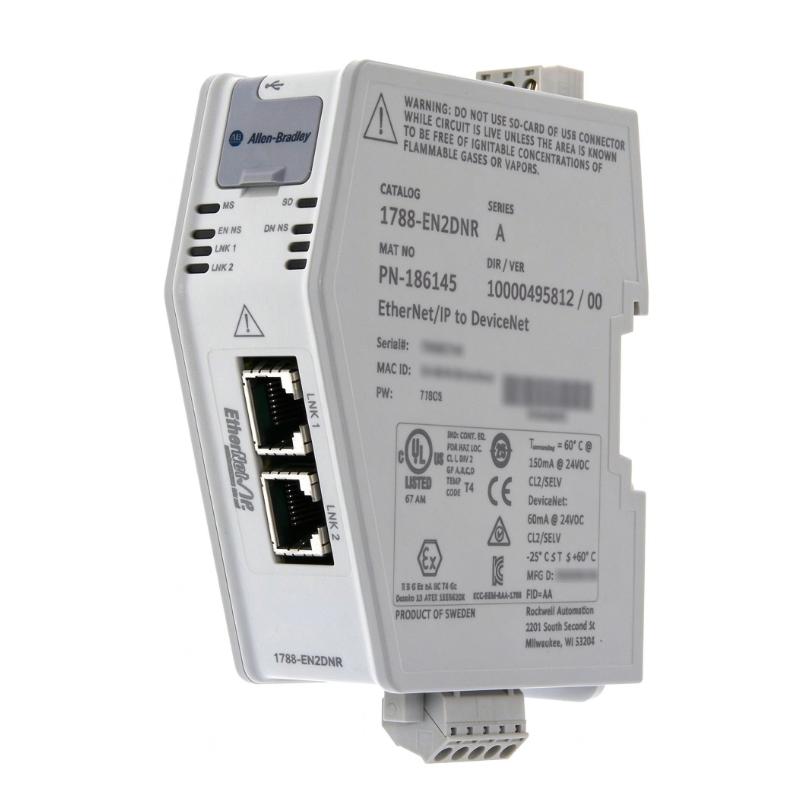
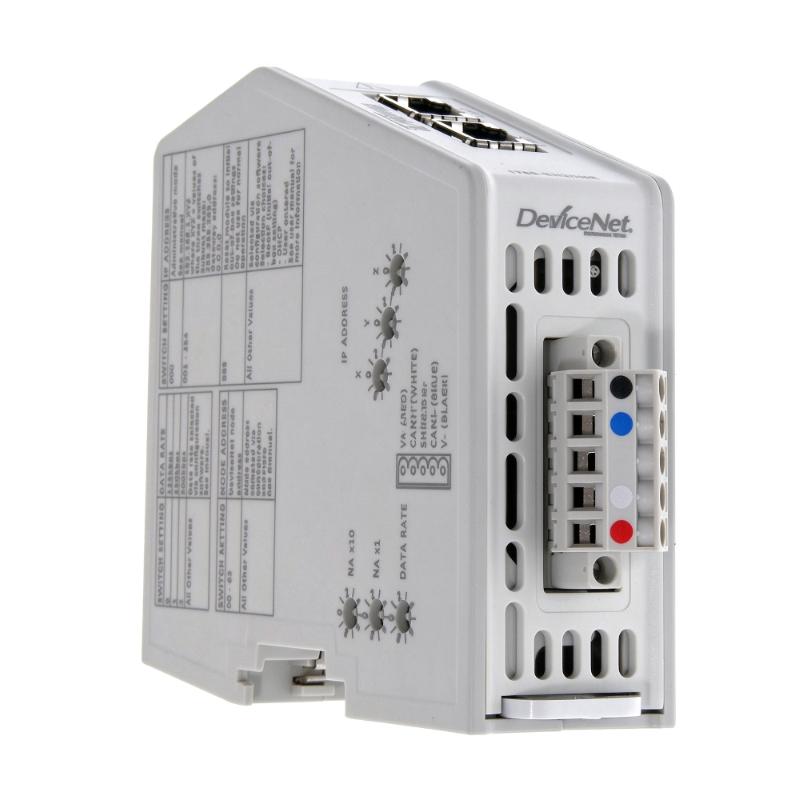
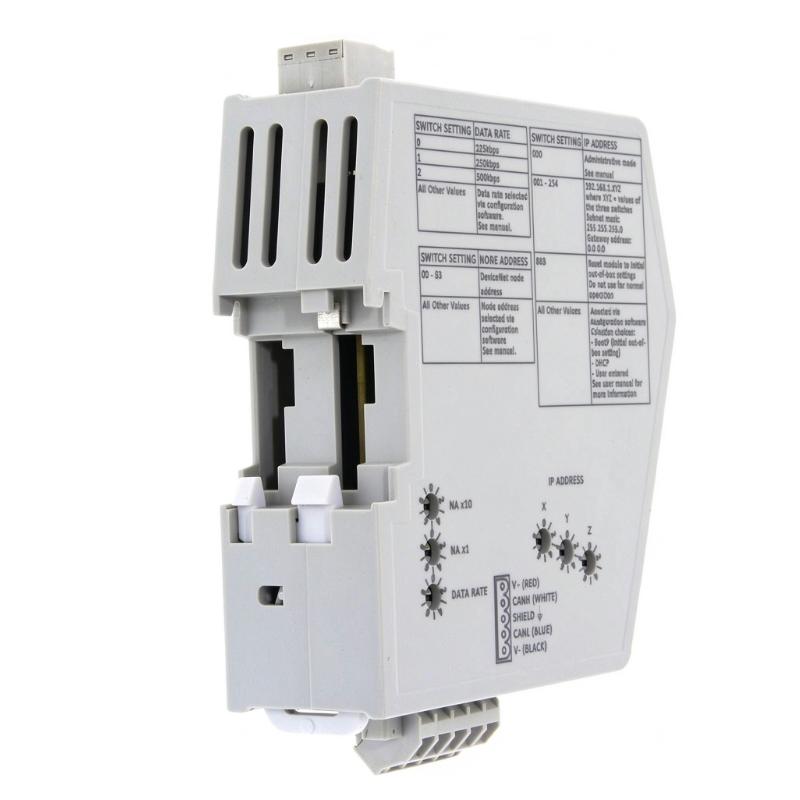
Allen Bradley 1788-EN2DNR EtherNet/IP to DeviceNet Communication Module
Allen Bradley 1788-EN2DNR EtherNet/IP to DeviceNet Communication Module
0.0
Points
Brand:Allen Bradley PLC Item No.:1788-EN2DNR Product Origin:USA Product Dimensions:134 x 26 x 112 mm Product Weight:0.24 kg Payment:T/T, Western Union, Credit Card Goods_stock:15 Shipping Port:Xiamen, China Lead Time:1-3 Days Condition:Brand New And Original Warranty:1 Year Certificate:COO
The Allen Bradley 1788-EN2DNR EtherNet/IP to DeviceNet Communication Module is associated with industrial network integration involving EtherNet/IP and DeviceNet. In automation systems, communication modules help connect different layers of equipment so that controllers and field devices can exchange information needed for monitoring, coordination, and control.
EtherNet/IP is widely used in industrial control architectures, while DeviceNet is commonly associated with field-level equipment such as sensors, actuators, and motor-control devices. A compatible linking or communication module can help integrate these network environments while preserving supported existing devices.
Successful deployment requires careful network planning. Engineers should confirm the module's exact supported function, controller compatibility, network addressing requirements, and configuration procedures. They should also consider the effect of communication interruptions on production equipment before replacing or modifying network hardware.
For maintenance and procurement, verify the complete catalog number on the device label and compare it with the required system documentation. This is especially important when maintaining established installations where a visually similar module may not provide the same communication functions.
Technical Specifications
Parameter
Specification
Brand
Allen Bradley
Model
1788-EN2DNR
Product Type
EtherNet/IP to DeviceNet Communication Module
Dimensions
134 × 26 × 112 mm
Weight
0.24 kg / 0.53 lb
Ethernet Network
EtherNet/IP
Field Network
DeviceNet
Communication Protocols
EtherNet/IP and DeviceNet, subject to exact model verification
Compatibility
Confirm controller, firmware, and network configuration requirements before installation
Note: Dimensions and weight are based on the supplied product data. Verify electrical ratings, supported devices, connector details, and configuration requirements against the exact catalog number before installation.
Recommended Related Models
The following Allen Bradley product families may be relevant when maintaining EtherNet/IP, DeviceNet, and related automation networks. They are related product groups, not confirmed direct replacements for the 1788-EN2DNR.
Product Family
Typical Application
Allen Bradley 1756 Series
ControlLogix controllers and communication modules
Allen Bradley 1769 Series
CompactLogix controllers and I/O modules
Allen Bradley 1734 Series
POINT I/O modules and accessories
Allen Bradley 1794 Series
FLEX I/O modules and accessories
Allen Bradley 1786 Series
ControlNet network components and accessories
Popular Related Models
When planning an industrial network installation or replacement project, consider the control platform and field I/O equipment already used in the system.
Model / Product Family
Product Category
1756 Series
ControlLogix automation platform
1769 Series
CompactLogix automation platform
1734 Series
POINT I/O system
1794 Series
FLEX I/O system
1786 Series
ControlNet network hardware and accessories
Selection recommendation:Before purchasing the Allen Bradley 1788-EN2DNR, confirm the complete catalog number, intended communication role, supported network interfaces, and compatibility with the installed control system. Accurate verification helps reduce replacement errors and supports reliable industrial network operation.
Applications
The Allen Bradley 1788-EN2DNR EtherNet/IP to DeviceNet Communication Module is identified as a communication component for industrial automation systems that require connectivity between EtherNet/IP and DeviceNet networks. Such network integration can help connect controller-level systems with field devices operating on DeviceNet, subject to the module's documented capabilities and configuration requirements.
Typical application scenarios include:
EtherNet/IP and DeviceNet integration: Connecting compatible industrial networks through a supported communication architecture.
PLC-based automation: Supporting data exchange between a compatible EtherNet/IP control system and DeviceNet field equipment.
Distributed machine control: Integrating networked devices used in manufacturing machinery and production lines.
Legacy equipment integration: Helping maintain existing DeviceNet devices within a broader Ethernet-based automation system.
Industrial maintenance and upgrades: Providing a catalog-number reference when identifying or replacing communication hardware.
Before installation, verify the supported controllers, network topology, firmware requirements, and DeviceNet configuration procedures for the exact model.
Advantages
The Allen Bradley 1788-EN2DNR is intended for applications where EtherNet/IP and DeviceNet communication need to be integrated. Its suitability depends on the requirements of the existing automation architecture.
Network integration: Supports the connection of compatible EtherNet/IP and DeviceNet environments when configured according to the product documentation.
Support for existing field devices: Can help retain compatible DeviceNet equipment during automation system upgrades.
Flexible system planning: Provides an option to evaluate when designing communication between Ethernet-based control equipment and DeviceNet devices.
Simplified maintenance identification: The full catalog number helps technicians identify the required component for service and replacement.
Improved troubleshooting workflow: Clear documentation of network hardware helps maintenance teams investigate communication faults more efficiently.
Industrial automation compatibility: Can be incorporated into suitable control architectures after verifying the supported interfaces and operating requirements.
Actual performance depends on device compatibility, network configuration, data requirements, and the specifications of the connected equipment.
Technical FAQs
Q1: What is the main function of the 1788-EN2DNR?
Its stated function is to provide communication between EtherNet/IP and DeviceNet networks. Confirm the exact supported operating modes and device compatibility in the documentation for the specific catalog number.
Q2: What is the difference between EtherNet/IP and DeviceNet?
EtherNet/IP uses standard Ethernet infrastructure with the Common Industrial Protocol (CIP) for industrial communication. DeviceNet also uses CIP but operates over a CAN-based network commonly used for field-level devices.
Q3: Can the module communicate with any EtherNet/IP controller?
Not necessarily. Compatibility depends on the controller, supported communication functions, configuration requirements, and the system architecture. Check the relevant product documentation before installation.
Q4: Does the module automatically recognize all DeviceNet devices?
Automatic discovery and device accessibility depend on the module's supported features and configuration. Verify node addressing, electronic data sheet requirements where applicable, and controller-side setup procedures.
Q5: What should be checked if DeviceNet devices are not communicating?
Check the network power supply, wiring, connector condition, node addresses, network termination, and device status indicators. Also review the module's diagnostics and the configuration of the connected controller.
Q6: Why is DeviceNet node addressing important?
Each DeviceNet node must have a valid address within the network's supported range. Duplicate addresses or inconsistent configuration can prevent correct communication.
Q7: What should be considered when connecting the module to an Ethernet network?
Verify the supported Ethernet interface, network addressing, connection settings, and any required controller configuration. Follow the manufacturer's instructions for network installation and commissioning.
Q8: Can this module replace a different EtherNet/IP communication adapter?
Not automatically. Different adapters can have different network roles, supported devices, and configuration methods. Confirm functional and electrical compatibility before selecting a replacement.
Q9: Does replacing the module require changes to the controller program?
It may, depending on the network architecture and the role of the device. Review controller configuration, device definitions, addressing, and communication settings before returning the system to operation.
Q10: How should the module be commissioned after installation?
Verify wiring and power, confirm the network configuration, check module diagnostics, and test data exchange between the connected network segments. Perform functional tests under the site's approved commissioning procedure.