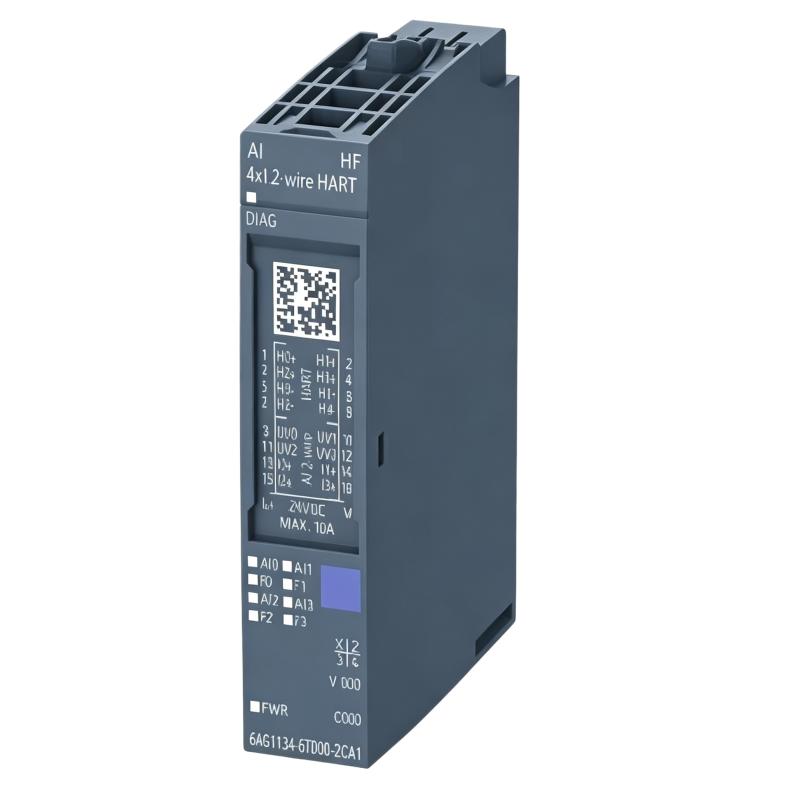
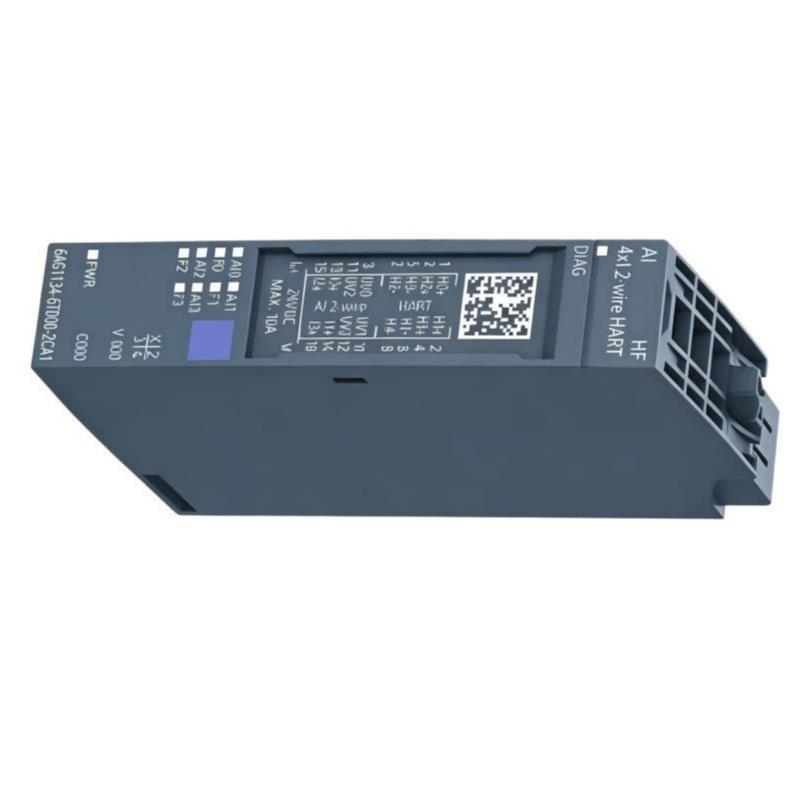
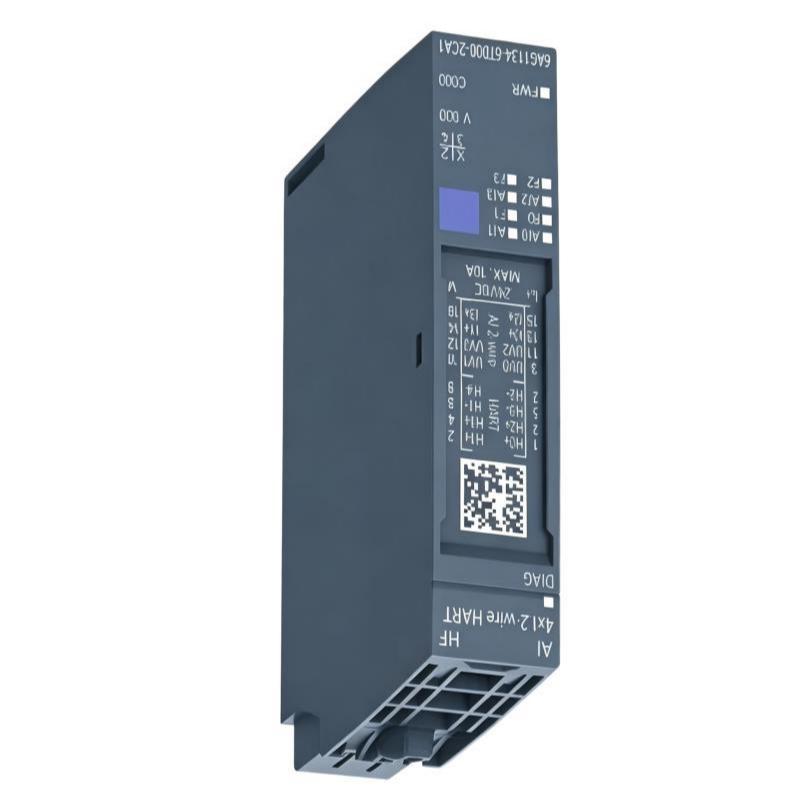
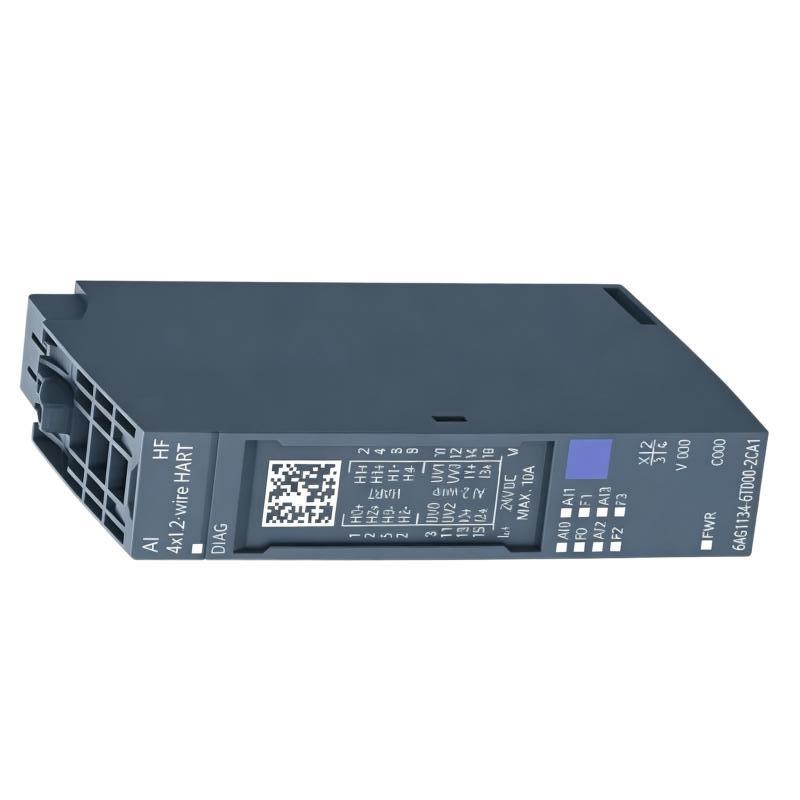
Brand:Siemens Item No.:6AG1134-6TD00-2CA1 Product Origin:Germany Product Dimensions:15 × 73 × 58 mm Product Weight:0.031 kg Payment:T/T, Western Union, Credit Card Goods_stock:15 Shipping Port:Xiamen, China Lead Time:1-3 Days Condition:Brand New And Original Warranty:1 Year Certificate:COO
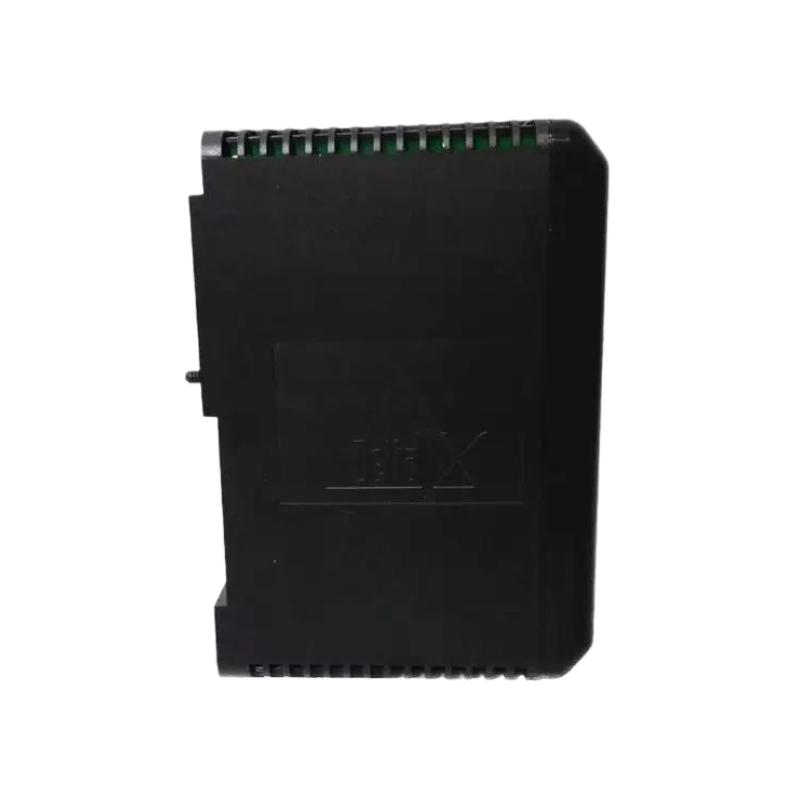
The Siemens 6AG1134-6TD00-2CA1 Analog Input Module is a compact component for acquiring analog measurement signals in industrial automation systems.
For a controller to regulate a process effectively, it needs dependable feedback from the field. Analog measurements provide that feedback in a continuous form, allowing the control program to determine not just whether a condition exists, but how the measured variable is changing.
This makes analog inputs valuable in applications involving temperature, pressure, level, flow, position, and other process variables. Once the field instrument and input channel are correctly configured, the acquired information can be used for visualization, alarming, data processing, equipment monitoring, and closed-loop regulation.
The module's supplied dimensions of 15 × 73 × 58 mm provide a compact installation profile. This is useful for OEM control panels and existing cabinets where additional I/O capability must fit into a limited space.
A practical troubleshooting approach should always consider the complete measurement chain. If a process value looks incorrect, technicians should compare the actual field signal with the controller reading and then inspect the instrument, wiring, terminals, configuration, and input hardware in sequence.
For replacement projects, the exact Siemens order number 6AG1134-6TD00-2CA1 should be confirmed before installation. Matching the correct hardware configuration helps avoid unnecessary commissioning work and system compatibility problems.
Technical Specifications
Parameter
Specification
Brand
Siemens
Model
6AG1134-6TD00-2CA1
Product Type
Analog Input Module
Module Function
Analog Signal Acquisition
Application
Industrial Automation
Signal Type
Analog Input
System Integration
Siemens Automation / I/O System
Dimensions
15 × 73 × 58 mm
Weight
0.03 kg (0.07 lb)
Dimensions: 15 × 73 × 58 mm Weight: 0.03 kg (0.07 lb)
Before commissioning, verify the field-device signal, wiring arrangement, channel configuration, and controller parameters. For low-level or sensitive analog signals, appropriate grounding, shielding, and cable routing should be incorporated into the installation design.
Recommended Related Models
Model
Product Type
Application Relationship
6AG1134-6TD00-2CA1
Analog Input Module
Primary model
6AG1134-6JF00-2CA1
Analog Input Module
Related analog input hardware
6AG1134-6JD00-2CA1
Analog Input Module
Related analog acquisition configuration
6AG1134-6PA20-7BD0
Analog Input Module
Related Siemens analog input module
6AG1134-6HB00-2CA1
Analog Input Module
Related analog input hardware
The related models may differ in electrical characteristics, channel configuration, or system compatibility. Confirm the complete order number and required signal specifications before using an alternative.
Popular Related Models
Siemens 6AG1134-6JF00-2CA1 — Analog Input Module
Siemens 6AG1134-6JD00-2CA1 — Analog Input Module
Siemens 6AG1134-6PA20-7BD0 — Analog Input Module
Siemens 6AG1134-6HB00-2CA1 — Analog Input Module
Siemens 6AG1134-6HA00-2CA1 — Analog Input Module
For maintenance, replacement, and retrofit applications, verify the complete Siemens order number, supported signal characteristics, channel configuration, field wiring, and automation-system compatibility before installation.
Where the Module Fits in Automation Systems
The Siemens 6AG1134-6TD00-2CA1 Analog Input Module is intended for automation applications that require reliable acquisition of analog signals from field-level sensors and instrumentation.
Analog measurement is essential when a controller needs continuous process information rather than a simple switching state. Depending on the supported signal configuration, the module can form part of applications involving process measurement, machine feedback, equipment monitoring, and closed-loop control.
Common application areas include:
Industrial machine automation
Process measurement systems
Sensor signal acquisition
Temperature and pressure monitoring
Level and flow measurement
Position feedback
Equipment monitoring
Closed-loop control
Production automation
Distributed I/O installations
A well-configured analog input provides the controller with the measurement information needed to make consistent control decisions and gives operators better visibility into actual machine or process conditions.
What Makes This Module Useful
Compact signal acquisition
The 6AG1134-6TD00-2CA1 provides a compact interface for integrating compatible analog field signals into a Siemens automation system.
Continuous measurement capability
Analog acquisition allows the control application to process changing field values rather than relying solely on binary information.
Efficient cabinet design
At 15 × 73 × 58 mm, the module has a compact physical footprint that can be advantageous in densely populated control cabinets.
Useful process feedback
Measured values can provide feedback for regulation, alarming, visualization, diagnostics, and equipment supervision.
Straightforward fault isolation
The module can serve as a practical diagnostic point when technicians need to determine whether an abnormal reading comes from the instrument, wiring, configuration, or input hardware.
Suitable for automation upgrades
Its compact form factor is useful when adding or replacing analog acquisition hardware in existing automation installations.
Accurate replacement identification
The complete Siemens order number 6AG1134-6TD00-2CA1 should be used when identifying the module for purchasing, maintenance, or replacement.
Professional industrial integration
For OEM machinery and process automation, dependable analog feedback helps improve process visibility and supports stable automated operation.
Technical FAQs
1. What is the Siemens 6AG1134-6TD00-2CA1 used for?
It is an analog input module designed to acquire compatible analog signals from field devices and provide the resulting information to the automation system.
2. What types of field devices can be used with an analog input?
Depending on the supported signal characteristics, analog inputs are commonly used with temperature, pressure, flow, level, position, and other compatible measurement instruments.
3. Why must the input channel be configured correctly?
The automation system needs to interpret the incoming electrical signal according to the intended signal type and range. Incorrect configuration can lead to inaccurate process values or diagnostic faults.
4. What can cause an analog channel to show no signal?
Possible causes include an inactive or disconnected field device, broken wiring, loose terminals, incorrect channel configuration, missing transmitter power where applicable, or an input-channel fault.
5. Why does an analog value sometimes fluctuate unexpectedly?
Potential causes include electrical interference, unstable instrumentation, poor terminal connections, grounding problems, damaged cables, or inappropriate configuration.
6. How can technicians determine whether the sensor or input module is responsible for a bad reading?
Compare the actual field signal with the value recognized by the controller. Inspect the sensor and wiring first, then verify terminals, configuration, and input-channel behavior.
7. Can nearby motor cables interfere with analog signals?
High-power conductors and switching equipment can generate electromagnetic interference. Appropriate cable separation, routing, shielding, and grounding practices can help reduce unwanted signal disturbances.
8. What should be checked before replacing the module?
Check the field instrument, cable continuity, terminals, signal characteristics, channel configuration, controller diagnostics, and actual input signal before concluding that the module is defective.
9. What is a sensible commissioning procedure for an analog input?
Confirm the wiring and signal type, configure the channel, apply a known field input, and verify that the controller produces the expected measurement.
10. Is this module automatically appropriate for safety-related measurement?
No. A standard analog input should not be assumed to be safety-rated. Safety functions require appropriately certified hardware, architecture, diagnostics, and engineering procedures.