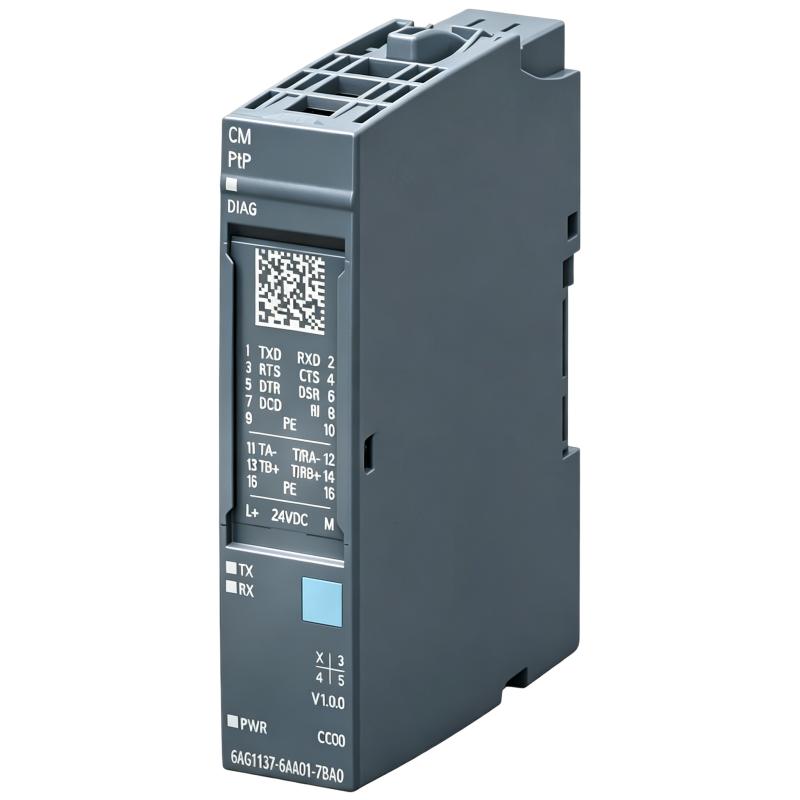
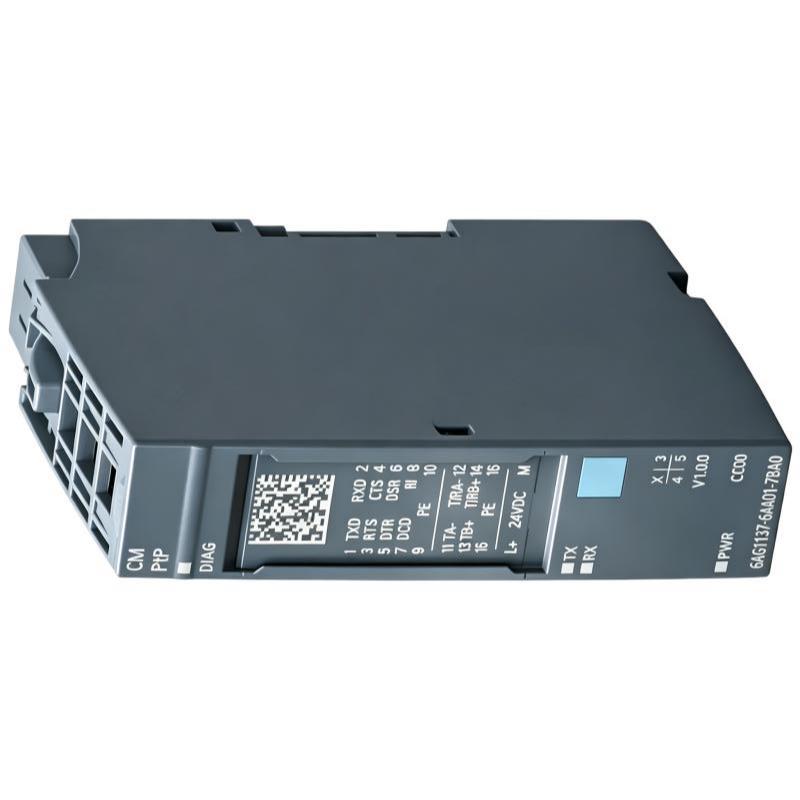
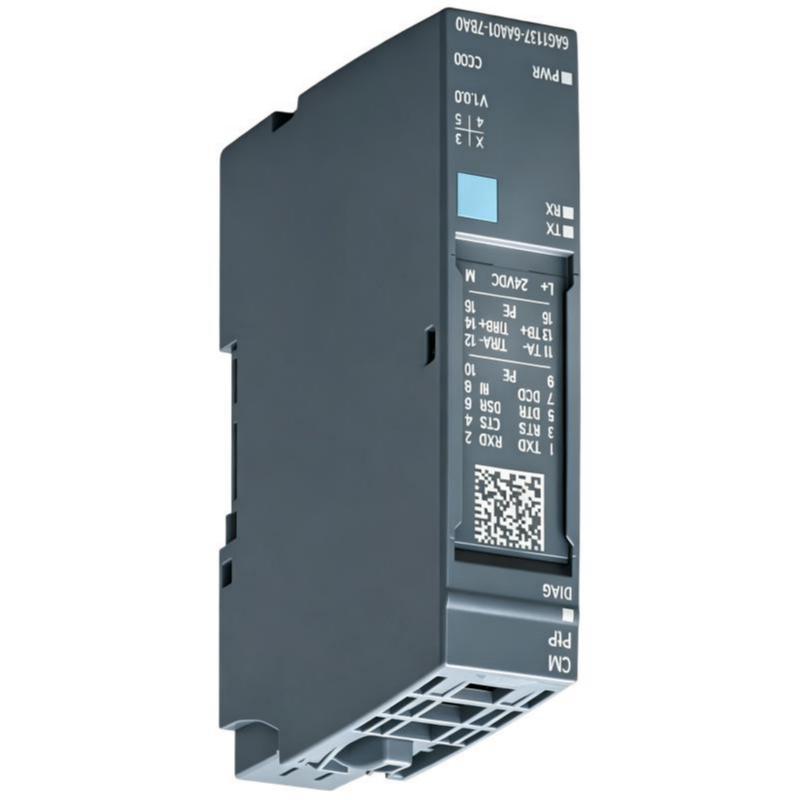
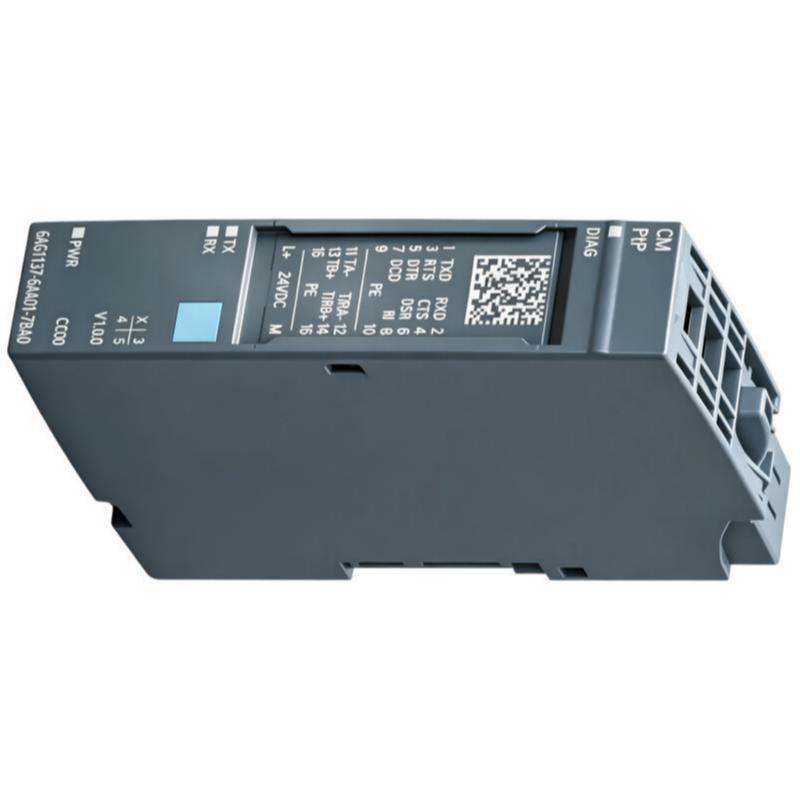
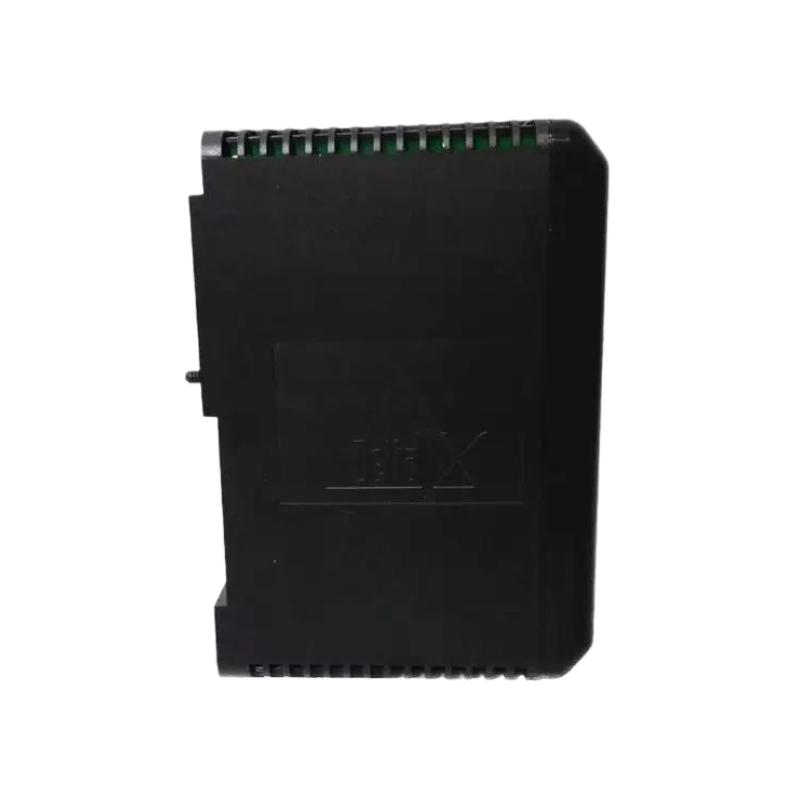
Brand:Siemens Item No.:6AG1137-6AA01-7BA0 Product Origin:Germany Product Dimensions:15 × 73 × 58 mm Product Weight:0.03 kg Payment:T/T, Western Union, Credit Card Goods_stock:15 Shipping Port:Xiamen, China Lead Time:1-3 Days Condition:Brand New And Original Warranty:1 Year Certificate:COO
The Siemens 6AG1137-6AA01-7BA0 Communication Module provides a compact solution for serial communication within compatible Siemens automation installations.
Although Ethernet-based industrial communication has become increasingly common, serial interfaces remain an important part of real-world automation. Production equipment can remain operational for many years, and machines often contain a mixture of generations of equipment. Drives, instruments, meters, controllers, and specialized devices may still depend on established serial communication technologies.
This makes a dedicated communication module particularly valuable for retrofit and modernization projects. Instead of replacing every legacy device, engineers can establish an appropriate communication interface and allow the existing equipment to exchange data with the newer control architecture.
Reliable serial communication depends on more than connecting two devices together. Parameters such as transmission speed, parity, stop bits, addressing, protocol format, and physical wiring must be compatible. A single incorrect parameter can prevent communication even when the hardware itself is operating normally.
For maintenance engineers, communication troubleshooting should therefore follow a logical sequence. Start with the physical layer, then verify communication parameters, protocol configuration, device addressing, and controller diagnostics. If the external device responds correctly when tested independently, attention can then move toward the automation-side interface.
The module's compact 15 × 73 × 58 mm form factor makes it suitable for control cabinets where installation space is limited. At a supplied weight of only 0.03 kg, it adds minimal mechanical load to the overall modular assembly.
For machine builders and system integrators, the 6AG1137-6AA01-7BA0 can be an effective component when serial connectivity is required as part of an established Siemens automation architecture.
For procurement and replacement, always verify the full order number 6AG1137-6AA01-7BA0 rather than relying only on the general description "Communication Module." Exact product identification helps prevent incorrect substitutions and unnecessary commissioning work.
Technical Specifications
Parameter
Specification
Brand
Siemens
Model
6AG1137-6AA01-7BA0
Product Type
Communication Module
Application
Industrial Automation
Communication Function
Serial Device Communication
Product Family
Siemens ET 200SP / SIPLUS
Module Design
Compact Modular Communication Interface
Installation
Modular I/O Assembly
Dimensions
15 × 73 × 58 mm
Weight
0.03 kg (0.07 lb)
Dimensions: 15 × 73 × 58 mm Weight: 0.03 kg (0.07 lb)
Before commissioning, verify the communication interface, connected-device requirements, protocol configuration, wiring, addressing, transmission parameters, and compatibility with the installed Siemens automation architecture.
Recommended Related Models
Model
Product Type
Application Relationship
6AG1137-6AA01-7BA0
Communication Module
Primary model
6AG1137-6AA00-2BA0
Communication Module
Related serial communication module
6AG1136-6PA00-2BC0
Power Module
Related ET 200SP power hardware
6AG1136-6DC00-2CA0
Digital Output Module
Related digital I/O hardware
6AG1136-6RA00-2BF0
Relay Output Module
Related relay output hardware
The related communication modules may differ in configuration or application requirements. The digital, relay, and power modules listed above perform different functions and should not be considered direct substitutes.
Popular Related Models
Siemens 6AG1137-6AA00-2BA0 — Communication Module
Siemens 6AG1136-6PA00-2BC0 — Power Module
Siemens 6AG1136-6DC00-2CA0 — Digital Output Module
Siemens 6AG1136-6RA00-2BF0 — Relay Output Module
Siemens 6AG1135-4FB01-2AB0 — Analog Output Module
For replacement and retrofit projects, confirm the exact Siemens order number, communication requirements, connected-device parameters, wiring arrangement, system compatibility, and commissioning configuration before installation.
Industrial Communication Applications
The Siemens 6AG1137-6AA01-7BA0 Communication Module is a compact communication interface designed for integrating serial field devices into compatible Siemens automation systems.
In industrial environments, machines frequently combine modern PLC infrastructure with drives, instruments, meters, barcode readers, controllers, and other equipment that communicates through serial interfaces. A dedicated communication module provides a structured way to connect these devices and exchange process data with the control system.
Typical applications include:
Serial PLC-to-device communication
Industrial instrumentation
Drive and controller integration
MODBUS RTU systems
Machine data acquisition
Barcode and identification equipment
Weighing and measurement systems
Legacy equipment integration
Distributed automation
OEM machine control
The module is especially useful in retrofit projects where existing serial equipment needs to remain in service while being integrated into a newer automation platform.
Communication Performance and Integration Benefits
Dedicated serial communication interface
The 6AG1137-6AA01-7BA0 provides a practical communication solution for compatible serial automation equipment, helping bridge field devices with the higher-level control system.
Flexible industrial connectivity
Serial communication remains widely used in drives, instruments, controllers, and specialized machine equipment. A dedicated interface simplifies the integration of these devices.
Compact ET 200SP architecture
With dimensions of 15 × 73 × 58 mm, the module requires limited cabinet space and fits naturally into compact modular automation installations.
Useful for retrofit applications
The module can help extend the service life of existing equipment by providing a communication path between legacy serial devices and a modern automation system.
Efficient maintenance structure
Communication faults can be investigated systematically through device parameters, wiring, communication status, protocol settings, and diagnostic information.
Professional industrial integration
A dedicated communication module provides a cleaner alternative to improvised serial interfaces and helps create a more organized control-system architecture.
Suitable for machine builders
OEMs can use serial communication interfaces when integrating specialized third-party instruments or machine components into a centralized PLC system.
Clear product identification
The complete Siemens order number 6AG1137-6AA01-7BA0 should be retained when sourcing, replacing, or documenting the module.
Technical FAQs
1. What is the Siemens 6AG1137-6AA01-7BA0 used for?
It is a communication module used to provide serial communication between compatible external devices and a Siemens automation system.
2. Why would an industrial system still require serial communication?
Many installed drives, instruments, meters, controllers, and specialized machines continue to use serial interfaces. Serial communication modules provide an effective way to integrate these devices without replacing the entire field installation.
3. What is the first thing to check when communication fails?
Begin with the physical connection and communication parameters. Verify wiring, interface selection, baud rate, parity, stop bits, addressing, and protocol settings before assuming that the module is defective.
4. Why can incorrect baud rates prevent communication?
Both communicating devices must use compatible transmission parameters. If the baud rate differs, the receiver may not correctly interpret the incoming data.
5. What can cause intermittent serial communication?
Possible causes include loose connections, poor-quality cables, electromagnetic interference, incorrect termination, grounding problems, incompatible parameters, or unstable external equipment.
6. How should an RS-485 communication problem be approached?
Check the differential signal wiring, network topology, device addressing, termination, cable routing, grounding arrangement, and communication parameters. Multiple devices should also be checked for address conflicts.
7. Can incorrect protocol settings cause a communication timeout?
Yes. Even when the electrical connection is correct, incompatible protocol configuration can prevent valid messages from being exchanged.
8. Why is device addressing important in a multidrop network?
Each device must have an appropriate unique address when the selected communication protocol requires addressing. Duplicate addresses can result in corrupted or unpredictable communication.
9. Should the communication module be replaced immediately after a communication error?
No. Check the external device, wiring, parameters, protocol configuration, addressing, and diagnostic information first. Many communication failures are caused by configuration or field wiring rather than hardware failure.
10. What should be verified after replacing the communication module?
Confirm module recognition, communication configuration, wiring, protocol parameters, device addressing, and successful data exchange before returning the system to production.