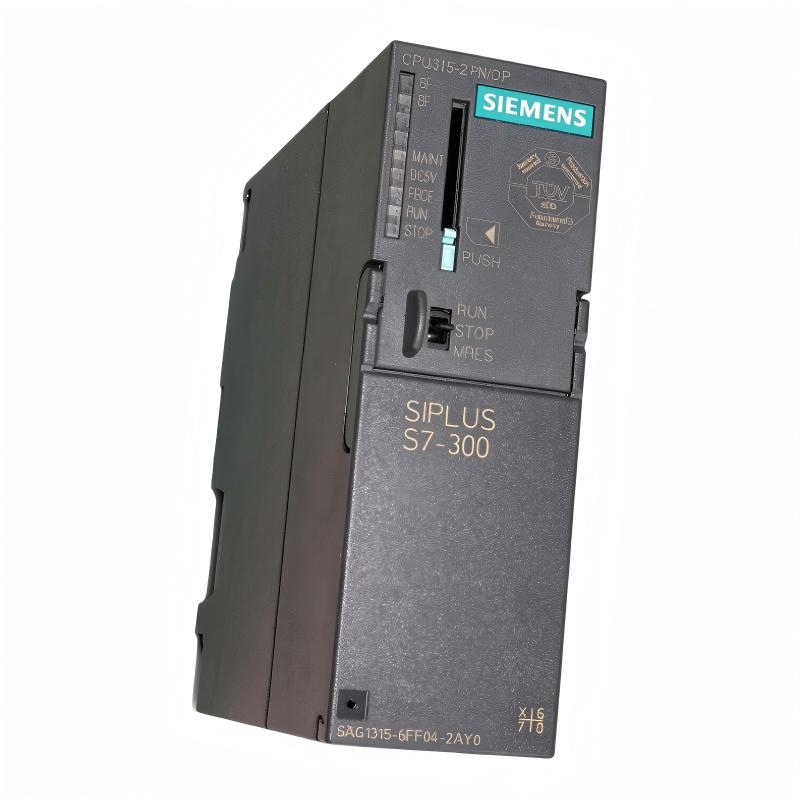
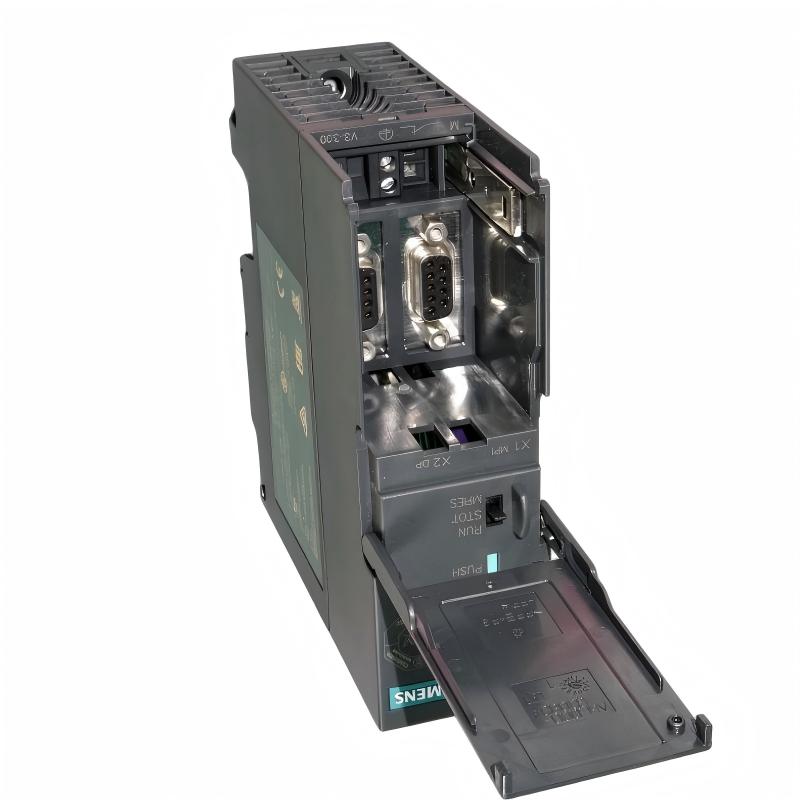
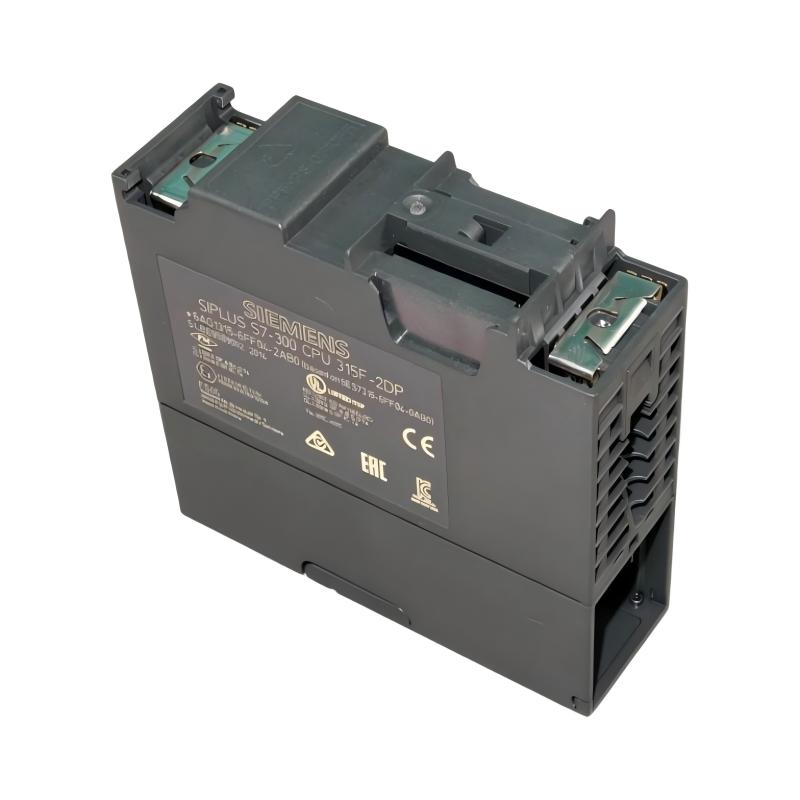
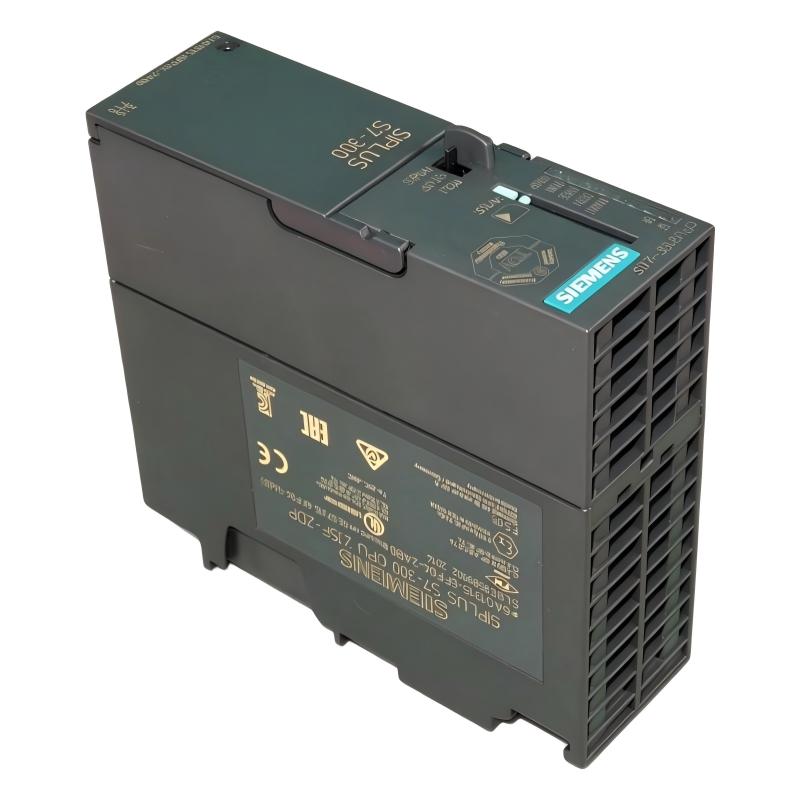
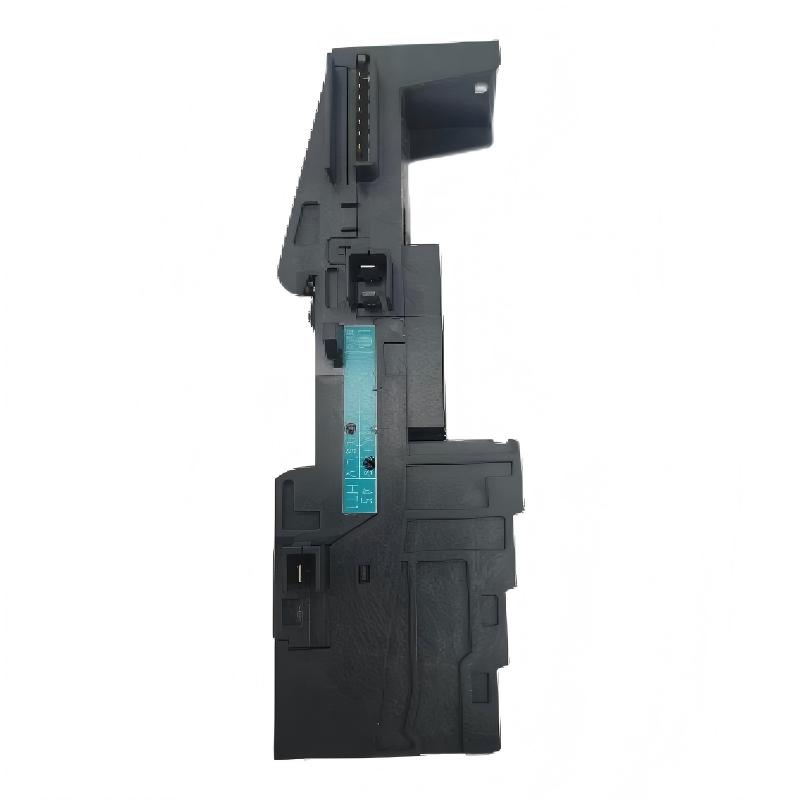
Brand:Siemens Item No.:6AG1315-6FF04-2AY0 Product Origin:Germany Product Dimensions:40 × 125 × 130 mm Product Weight:0.35 kg Payment:T/T, Western Union, Credit Card Goods_stock:15 Shipping Port:Xiamen, China Lead Time:1-3 Days Condition:Brand New And Original Warranty:1 Year Certificate:COO
The Siemens 6AG1315-6FF04-2AY0 SIPLUS S7-300 CPU 315F-2DP is a fail-safe programmable logic controller designed for railway-related automation and compatible industrial control systems. Based on the 6ES7315-6FF04-0AB0 platform, it combines 384 KB of work memory with MPI and PROFIBUS DP communication interfaces.
A key characteristic of this version is its conformity with EN 50155. It is designed for railway rolling-stock applications and features conformal coating according to the specified railway environmental classification. Its integrated 24 V DC power supply and PROFIBUS DP master/slave interface support integration into compatible S7-300 control architectures.
The CPU provides standard PLC processing alongside fail-safe automation capabilities. Engineers can use it to coordinate machine operations, distributed I/O, and safety-related control tasks when the system is configured and validated with the appropriate Siemens engineering tools.
For railway automation integrators and maintenance teams, the 6AG1315-6FF04-2AY0 offers a specialized S7-300 controller option where fail-safe processing, PROFIBUS DP connectivity, and EN 50155 requirements are important selection criteria.
Technical Specifications
Parameter
Specification
Manufacturer
Siemens
Model
6AG1315-6FF04-2AY0
Product Family
SIPLUS S7-300
CPU Type
CPU 315F-2DP
Product Type
Fail-Safe PLC CPU Module
Base Model
6ES7315-6FF04-0AB0
Work Memory
384 KB
Railway Standard
EN 50155
Environmental Classification
T1, Category 1, Class A
Environmental Protection
Conformal coating
First Interface
MPI
Second Interface
PROFIBUS DP
PROFIBUS Function
DP Master / Slave
PROFIBUS DP Speed
Up to 12 Mbps
Integrated Power Supply
24 V DC
Memory Card
Micro Memory Card required
Programming Software
Compatible STEP 7 version
Safety Engineering
Distributed Safety
Dimensions (W × H × D)
40 × 125 × 130 mm
Weight
0.35 kg / 0.77 lb
Recommended Related Models
The following Siemens CPUs are relevant when comparing fail-safe functionality, communication interfaces, and environmental requirements within the SIPLUS S7-300 family.
Model
Product Description
6AG1315-6FF04-2AB0
SIPLUS S7-300 CPU 315F-2DP
6AG1315-2FJ14-2AY0
SIPLUS S7-300 CPU 315F-2PN/DP (EN 50155)
6AG1315-2FJ14-2AB0
SIPLUS S7-300 CPU 315F-2PN/DP
6AG1317-6FF04-2AB0
SIPLUS S7-300 CPU 317F-2DP
6ES7315-6FF04-0AB0
SIMATIC S7-300 CPU 315F-2DP
Popular Related Models
For S7-300 maintenance, railway automation projects, and spare-part planning, these Siemens models may also be relevant:
Siemens 6AG1315-2AH14-2AY0 – SIPLUS S7-300 CPU 315-2DP (EN 50155)
Siemens 6AG1315-2EH14-2AY0 – SIPLUS S7-300 CPU 315-2PN/DP (EN 50155)
Siemens 6AG1315-2FJ14-2AY0 – SIPLUS S7-300 CPU 315F-2PN/DP (EN 50155)
Siemens 6AG1317-2FK14-2AY0 – SIPLUS S7-300 CPU 317F-2PN/DP (EN 50155)
Siemens 6AG1317-6FF04-2AB0 – SIPLUS S7-300 CPU 317F-2DP
Siemens 6ES7315-2FJ14-0AB0 – SIMATIC S7-300 CPU 315F-2PN/DP
Siemens 6ES7317-6FF04-0AB0 – SIMATIC S7-300 CPU 317F-2DP
Applications
The Siemens 6AG1315-6FF04-2AY0 is a SIPLUS S7-300 CPU 315F-2DP designed for automation systems that require standard PLC processing and integrated fail-safe control. It combines the CPU 315F platform with PROFIBUS DP communication and environmental features intended for demanding installations.
This variant is associated with EN 50155 railway applications, making it relevant to compatible rolling-stock control systems. It can also be considered for industrial installations where its environmental specifications and PROFIBUS-based architecture match the application requirements.
Typical applications include:
Railway control systems: Supports automation tasks in rolling-stock applications designed around applicable EN 50155 requirements.
Machine safety systems: Executes standard and safety-related control tasks within an appropriately engineered and validated system.
Distributed I/O networks: Communicates with compatible remote I/O stations through PROFIBUS DP.
Industrial machinery: Coordinates operating sequences, equipment interlocks, and machine functions.
Material handling equipment: Supports control of conveyors, transfer systems, and automated handling machinery.
S7-300 system maintenance: Provides a SIPLUS fail-safe CPU option for compatible installations using PROFIBUS DP.
Advantages
1. Integrated Fail-Safe Processing
The CPU 315F-2DP supports standard automation and safety-related control functions. This enables coordinated machine control and safety operations within a compatible SIMATIC S7-300 architecture.
2. Railway-Oriented Design
The 2AY0 variant is associated with EN 50155 conformity, making it suitable for evaluating in railway rolling-stock applications where the relevant environmental and equipment requirements apply.
3. PROFIBUS DP Connectivity
Its MPI and PROFIBUS DP interfaces support communication with compatible controllers, distributed I/O stations, and field devices.
4. Efficient PLC Processing
The CPU 315F platform provides processing resources for medium-complexity automation tasks, including sequential control, interlocking, and distributed device coordination.
5. SIPLUS Environmental Protection
The SIPLUS design incorporates conformal coating to provide additional protection for electronic components against environmental influences. This is useful when selecting control equipment for demanding installation conditions.
6. Established Siemens Engineering Tools
The module fits into the SIMATIC S7-300 engineering environment. STEP 7 and the appropriate Distributed Safety engineering tools support configuration, programming, and maintenance of compatible applications.
Technical FAQs
Q1: What is the Siemens 6AG1315-6FF04-2AY0 used for?
It is a fail-safe PLC central processing unit for SIMATIC S7-300 automation systems. It executes standard control programs and supports safety-related automation functions in appropriately configured applications.
Q2: What does CPU 315F-2DP mean?
The 315F designation identifies a fail-safe CPU. The 2DP designation indicates its MPI interface and additional PROFIBUS DP interface, which supports master and slave communication.
Q3: How much work memory does this CPU provide?
The CPU provides 384 KB of work memory for program execution and data processing.
Q4: Does the 6AG1315-6FF04-2AY0 support PROFINET?
No. This model uses MPI and PROFIBUS DP interfaces. If an application requires integrated Ethernet PROFINET communication, a compatible CPU 315F-2PN/DP should be considered.
Q5: What is the significance of EN 50155 conformity?
EN 50155 is a standard covering electronic equipment used on railway rolling stock. This version is intended for railway applications and is specified for the applicable T1 environmental category.
Q6: Does this CPU have an integrated power supply?
Yes. It has an integrated 24 V DC power supply. The installation must still meet Siemens requirements for external supply, wiring, and system configuration.
Q7: Is a Micro Memory Card required?
Yes. A compatible Siemens Micro Memory Card is required to store the user program and relevant configuration data.
Q8: Which software is used to configure this CPU?
The CPU belongs to the SIMATIC S7-300 platform and is configured using compatible STEP 7 engineering software. Distributed Safety tools are required for engineering its fail-safe functions.
Q9: What should be checked if PROFIBUS DP communication is interrupted?
Inspect the bus cable, connectors, termination resistors, station addresses, transmission rate, and network configuration. CPU diagnostic information and the status of connected DP devices can help identify the source of the fault.
Q10: Can this model replace the 6AG1315-6FF04-2AB0?
The two models share the CPU 315F-2DP platform, but they are intended for different application environments. The 2AY0 version is specified for railway applications conforming to EN 50155, while the 2AB0 version is intended for industrial applications with extended ambient conditions. Verify the installation requirements and system configuration before replacement.