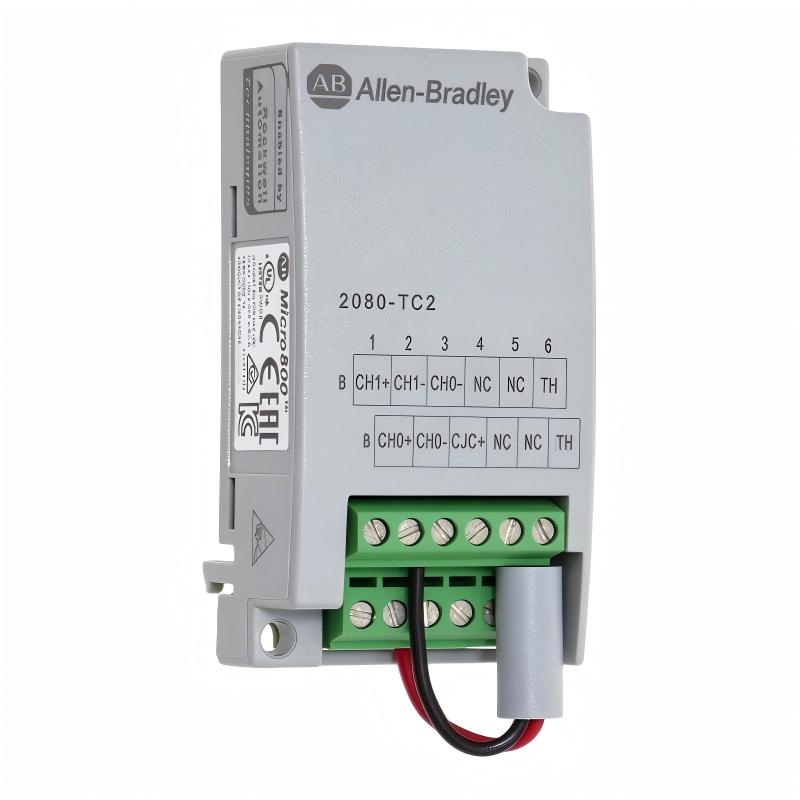
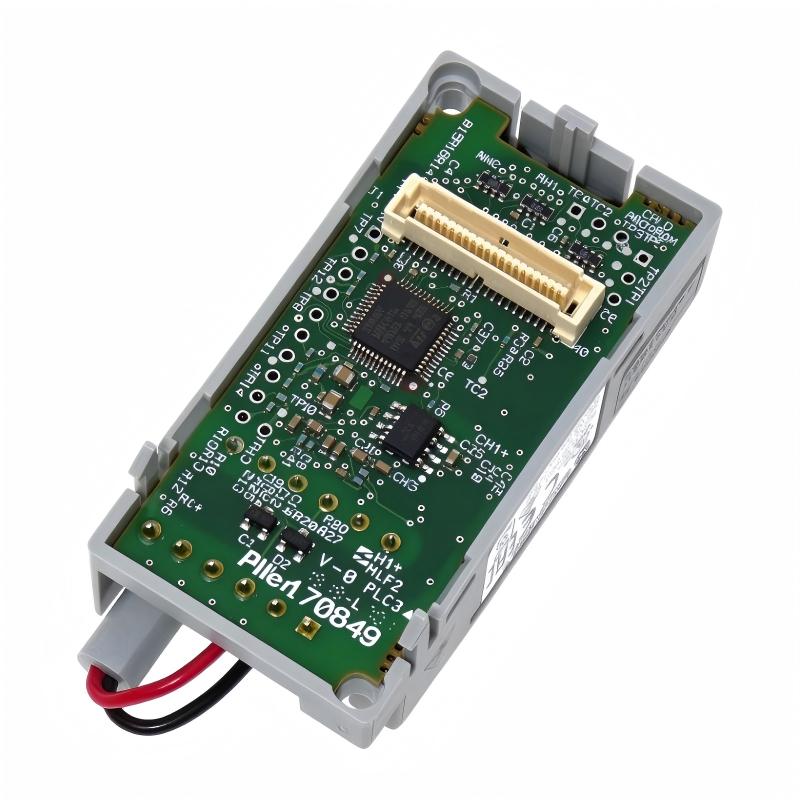
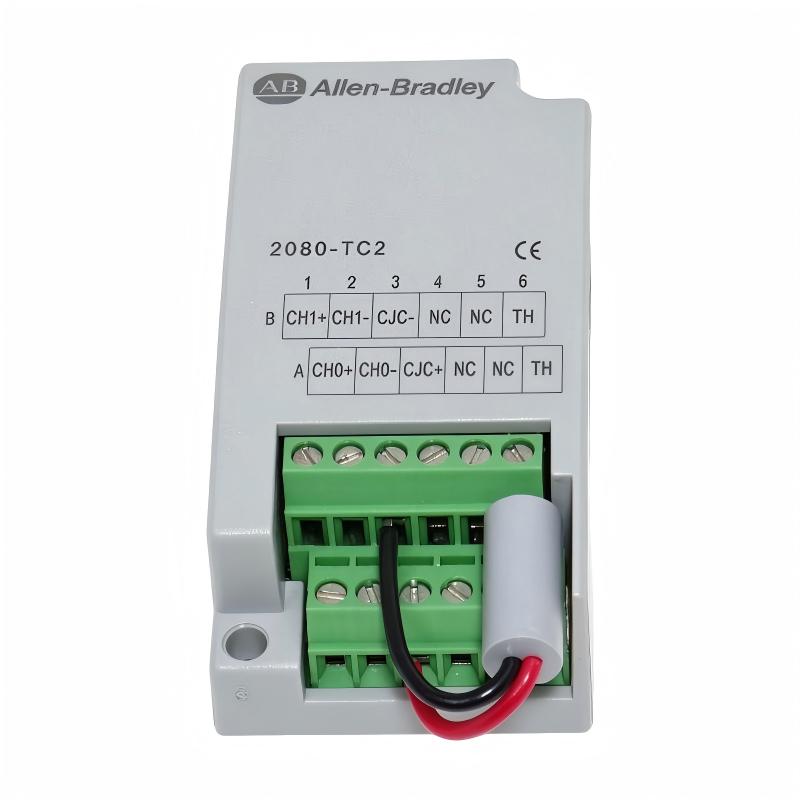
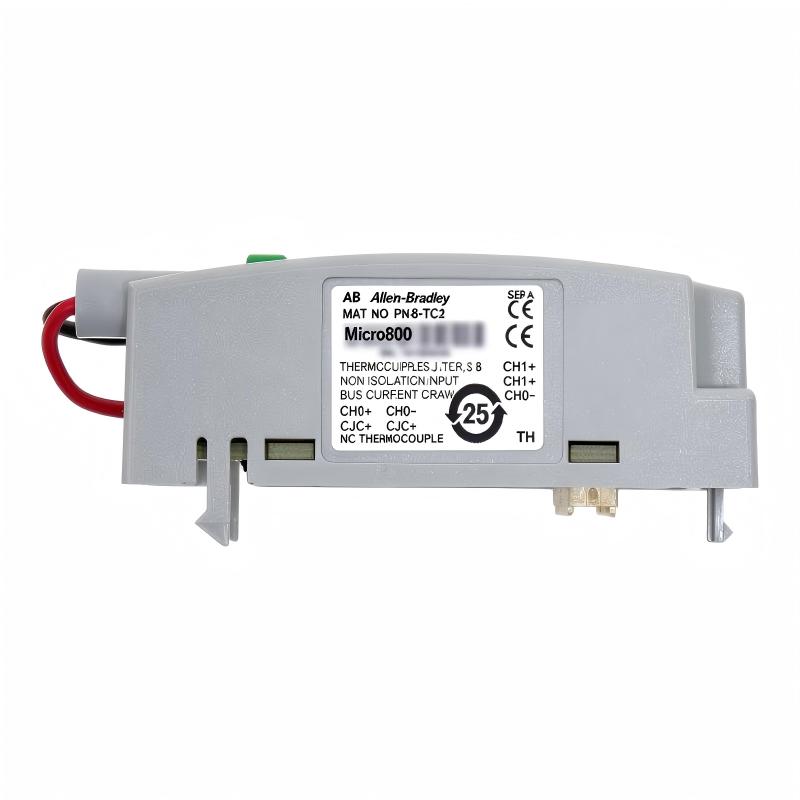
Allen Bradley 2080-TC2 Micro800 2-Channel Non-Isolated Thermocouple Plug-in Module
Allen Bradley 2080-TC2 Micro800 2-Channel Non-Isolated Thermocouple Plug-in Module
0.0
Points
Brand:Allen Bradley PLC Item No.:2080-TC2 Product Origin:USA Product Dimensions:62 x 20 x 31.5 mm Product Weight:0.021 kg Payment:T/T, Western Union, Credit Card Goods_stock:15 Shipping Port:Xiamen, China Lead Time:1-3 Days Condition:Brand New And Original Warranty:1 Year Certificate:COO
The Allen Bradley 2080-TC2 Micro800 2-Channel Non-Isolated Thermocouple Plug-in Module is an expansion component developed for temperature measurement in compatible Micro800 programmable controller systems.
In industrial automation, temperature is one of the most frequently monitored process variables. Applications such as heating equipment, packaging machinery, plastic processing, and industrial ovens depend on reliable temperature feedback to maintain consistent operating conditions. Thermocouples are widely used in these environments because they can measure a broad range of temperatures and are suitable for many industrial sensing applications.
The 2080-TC2 addresses this requirement by providing two thermocouple input channels in a compact plug-in format. It allows a compatible Micro800 controller to receive temperature signals from two measurement locations and incorporate those values into programmed monitoring or control functions.
Its non-isolated input architecture should be considered carefully during system design. Engineers need to evaluate sensor wiring, grounding arrangements, electrical interference, and the characteristics of the connected thermocouples to achieve stable measurement performance.
For OEMs, machine manufacturers, and industrial maintenance teams, the 2080-TC2 is a practical expansion option when additional thermocouple measurement capability is required within a Micro800-based control system.
When purchasing this module, verify the complete catalog number, controller compatibility, thermocouple input requirements, and module condition to ensure that it meets the intended application.
Technical Specifications
The following table summarizes the product identification and available physical specifications of the Allen Bradley 2080-TC2.
Parameter
Specification
Brand
Allen Bradley
Model
2080-TC2
Product Family
Micro800
Product Type
Thermocouple Plug-in Module
Input Channels
2
Input Type
Thermocouple
Channel Configuration
Non-Isolated
Application
Industrial Temperature Measurement
Controller Platform
Compatible Micro800 Controllers
Dimensions (H × W × D)
62 × 20 × 31.5 mm
Weight
0.021 kg / 0.05 lb
Installation
Micro800 Controller Plug-in Expansion
Note: Supported thermocouple types, temperature ranges, input accuracy, resolution, and controller compatibility should be confirmed against the exact module specifications before system integration.
Recommended Related Models
The following Allen Bradley Micro800 components may be relevant when developing or expanding a controller-based temperature monitoring system.
These modules provide different expansion functions for compatible Micro800 controllers. The appropriate selection depends on whether the application requires temperature measurement, analog signal processing, or digital I/O.
Popular Related Models
For customers sourcing Allen Bradley Micro800 automation components, the following models may also be of interest.
The Allen Bradley 2080-TC2 provides a dedicated two-channel thermocouple measurement option for compatible Micro800 systems. For industrial buyers seeking to expand temperature monitoring capabilities, it offers a compact solution within the Micro800 product ecosystem.
Applications
The Allen Bradley 2080-TC2 Micro800 2-Channel Non-Isolated Thermocouple Plug-in Module is designed for temperature measurement in industrial automation and machine control applications. It provides two thermocouple input channels, allowing compatible Micro800 controllers to receive temperature signals from connected sensing devices.
Accurate temperature monitoring is important in manufacturing processes where thermal conditions directly influence product quality, equipment performance, and operational safety. By adding thermocouple input capability to a compatible Micro800 controller, the 2080-TC2 helps expand the controller's ability to monitor temperature-dependent processes.
Typical application areas include:
Industrial Heating Systems: Monitors temperature signals from thermocouples used in heating equipment and industrial ovens.
Packaging Machinery: Supports temperature monitoring in heat-sealing and thermal packaging processes.
Food Processing Equipment: Provides temperature input for compatible heating, cooking, and processing machinery.
Plastic Processing: Helps monitor thermal conditions in equipment such as heaters and processing machines.
HVAC Equipment: Supports temperature measurement in industrial heating and ventilation control applications.
Machine Automation: Adds thermocouple measurement capability to Micro800-based machine control systems.
Process Temperature Monitoring: Collects temperature signals for use in controller-based monitoring and control strategies.
For machine builders and automation engineers, the 2080-TC2 provides a compact way to introduce two-channel thermocouple measurement into a suitable Micro800 control system.
Advantages
The 2080-TC2 combines compact construction with dedicated thermocouple input functionality, making it a useful expansion option for compatible Allen Bradley Micro800 controllers.
1. Two-Channel Temperature Measurement
Two thermocouple input channels allow the controller to monitor temperature at two separate measurement points without requiring two individual plug-in modules.
2. Direct Thermocouple Integration
The module is designed to receive thermocouple signals, helping simplify the integration of temperature sensors into compatible automation systems.
3. Non-Isolated Input Architecture
Its non-isolated channel design provides a straightforward temperature input arrangement. System designers should consider grounding, wiring, and electrical noise conditions when planning the installation.
4. Compact Plug-in Construction
The small form factor makes the module suitable for applications where control panel space and controller expansion capacity are important considerations.
5. Micro800 Platform Compatibility
It is designed for use within the Allen Bradley Micro800 ecosystem, providing an expansion option for supported Micro800 controller configurations.
6. Improved Process Monitoring
Thermocouple feedback allows automation programs to monitor thermal conditions and implement suitable temperature-related control logic.
7. Flexible Machine Design
The additional input capability supports different machine configurations, including applications that require monitoring at multiple thermal points.
8. Reduced Expansion Complexity
A dedicated plug-in module provides a convenient approach to adding temperature measurement functionality without introducing a separate standalone temperature controller.
Technical FAQs
Q1: What is the primary function of the Allen Bradley 2080-TC2?
The 2080-TC2 is a two-channel non-isolated thermocouple plug-in module designed to provide temperature measurement inputs for compatible Micro800 controllers. It allows the controller to receive thermocouple signals and use the resulting temperature information in its control program.
Q2: What does the term non-isolated mean in this module?
Non-isolated means the input channels do not have galvanic isolation from each other or from the relevant module circuitry. Engineers should pay particular attention to sensor grounding, common-mode voltage, and electrical noise when designing the wiring arrangement.
Q3: Which thermocouple types can be connected to the 2080-TC2?
The supported thermocouple types depend on the module's specified input configuration. The sensor type selected in the controller configuration must match the connected thermocouple. Refer to the module's technical specifications before selecting Type J, K, or other sensor types.
Q4: Can the two channels measure different temperatures independently?
The module provides two separate thermocouple input channels, allowing measurements at different locations. Each channel should be configured according to the connected sensor and the requirements of the application.
Q5: Why does thermocouple polarity matter during installation?
Thermocouples generate a small voltage based on the temperature difference between their measuring junction and reference junction. Reversing the positive and negative connections can produce incorrect readings or unexpected temperature changes.
Q6: What can cause an inaccurate temperature reading?
Possible causes include incorrect thermocouple type selection, reversed polarity, poor terminal connections, unsuitable extension wire, electrical interference, or an incorrectly configured input channel. Sensor condition and reference-junction requirements should also be checked.
Q7: Does the 2080-TC2 require special thermocouple extension cables?
Thermocouple-compatible extension or compensating cable should be selected according to the sensor type and installation requirements. Using ordinary copper wiring in an inappropriate measurement circuit can introduce additional measurement errors.
Q8: Can the module be used with every Micro800 controller?
Compatibility depends on the specific Micro800 controller model and its supported plug-in expansion options. Confirm the controller's compatibility list, available plug-in position, and firmware requirements before installation.
Q9: How can electrical noise affect thermocouple measurements?
Thermocouple signals are relatively small, making them susceptible to electrical interference. Poor cable routing, inadequate shielding, grounding problems, and proximity to motor or inverter wiring can cause unstable readings. Proper installation practices help reduce these effects.
Q10: What should be checked if one channel stops reporting temperature values?
Inspect the thermocouple sensor, polarity, terminal connections, input configuration, and channel status. If possible, test the sensor independently and compare its signal with the controller's reported value to determine whether the problem originates from the sensor, wiring, or module.