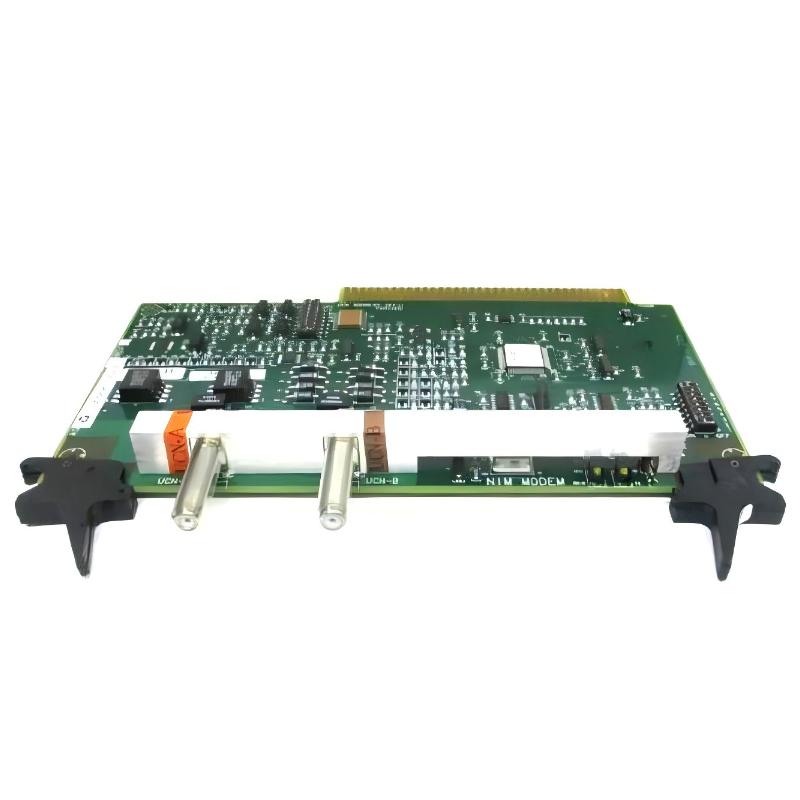
Brand:ABB PLC Item No.:PU515A Product Origin:Sweden (SE) Product Dimensions:150 × 100 × 50 mm Product Weight:0.4 kg Payment:T/T, Western Union, Credit Card Goods_stock:15 Shipping Port:Xiamen, China Lead Time:1-3 Days Condition:Brand New And Original Warranty:1 Year Certificate:COO
The ABB PU515A Real-time Accelerator Board is engineered to deliver enhanced computational performance for industrial control systems where timing precision and processing speed are essential. By supporting real-time operations, the module enables automation platforms to handle complex control algorithms and large data volumes with improved efficiency.
Its compact and robust design allows seamless integration into ABB automation environments, helping operators extend system capabilities while maintaining proven infrastructure. The PU515A is particularly valuable for facilities seeking performance optimization with minimal system disruption.
Technical Specifications
Parameter
Specification
Manufacturer
ABB
Product Type
Real-time Accelerator Board
Model
PU515A
Order Number
3BSE032401R1
Function
Real-time Processing Acceleration
Installation
Control Cabinet Integration
Application
Industrial Automation & Distributed Control
Operating Mode
Continuous Industrial Operation
Dimensions
150 × 100 × 50 mm
Weight
0.4 kg
Recommended Related Models
ABB PM511V16 — Processor module used in ABB Advant controller systems
ABB CI522A — Communication interface module for industrial networking integration
ABB SA811F — Power supply module supporting ABB control platforms
ABB AI810 — Analog input module for industrial signal measurement
Popular Related Models
ABB PM510V16 — Central processing unit for Advant automation systems
ABB DI810 — Digital input module for field signal monitoring
ABB DO810 — Digital output module for industrial actuator control
ABB CI854A — PROFIBUS communication interface module for distributed automation networks
Application Perspectives in Modern Automation
The ABB PU515A Real-time Accelerator Board is developed to strengthen processing efficiency within advanced industrial automation systems. Acting as a dedicated performance enhancement module, it supports high-speed data handling and deterministic execution required by complex control environments.
This accelerator board is widely used in:
Distributed Control System (DCS) architectures
Process industries requiring real-time computation
Power generation monitoring and control platforms
Continuous production automation lines
Industrial data acquisition and supervision systems
Control system performance upgrade projects
Performance Advantages for Industrial Operations
Designed for precision-driven environments, the PU515A improves system responsiveness by assisting the primary controller with computational workloads. Its industrial-grade construction ensures stable operation even under long-term continuous usage.
Main operational advantages include:
Enhanced real-time processing capability
Improved execution speed for automation logic
Stable performance during high data throughput operations
Reliable integration within ABB control ecosystems
Compact structure simplifying installation and replacement
Long operational lifecycle supporting plant reliability goals
Technical FAQs
1. What is the main function of the PU515A board?
It accelerates real-time processing tasks within ABB automation systems.
2. Is this module a standalone controller?
No, it works alongside a main processor to enhance system performance.
3. Where is the board installed?
It is mounted inside industrial control cabinets as part of the control hardware assembly.
4. What systems benefit most from this accelerator board?
Distributed control and process automation systems requiring fast response times.
5. Does it improve control accuracy?
Yes, faster processing contributes to more responsive and stable control execution.
6. Is continuous operation supported?
Yes, it is designed for 24/7 industrial environments.
7. Can it be used for system modernization?
Yes, it is often installed to improve performance without replacing the entire control system.
8. What industries typically deploy this module?
Energy, manufacturing, chemical processing, and infrastructure automation sectors.
9. Does it require special cooling or maintenance?
Standard cabinet ventilation and routine inspection are generally sufficient.
10. What advantage does an accelerator board provide compared to upgrading a CPU?
It increases processing efficiency while preserving existing system architecture.