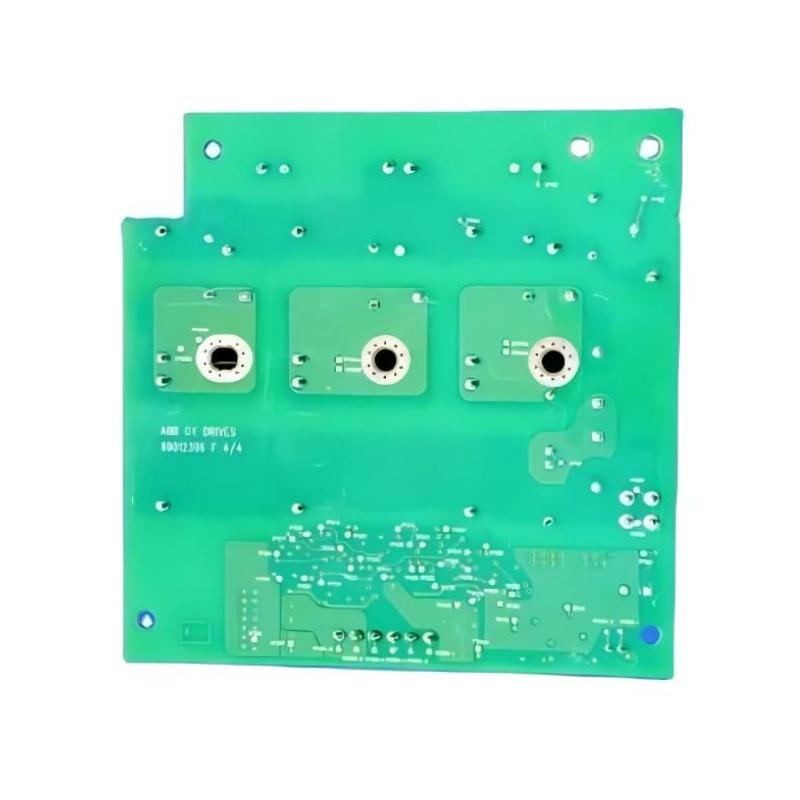
Brand:ABB PLC Item No.:ZINP-571 Product Origin:Sweden (SE) Product Dimensions:142 x 122 x 25 mm Product Weight:1.0 kg Payment:T/T, Western Union, Credit Card Goods_stock:15 Shipping Port:Xiamen, China Lead Time:1-3 Days Condition:Brand New And Original Warranty:1 Year Certificate:COO
The ABB ZINP-571 3AUA0000050511 Interface Board is a robust and reliable module designed for ABB automation systems. It provides accurate signal interfacing, enabling communication between controllers, I/O modules, and peripheral devices while enhancing system stability and performance.
Engineered for industrial environments, the ZINP-571 operates continuously in demanding applications such as manufacturing, power generation, chemical, and pharmaceutical automation systems. Its compact and lightweight design allows flexible installation and straightforward maintenance.
Technical Specifications
Parameter
Specification
Manufacturer
ABB
Model
ZINP-571 3AUA0000050511
Product Type
Interface Board
Function
Communication and signal interface for automation modules
Installation
Control cabinet / module rack
Application
Industrial automation and process control
Dimensions
142 × 122 × 25 mm
Weight
1 kg
Recommended Related Models
Model
Description
PM511V16
CPU Processor Module
PM554-T
CPU Processor Unit
SDCS-AC-CON-2
Control Board
AC800 I/O Module
Input/Output Module
AC800 PSU
Power Supply Module
Popular Related Models
Model
Description
PM564-T
CPU Processor Unit
PP D512 A10-15000
AC800 Control Module
SDCS-AC-AI
Analog Input Module
SDCS-AC-AO
Analog Output Module
ZINP-570
Interface Board Alternate
SDCS-AC-BUS
System Communication Module
Typical Application Scenarios
Acts as a communication and signal interface within ABB automation and control systems
Installed in industrial control cabinets to connect controllers with I/O and peripheral modules
Used in manufacturing plants for reliable signal routing and system integration
Deployed in power generation and utility facilities for structured and safe module interfacing
Applied in oil & gas, chemical, and pharmaceutical automation for precise signal coordination
Supports modular system expansions and upgrades in complex industrial environments
Integrated into industrial networks requiring robust and reliable signal interfacing
Key Operational Advantages
Reliable Signal Interface – Ensures accurate communication between control modules and peripheral devices
Industrial-Grade Durability – Designed to withstand demanding operating environments
Seamless Integration – Fully compatible with ABB automation modules and system architecture
Compact and Lightweight – Space-efficient design for flexible installation in control cabinets
Enhances System Performance – Reduces signal interference and improves overall module communication
Facilitates Maintenance and Upgrades – Easy to install, remove, or replace during system servicing
Technical FAQs
1. What is the primary function of the ZINP-571 interface board?
It serves as a communication and signal interface, linking controllers with I/O and peripheral modules.
2. Can it handle continuous industrial operation?
Yes, it is engineered for 24/7 performance in demanding industrial environments.
3. Which industries commonly use this interface board?
Manufacturing, power generation, oil & gas, chemical processing, pharmaceuticals, and automation systems.
4. How does it integrate with other ABB modules?
It connects control modules with I/O and peripheral units, enabling coordinated and reliable communication.
5. Does it improve system reliability?
Yes, by providing accurate signal routing and reducing interference, it enhances system stability.
6. Can it support system expansions?
Yes, additional modules can be added while maintaining effective communication through the interface board.
7. Is the board easy to maintain?
Yes, it is designed for straightforward installation, removal, and replacement during maintenance.
8. What is the advantage of its compact design?
Its small footprint allows installation in tight cabinet spaces without compromising performance.
9. Does it protect sensitive electronics?
Yes, by managing signal flow and minimizing interference, it helps safeguard connected modules.
10. Why is an interface board important in automation systems?
It ensures reliable communication between system components, maintaining coordination and efficient operation.