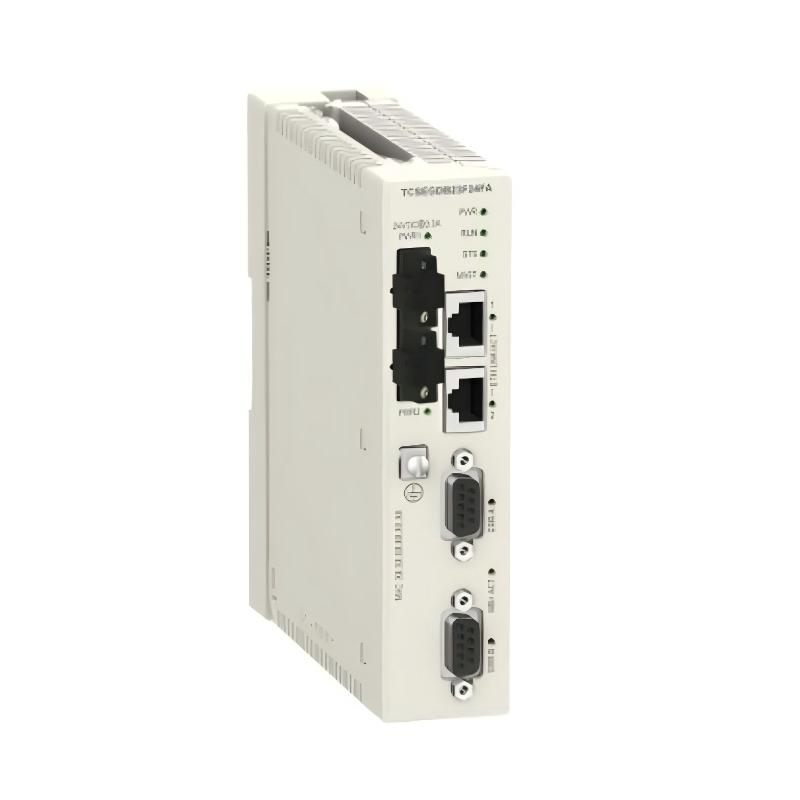
Schneider TCSEGDB23F24FA Modbus Plus Proxy Module Communication Fault Troubleshooting Guide (Network Loss & Mapping Failure Diagnosis)
Schneider TCSEGDB23F24FA communication faults are often misdiagnosed as PLC hardware or Ethernet failures, but in real Modicon M340 field applications, more than 80% of issues are caused by Modbus Plus addressing conflicts, register mapping errors, or network segmentation problems rather than module failure itself.
Schneider TCSEGDB23F24FA Fault Symptoms in Real PLC Systems
When this proxy module develops communication issues, engineers typically observe:
- Modbus TCP side is online but no data exchange occurs
- SCADA shows stale or frozen values from legacy devices
- Intermittent loss of Modbus Plus node visibility
- Data inconsistency between PLC registers and field devices
- Gateway responds to ping but no process data flows
In one pulp and paper plant, operators reported that motor status signals were randomly switching between RUN and STOP without actual field changes.
Field Case: Misleading Hardware Replacement Scenario
During troubleshooting, the maintenance team initially replaced:
- PLC CPU module
- Ethernet communication switch
- TCSEGDB23F24FA proxy module
However, the issue persisted.
After field diagnostics, engineers observed:
- Modbus TCP communication fully stable
- Ethernet latency within normal range
- Modbus Plus segment showing intermittent node dropouts
The root cause was eventually identified as duplicate Modbus Plus node addressing introduced during system expansion.
Once corrected, all false signals disappeared immediately.
Root Causes of TCSEGDB23F24FA Communication Failures
1. Modbus Plus Address Conflict
This is the most critical and common issue. If two nodes share the same address:
- Entire segment communication becomes unstable
- Random data loss occurs
- SCADA displays inconsistent values
This issue often appears after system expansion or retrofitting.
2. Incorrect Register Mapping Between Protocols
When Modbus TCP and Modbus Plus mapping tables are misaligned:
- Sensor values appear shifted or inverted
- Alarm conditions trigger incorrectly
- PLC logic behaves unpredictably
In one steel mill application, a temperature value was incorrectly mapped to a pressure register, causing false shutdown alarms.
3. Backplane or Rack Connection Instability
Loose seating in the M340 rack can cause:
- Intermittent module resets
- Random loss of gateway function
- No hardware fault indication
This is often mistaken for internal module failure.
4. Legacy Modbus Plus Cable Degradation
Modbus Plus is sensitive to:
- Cable aging
- Improper termination
- EMI interference from nearby drives
Signal quality degradation leads to intermittent node disappearance.
Structured Diagnostic Approach Used in Field Engineering
Experienced engineers do not replace the module immediately. Instead, they follow a layered diagnostic logic:
First, isolate Ethernet side communication. If Modbus TCP remains stable, the issue is likely on the legacy bus side.
Next, check Modbus Plus node table for duplicate addresses or missing nodes.
Then validate register mapping consistency between PLC and gateway configuration.
Finally, inspect physical wiring integrity and termination resistance on Modbus Plus network.
Field Recovery Actions That Prove Effective
Based on real industrial maintenance cases:
- Rebuild Modbus Plus addressing table from scratch
- Remove duplicate node IDs across legacy segments
- Re-map register structures using clean configuration templates
- Re-seat module in rack to eliminate backplane contact issues
- Replace aged Modbus Plus cable segments in high-noise areas
In a refinery system, after correcting addressing and cleaning legacy bus wiring, communication stability improved from intermittent failure every 20–30 minutes to continuous 45+ days of stable operation.
Engineering Insight
The TCSEGDB23F24FA is not a control module and does not execute automation logic. It functions purely as a protocol translation gateway between Modbus TCP and Modbus Plus networks.
Therefore:
- It does not “fail logically” in most cases
- It only exposes underlying network architecture issues
- Most faults originate outside the module itself
Final Conclusion
Schneider TCSEGDB23F24FA communication faults are almost always caused by system-level configuration issues rather than hardware failure. The most critical diagnostic focus areas are Modbus Plus addressing, register mapping integrity, and legacy network physical condition.
Proper troubleshooting requires treating the module as a gateway component rather than a PLC control element.