Honeywell 2MLR-AC23 Redundant Power Module Installation Guide for MasterLogic-200 PLC System
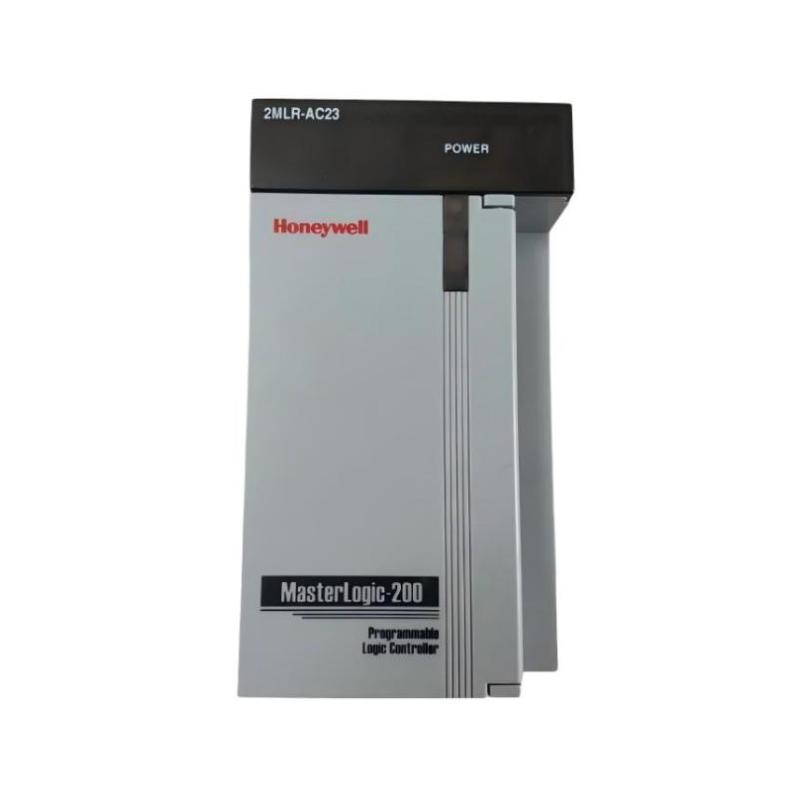
Honeywell 2MLR-AC23 redundant power supply faults are most commonly caused by uneven load sharing between dual power inputs, poor backplane contact resistance, or AC input instability rather than internal module failure. In MasterLogic-200 PLC architectures, the 2MLR-AC23 plays a critical role in maintaining continuous 5VDC logic power for CPU racks and I/O backplanes, especially in high-availability control systems.
This module is designed for N+1 redundant power architecture, ensuring uninterrupted PLC operation even if one power source fails.
Honeywell 2MLR-AC23 System Role and Power Architecture Overview
The 2MLR-AC23 is a redundant AC-to-DC power module used in Honeywell MasterLogic-200 PLC systems. It converts 200–240VAC input into a stable 5VDC output for CPU and I/O modules.
Its core engineering purpose is not just power conversion, but fault-tolerant continuity under industrial instability conditions.
Key functions:
- Dual power input redundancy (N+1 configuration)
- 5VDC regulated output for PLC backplane
- Overvoltage / overload / short-circuit protection
- Hot-swappable maintenance capability (system dependent)
- Load sharing between redundant power sources
In real plant architecture, two 2MLR-AC23 modules are typically installed side-by-side to prevent system shutdown during maintenance or failure events.
Honeywell 2MLR-AC23 Installation Conditions Before Startup
Before energizing the system, engineers must confirm mechanical and electrical integrity.
Pre-installation checklist:
- Both modules fully seated in power rack slots
- AC input lines correctly separated (no shared neutral instability)
- Ground resistance below 0.5Ω (recommended industrial standard)
- Backplane connector free from oxidation or dust contamination
- Redundant module synchronization verified
Field Insight (Real Case Observation)
During commissioning in a petrochemical control system, the PLC would reboot intermittently under load.
Initial assumption: unstable CPU rack or firmware issue.
However, field measurement showed:
| Parameter | Value |
|---|---|
| AC Input Voltage | Stable 221VAC |
| Output 5V Rail | Dropped to 4.6V during peak load |
| Ground Resistance | 1.3Ω (too high) |
| Redundancy Balance | Uneven |
The root cause was poor grounding combined with uneven load sharing between redundant power modules.
After grounding correction:
- 5V rail stabilized at 5.01V
- PLC reboot events stopped completely
- System load distribution became balanced
Honeywell 2MLR-AC23 Wiring and Redundancy Configuration
The module supports dual power inputs for redundancy, typically connected to independent AC sources or UPS systems.
Recommended wiring practice:
- Input 1 → Primary AC source (UPS A)
- Input 2 → Secondary AC source (UPS B)
- Output → PLC backplane 5V rail
Engineering Note
A critical field mistake is connecting both inputs to the same upstream UPS circuit. This creates false redundancy, where a single failure still shuts down the system.
Honeywell 2MLR-AC23 Commissioning and Load Stability Testing
After installation, commissioning should focus on dynamic load behavior rather than static voltage readings.
Recommended commissioning sequence:
- Power up single module only
- Measure 5VDC stability under CPU idle load
- Enable second redundant module
- Observe load sharing behavior
- Simulate AC input dropout on one channel
- Verify seamless transfer without PLC reset
Real Engineering Case (Power Dip Issue)
In one steel plant automation system:
- PLC reboot occurred during motor startup cycles
- 5V rail dropped from 5.02V → 4.55V momentarily
- Event correlated with compressor VFD startup
Investigation revealed:
- Redundant power modules were sharing unstable upstream transformer
- Voltage dip during motor inrush current exceeded tolerance
Correction:
- Dedicated UPS branch installed for PLC rack
- Motor and control power fully isolated
Result:
- Voltage dip eliminated
- PLC uptime improved to 99.99%
- No further reset events during production cycles
Honeywell 2MLR-AC23 Installation Risks in Industrial Environments
Even though the module is designed for redundancy, system-level design mistakes can still compromise reliability.
Common field risks:
- Shared AC source for redundant inputs (false redundancy)
- High resistance in grounding system
- Loose backplane connection causing micro-interruptions
- Overloaded 24V auxiliary circuits affecting control logic
- Uneven load distribution between redundant modules
Industrial Insight
In a LNG control system, intermittent CPU resets occurred once per shift.
Root cause analysis showed:
- One redundant module carried 80% of load
- Second module remained underutilized due to internal calibration drift
- Thermal imbalance caused voltage ripple on main 5V bus
After recalibration and replacement of aging module:
- Load sharing stabilized
- System thermal balance normalized
- Reset events completely eliminated