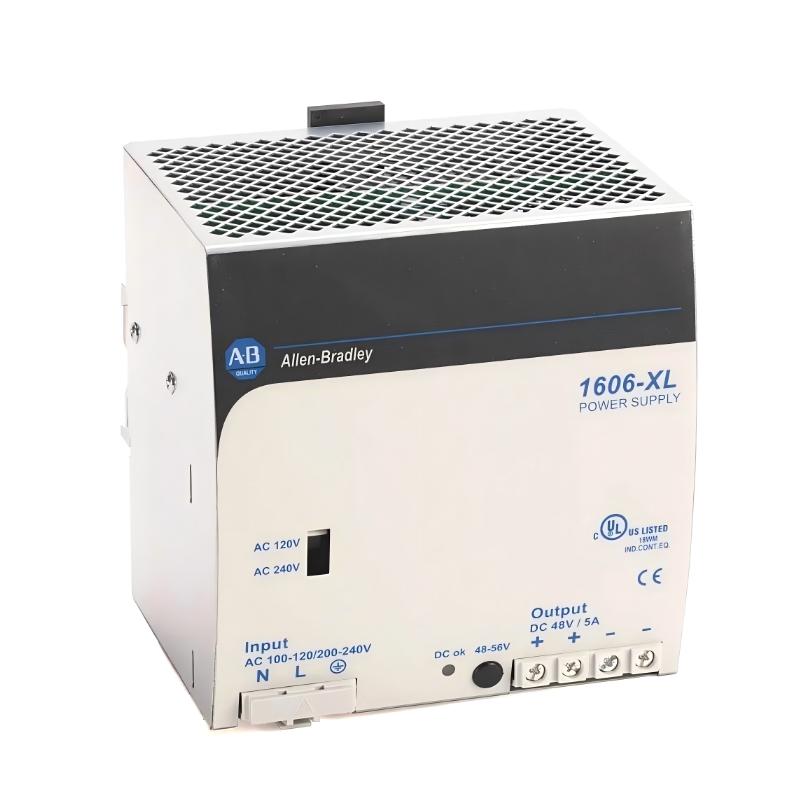
Allen-Bradley 1606-XL240DR Redundant Power Supply Fault Troubleshooting Guide (24V DC Instability & Redundancy Failure Diagnosis)
Allen-Bradley 1606-XL240DR power supply faults are often misdiagnosed as hardware failure, but in field experience, most issues originate from load imbalance, redundancy miswiring, or upstream AC instability rather than internal component failure.
Typical Fault Symptoms in Industrial PLC Systems
When issues occur, engineers typically observe:
- 24V DC rail voltage fluctuating under load
- PLC CPU random reset or brownout alarms
- One redundant PSU carrying most of the load
- “Power OK” indicator unstable or flickering
- SCADA communication dropping intermittently
In one food processing plant, operators reported random PLC reboots every 2–3 hours, initially assumed to be CPU-related.
Field Diagnostic Case: Misleading Power Supply Replacement
During troubleshooting, maintenance engineers replaced:
- PLC CPU module
- 24V DC power supply unit
- Redundancy configuration module
However, the issue persisted.
Field measurements revealed:
- AC input voltage stable
- One PSU output slightly higher (~24.6V vs 24.1V)
- Load sharing heavily unbalanced
- Redundancy path continuously correcting current flow
The root cause was improper output voltage calibration mismatch between redundant power supplies, causing continuous cross-loading stress.
Once output levels were aligned, system stability returned immediately.
Root Causes of 1606-XL240DR Failures in Real Applications
1. Load Imbalance Between Redundant Units
This is the most common field issue:
- One PSU carries majority of load
- Second PSU remains underutilized
- Thermal stress increases on primary unit
This leads to premature degradation and instability under peak load.
2. AC Input Quality Problems
Industrial environments often introduce:
- Voltage dips during motor startup
- Harmonic distortion from VFDs
- Phase imbalance in multi-source panels
These conditions directly affect 24V DC stability.
3. Redundancy Wiring Errors
Incorrect wiring causes:
- Reverse current flow between PSUs
- Unstable OR-ing behavior
- Unexpected shutdown under transient load
This is frequently seen after maintenance modifications.
4. Aging Capacitor Performance Degradation
In long-term operation:
- Output ripple increases gradually
- Transient response slows down
- Brownout events become more frequent under sudden load change
This is often mistaken for PLC failure.
Structured Troubleshooting Method Used in Field Engineering
Experienced engineers follow a layered approach:
First, isolate AC input stability using real-time voltage monitoring under load conditions.
Next, measure each PSU output independently to verify voltage matching and load distribution.
Then inspect redundancy wiring for reverse current paths or improper diode OR-ing behavior.
Finally, apply dynamic load testing to observe transient response behavior.
Field Repair Actions That Prove Effective
Based on industrial maintenance experience:
- Recalibrate output voltage alignment between redundant units
- Replace or reconfigure redundancy module wiring
- Separate PSU input sources from high-noise industrial loads
- Balance load distribution using proper power segmentation
- Replace aged units showing increased ripple under load
In one pharmaceutical facility, after correction, system uptime improved from frequent micro-interruptions to stable continuous operation over several months.
Engineering Insight
The 1606-XL240DR does not fail randomly in most cases. Instead, it exposes system-level power design weaknesses, especially in redundancy architecture and load distribution planning.
It should always be evaluated as part of a complete 24V DC power ecosystem, not as an isolated component.
Final Conclusion
Allen-Bradley 1606-XL240DR redundancy faults are overwhelmingly caused by system design issues, load imbalance, or AC power quality problems, not internal power supply failure. Proper troubleshooting requires evaluating the entire power architecture rather than replacing individual units.