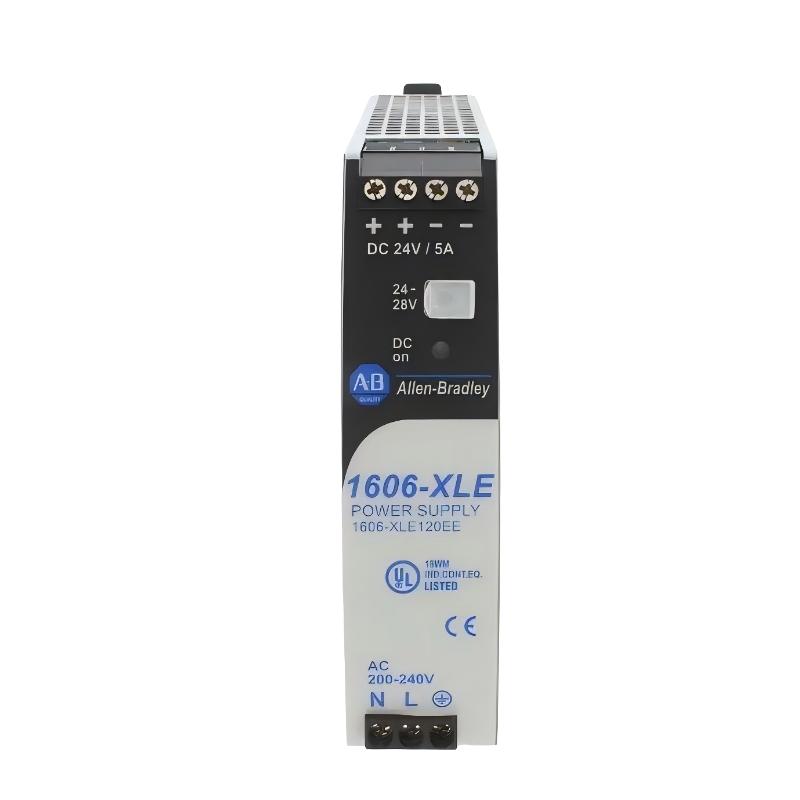
Allen Bradley 1606-XLE120EE Power Supply Troubleshooting Guide (24V Drop, PLC Reset, DC Fault Diagnosis)
Introduction
Allen Bradley 1606-XLE120EE troubleshooting cases are frequently misdiagnosed as internal failure. In reality, most issues are caused by load transients, wiring resistance, or improper DC grounding design.
In PLC systems, even short voltage dips can trigger CPU reset or I/O dropout.
Allen Bradley 1606-XLE120EE Fault Symptoms in Industrial Systems
Common symptoms include:
- PLC random restart or brownout
- DC OK relay flickering
- 24VDC unstable under switching load
- Output appears normal at idle but collapses under load
- Communication module resets intermittently
In one conveyor system, PLC resets occurred every 10–20 minutes despite stable idle voltage readings.
Allen Bradley 1606-XLE120EE Diagnostic Thinking Process
Field engineers typically follow a structured approach:
- Does failure occur only during load switching?
- Is voltage stable at PSU terminals but not at load?
- Are multiple inductive loads switching simultaneously?
- Is cable resistance causing DC drop?
Observation:
During solenoid activation, voltage dropped to 21.7V at PLC terminals, triggering CPU reset even though PSU output remained within spec.
Allen Bradley 1606-XLE120EE Case Study: PLC Random Restart
System Configuration:
- PLC: CompactLogix
- Loads: sensors + relays + communication module
- Power supply: 1606-XLE120EE
Symptoms:
- Random PLC restart every 15–30 minutes
- DC OK flickering during operation
- No internal PSU fault indication
Diagnostic Results:
- PSU output stable at terminals
- PLC input voltage fluctuating 22.0–24.2V
- Voltage drop increases during simultaneous relay switching
Root Cause:
- Long DC wiring run (~18 meters)
- Undersized cable cross-section
- All loads connected on a single DC branch
- High inrush from multiple relays
Correction:
- Split DC loads into two power branches
- Increased wire size
- Staggered relay activation sequence
Result:
- Voltage drop reduced to <0.3V
- PLC reset completely eliminated
Allen Bradley 1606-XLE120EE Common Fault Patterns
1. DC OK Relay Flicker
Caused by:
- transient voltage dips
- loose terminals
- high inrush switching loads
2. Output Voltage Collapse
Caused by:
- long cable resistance
- overloaded single DC rail
- simultaneous inductive switching
3. Thermal Stress Behavior
Occurs when:
- cabinet temperature >45°C
- continuous near-maximum load
- poor ventilation around DIN rail
Allen Bradley 1606-XLE120EE Repair Strategy
Step 1: Load Isolation Test
Disconnect external loads:
- Stable → external wiring/load issue
- Unstable → PSU or AC input issue
Step 2: Voltage Drop Measurement
Compare:
- PSU output terminals
-
PLC input terminals
If difference >1V → wiring problem confirmed
Step 3: Switching Behavior Test
Stagger relay/solenoid switching to reduce peak inrush current.
Engineering Insight
The 1606-XLE120EE is generally reliable in industrial environments. Most failures attributed to it are actually caused by DC system design errors rather than component degradation.
Final Conclusion
For 1606-XLE120EE-related issues, the correct troubleshooting priority is:
- Check load distribution
- Verify wiring resistance
- Analyze switching transients
- Inspect PSU only as last step
Most field cases are resolved without replacing the power supply.