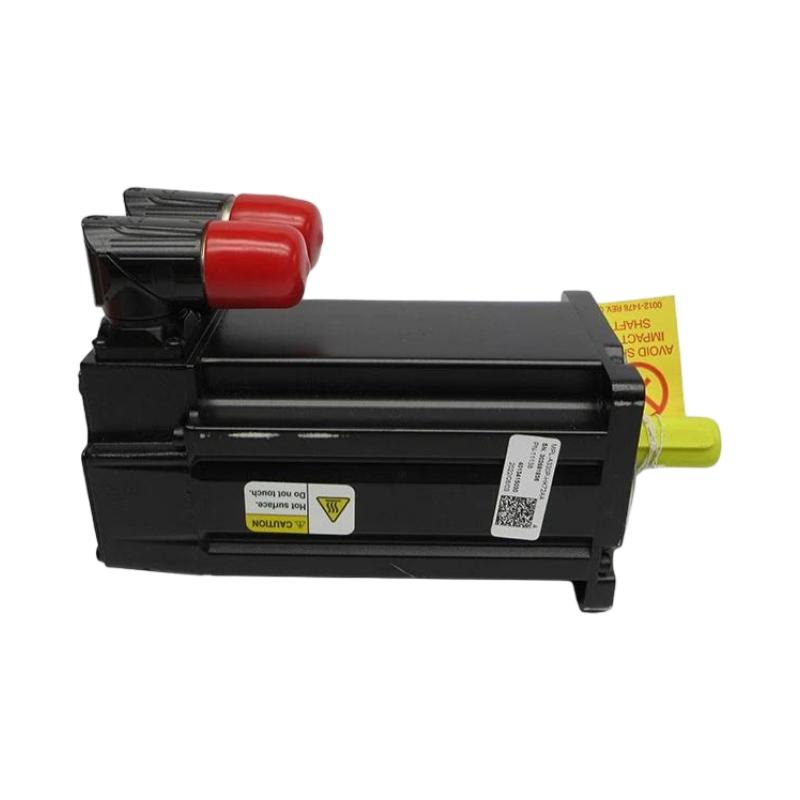
Allen-Bradley MPL-A420P-HK72AA Servo Motor Troubleshooting Guide (Fault Diagnosis)
Allen-Bradley MPL-A420P-HK72AA servo motor troubleshooting should begin by separating electrical, feedback, drive, and mechanical causes. A servo fault does not automatically mean that the motor itself has failed.
The most effective Fault Diagnosis approach is to determine when the problem occurs and under what operating condition.
Allen-Bradley MPL-A420P-HK72AA Servo Motor Fault Symptoms
Typical symptoms include:
- Motor does not rotate
- Servo drive reports a fault
- Following error increases during acceleration
- Motor vibrates at low speed
- Position becomes inaccurate
- Motor temperature rises abnormally
- Motion becomes unstable after prolonged operation
The timing of the fault is important.
For example:
Fault immediately after enable often points toward wiring, configuration, or feedback issues.
Fault only during acceleration may indicate mechanical load, tuning, current demand, or power-related problems.
Fault after prolonged operation requires thermal investigation.
Allen-Bradley MPL-A420P-HK72AA Servo Motor Fault Diagnosis by Operating Condition
A useful diagnostic table:
| Symptom | Initial Investigation |
|---|---|
| No rotation | Enable, drive status, power and feedback |
| Immediate servo fault | Configuration and feedback |
| High following error | Tuning and mechanical load |
| Vibration | Alignment and control response |
| Overtemperature | Load, cooling and duty cycle |
| Position drift | Feedback and mechanical transmission |
This approach prevents engineers from replacing the motor without evidence.
Allen-Bradley MPL-A420P-HK72AA Feedback Fault Investigation
Consider a machine where the servo drive reports a feedback-related fault immediately after startup.
Observed condition:
- Motor power: Available
- Drive: Enabled command present
- Motor: Does not rotate
- Feedback status: Invalid
The engineering team checks the feedback circuit first.
Inspection points:
- Feedback connector
- Cable continuity
- Connector pins
- Shielding
- Cable damage
In one field case, the feedback connector had not been completely seated after cabinet maintenance.
After reconnecting and securing the connector:
- Feedback became stable
- Drive enabled normally
- Motor completed the motion test
The motor had not failed.
Allen-Bradley MPL-A420P-HK72AA Following Error Fault Diagnosis
Following error deserves a different diagnostic approach.
Suppose:
Command Position
      ↓
Servo Controller
      ↓
MPL-A420P-HK72AA
      ↓
Actual Position
During a test cycle:
- Low-speed movement: Normal
- High-speed acceleration: Following error increases
- Motor current: Increases sharply
This pattern suggests that the problem may be related to:
- Mechanical resistance
- Excessive inertia
- Acceleration profile
- Servo tuning
- Mechanical coupling
Engineers should not immediately replace the motor.
A useful test is to compare unloaded and loaded operation.
If the motor operates correctly without the machine load but fails under load, the mechanical system becomes the primary investigation area.
Allen-Bradley MPL-A420P-HK72AA Vibration Fault Investigation
Servo vibration can originate from several sources.
Potential causes include:
- Coupling misalignment
- Mechanical resonance
- Excessive gain
- Loose mounting
- Damaged transmission components
Field observation is important.
For example:
Low Speed       → Smooth
Medium Speed    → Slight Vibration
High Speed      → Severe Vibration
If vibration follows a particular speed range, engineers should investigate mechanical resonance and control tuning rather than assuming bearing failure.
During one commissioning case, vibration was initially suspected to be caused by the servo motor.
The motor was tested separately and operated smoothly.
After reconnecting the machine load, vibration returned.
Inspection found a misaligned coupling.
Correcting the mechanical alignment eliminated the abnormal vibration.
Allen-Bradley MPL-A420P-HK72AA Servo Motor Overtemperature Troubleshooting
If the motor temperature increases beyond normal operating conditions, investigate the operating duty before replacing the motor.
Check:
- Load torque
- Acceleration frequency
- Continuous operating speed
- Mechanical resistance
- Cooling conditions
A useful diagnostic comparison is:
Normal Cycle
     ↓
Motor Temperature

High-Duty Cycle
     ↓
Motor Temperature
If temperature rises mainly during high-duty production, the cause may be excessive continuous load rather than an electrical motor failure.
Allen-Bradley MPL-A420P-HK72AA Troubleshooting Repair and Recovery
A practical repair process is:
Record fault → Identify operating condition → Check drive diagnostics → Verify feedback → Test motor unloaded → Inspect mechanical load → Reconnect system → Perform repeated-cycle validation
After repair, engineers should repeat the condition that originally produced the fault.
For example, if the original failure occurred during rapid acceleration, a slow jog is not sufficient validation.
The machine should be tested under the same acceleration and load conditions.
Allen-Bradley MPL-A420P-HK72AA Common Fault Diagnosis Methods
Motor Does Not Start
Check:
- Drive enable
- Motor power connection
- Feedback connection
- Drive configuration
- Safety interlocks
Following Error During Acceleration
Check:
- Mechanical load
- Coupling alignment
- Acceleration settings
- Servo tuning
- Current demand
Feedback Fault
Check:
- Feedback connector
- Cable continuity
- Shielding
- Connector condition
Excessive Vibration
Check:
- Motor mounting
- Coupling alignment
- Mechanical resonance
- Servo tuning
High Motor Temperature
Check:
- Load torque
- Duty cycle
- Cooling
- Mechanical friction
Allen-Bradley MPL-A420P-HK72AA Servo Motor Long-Term Maintenance
For reliable servo operation:
- Inspect motor connectors during scheduled maintenance
- Keep feedback cables properly routed
- Check coupling alignment
- Monitor following error trends
- Record motor temperature
- Inspect abnormal vibration
- Compare current operating data with commissioning records
The most valuable maintenance information is not simply whether the motor is running. Engineers should know what normal current, following error, vibration, temperature, and positioning behavior look like for the specific machine.
Practical engineering rule: When performing Allen-Bradley MPL-A420P-HK72AA Servo Motor Troubleshooting and Fault Diagnosis, separate the motor from the mechanical and feedback systems logically before concluding that the motor itself is defective.