Mitsubishi Electric Highlights Connected Manufacturing at IMTS 2026
The manufacturing industry is moving rapidly toward connected automation as machine builders and manufacturers look for ways to improve productivity while reducing engineering complexity.
Mitsubishi Electric is highlighting this trend at IMTS 2026 in Chicago, where its U.S. Industrial Automation division is presenting an integrated portfolio covering CNC systems, robotics, PLCs, HMIs, SCADA, and digital technologies.
The company announced that it will demonstrate how these technologies work together as a connected automation ecosystem during IMTS 2026, scheduled for September 14–19 in Chicago. The company also announced live machine demonstrations, integrated automation applications, and hands-on educational activities.
The event is particularly relevant to the PLC and industrial automation industry because it shows how machine control is increasingly becoming part of a broader digital manufacturing architecture.
Instead of treating CNC, PLC, robot, HMI, and SCADA systems as independent technologies, manufacturers are increasingly connecting them into unified production environments.
Why Connected Manufacturing Matters
Manufacturing companies are under constant pressure to improve production efficiency.
At the same time, they need to manage:
- Rising labor costs
- Skilled-worker shortages
- Product customization
- Shorter production cycles
- Higher quality requirements
- Energy efficiency
- Equipment downtime
Traditional automation can solve many of these problems, but connected automation can provide additional visibility.
When machines and automation systems exchange information, production teams can better understand what is happening across the manufacturing process.
For example, production data can be used to monitor:
- Machine utilization
- Cycle time
- Production quantity
- Equipment status
- Alarm conditions
- Quality information
This information provides a foundation for smarter manufacturing decisions.
CNC, PLC and Robotics Working Together
One of the key themes of Mitsubishi Electric's IMTS 2026 demonstration is the integration of CNC, robotics, automation, and digital technologies.
This integration is particularly important for machine tool applications.
A modern automated machining cell may contain:
- CNC machine tools
- PLC controllers
- Servo drives
- Servo motors
- Industrial robots
- HMIs
- Sensors
- Safety systems
- Industrial networks
If these technologies operate independently, engineering and maintenance can become complicated.
Integrated automation can reduce this complexity by creating a more consistent architecture.
For machine builders, this can help simplify engineering and support.
For manufacturers, it can make production cells easier to operate and expand.
Machine Tool Automation Is Becoming More Intelligent
Machine tools are increasingly becoming highly automated production systems.
A CNC controller manages the machining process, while PLC technology handles auxiliary equipment and machine sequences.
Robots can automatically load and unload parts.
Sensors monitor equipment conditions.
HMIs provide operators with information.
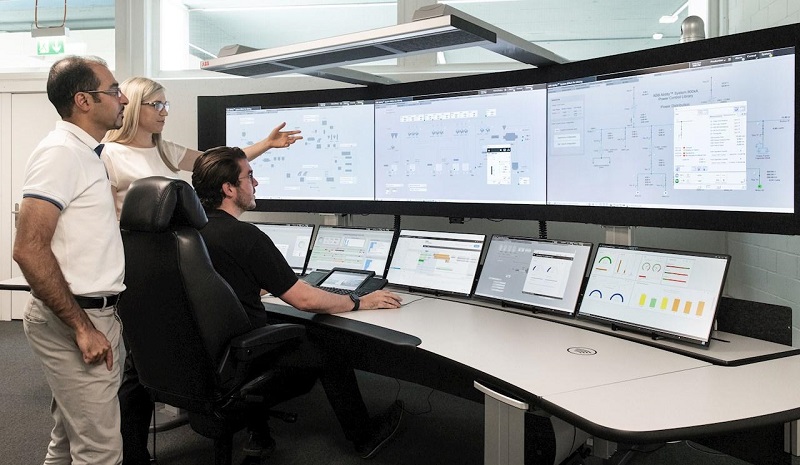
SCADA and digital systems can collect production data.
When these technologies are integrated, manufacturers can create automated production cells capable of running with less manual intervention.
This is particularly useful for repetitive machining operations.
Robotics and Machine Tending
Robot-based machine tending is an important application within modern manufacturing automation.
A robot can load raw material into a machine, remove completed parts, and transfer components to another process.
This can reduce manual handling and improve production consistency.
Mitsubishi Electric has been demonstrating robotic and machine-tool automation solutions, reinforcing the growing connection between robotics and traditional factory automation.
For automation engineers, this means PLC programming is increasingly being integrated with motion control and robotic systems.
The engineer may need to understand:
- PLC logic
- Robot communication
- Servo motion
- Safety systems
- CNC interfaces
- Industrial networking
This convergence is changing the skills required for modern automation projects.
Digitalization Adds Another Layer of Manufacturing Intelligence
The integration of digital technologies with automation is another major trend highlighted by the event.
Digital manufacturing systems can provide information that is difficult to obtain from individual machines.
For example, production managers may want to know:
- Which machine has the lowest utilization?
- Which process creates the most downtime?
- Which products require the longest cycle time?
- When does preventive maintenance need to occur?
Digital systems can aggregate this information and make it easier to analyze.
This creates a connection between shop-floor automation and higher-level production management.
Reducing Automation Engineering Complexity
Machine builders frequently face the challenge of integrating equipment from multiple technology categories.
A production machine may require separate expertise for:
- CNC
- PLC
- Robot
- HMI
- Servo
- Network
- Safety
A more integrated product ecosystem can simplify engineering.
Mitsubishi Electric emphasized its ability to provide automation technologies and application expertise across CNC, robotics, controls, and digitalization.
For OEMs, reducing engineering complexity can shorten development time.
For end users, standardized automation architectures can simplify training and maintenance.
The Role of Education in Industrial Automation
Another notable part of Mitsubishi Electric's IMTS 2026 participation is its focus on education.
The company announced participation in the IMTS Smartforce Student Summit, where students can receive hands-on exposure to automation and robotics through training sessions and demonstrations.
This is important because the industrial automation industry is facing a major skills challenge.
Advanced automation equipment is becoming more capable, but companies still need engineers and technicians who understand how to configure, program, maintain, and troubleshoot these systems.
Education is therefore becoming an important part of industrial automation development.
What This Means for PLC Suppliers
The increasing integration of PLCs with CNC, robots, and digital systems is changing demand in the automation market.
PLC customers increasingly need:
- High-speed controllers
- Motion control
- Industrial Ethernet
- Remote I/O
- HMI integration
- Robot communication
- Data connectivity
PLC suppliers and distributors therefore need to understand the complete automation ecosystem rather than focusing only on individual controller specifications.
For international automation equipment suppliers, this creates opportunities to provide both new components and replacement equipment for existing production systems.
Smart Manufacturing Is Becoming Practical
Smart manufacturing is sometimes described as a future concept.
However, the technologies being demonstrated at industrial events such as IMTS show that many elements of smart manufacturing are already practical.
Connected CNC systems, robots, PLCs, HMIs, and digital platforms are already being applied to real manufacturing processes.
The challenge is no longer simply whether these technologies exist.
The more important question is how manufacturers can integrate them economically and effectively.