ABB Drives: Deep Technology, Global Reach and Local Commitment — AI-Enabled Automation for Industrial Energy Efficiency
ABB Drives Strengthen the Link Between AI, Automation and Energy Efficiency
October 8, 2026 — ABB is expanding the role of intelligent drive technology in industrial automation, combining variable speed drives, digital platforms, artificial intelligence and energy-efficiency solutions to help manufacturers reduce energy consumption while improving equipment reliability and operational performance.
As industrial companies accelerate equipment upgrades and digital transformation, the role of the variable frequency drive is changing. Once primarily regarded as a device for controlling motor speed, the modern industrial drive is increasingly becoming a connected source of operational data and an important component of an intelligent automation architecture.
ABB's latest approach places greater emphasis on the combination of AI, drive technology, digitalization and energy management. The objective is not simply to replace individual pieces of equipment, but to use operational data to identify energy losses, optimize equipment performance, improve predictive maintenance and support better decisions throughout the equipment lifecycle.
This direction is particularly relevant as manufacturers face increasing pressure to control energy costs while maintaining production capacity and reliability. ABB says its strategy in China is built around three areas: deeper technological development, global capabilities and localized market support.
From Motor Control to Intelligent Drive Systems
Industrial motor-driven equipment represents a major area of energy consumption. Pumps, fans, compressors, conveyors, extruders, hoists and other rotating machinery often operate under changing load conditions, making accurate speed and torque control essential for efficient production.
A variable speed drive can adjust motor operation according to actual process requirements rather than allowing equipment to run continuously at a fixed speed. This can provide significant energy-saving opportunities, particularly in applications involving variable-torque loads such as fans and pumps.
ABB's current strategy goes a step further by connecting drive systems with digital technologies.
Through connected drives and digital platforms, operational information can be collected and analyzed instead of remaining isolated at the machine level. This creates the possibility of identifying abnormal operating conditions, inefficient production states and potential equipment problems at an earlier stage.
ABB's industrial energy-efficiency strategy emphasizes the combination of diagnostics, high-efficiency motor and drive systems, digital optimization and lifecycle services. The company also highlights AI-based optimization as an additional tool for improving industrial energy performance.
AI Turns Drive Data Into Actionable Information
One of the most important developments in industrial automation is the transition from simply collecting data to using data to support operational decisions.
ABB has been developing this direction through its digital ecosystem, including ABB Ability™, while also expanding the use of analytical AI and generative AI across industrial applications.
For drive systems, the practical value of AI does not necessarily mean replacing engineers or plant operators. Instead, AI can help process large volumes of equipment and energy data that would be difficult to analyze manually.
Potential applications include:
- Identifying abnormal energy consumption
- Detecting changes in equipment operating conditions
- Supporting predictive maintenance
- Optimizing motor and drive operating parameters
- Identifying production-line energy bottlenecks
- Forecasting energy demand
- Comparing actual energy performance with expected performance
- Supporting engineers with faster access to operational information
ABB has also highlighted AI-enabled energy optimization through solutions that combine operational information, equipment data and energy data. Its industrial AI portfolio includes applications for process optimization, predictive maintenance and energy management.
The important point for industrial users is that AI becomes more valuable when it is connected to reliable field data. Drives, motors, sensors, PLCs and other automation devices can therefore become part of a broader industrial intelligence architecture.
ABB's China Strategy Combines Global Technology With Local Manufacturing
China remains one of the world's most important industrial automation and manufacturing markets. ABB has operated in China for more than a century and has continued to develop local manufacturing, engineering, technical support and application capabilities.
According to ABB's latest China-focused communication, the company is positioning its drive business around the combination of global technology resources and local market requirements.
This approach is particularly important for manufacturers that are themselves expanding internationally.
Industrial equipment exported from China must often meet different electrical standards, certification requirements, environmental conditions and application requirements depending on the destination market. ABB says its global product development and certification framework can help Chinese OEMs address these requirements while maintaining local technical cooperation and support.
For automation equipment manufacturers, this can be particularly relevant when designing machines for Europe, North America, the Middle East or other international markets.
A standardized drive platform can simplify engineering and reduce the need for major redesigns when equipment is adapted for different markets. At the same time, local engineering and service capabilities can help manufacturers address application-specific requirements before equipment is shipped overseas.
Energy Efficiency Is Becoming a Business Issue, Not Only a Sustainability Issue
Energy efficiency has traditionally been associated with environmental targets and carbon reduction. For industrial companies, however, the financial impact is becoming equally important.
Higher electricity prices, increasingly complex energy markets and the growing power requirements of industrial facilities and data centers are making energy consumption a direct operating-cost issue.
ABB's 2026 industrial energy-efficiency analysis describes energy efficiency as a strategic factor affecting competitiveness, rather than simply a climate-related objective. The company combines equipment diagnostics, motor and drive modernization, digital optimization and lifecycle services to address energy consumption at the system level.
This is significant because replacing a single motor or drive does not automatically guarantee maximum system efficiency.
The actual energy performance of an industrial process depends on several factors, including motor sizing, load characteristics, control strategy, mechanical transmission, operating schedules and process requirements.
As a result, the next generation of industrial energy-saving projects is increasingly focused on system optimization rather than individual component replacement.
High-Efficiency Motors and Drives Create Additional Savings Opportunities
ABB's motor and drive portfolio also supports the industry's transition toward higher-efficiency motor systems.
High-efficiency motors, when properly matched with variable speed drives, can reduce losses and improve system performance. ABB has promoted IE5 synchronous reluctance motor and drive packages as one example of this approach.
The company has also published examples illustrating the potential energy reduction from upgrading conventional motor systems to higher-efficiency motor and drive combinations. Actual savings, however, depend on the application's operating profile, load characteristics, equipment condition and control strategy.
This distinction is important for industrial buyers.
A drive should not be evaluated only by its rated power or purchase price. Engineers increasingly need to consider the total cost of ownership, including:
Energy consumption + maintenance + downtime + engineering + lifecycle service + equipment replacement
A slightly higher initial investment can potentially be justified if the system delivers measurable energy savings and improved availability over many years.
ABB Targets Data Centers, Ports and Energy-Intensive Industries
ABB's drive technologies are used across a wide range of industrial applications, from water and wastewater treatment to HVAC, material handling, process industries, ports and heavy manufacturing.
More recently, data centers have become an increasingly important market for automation and electrification companies.
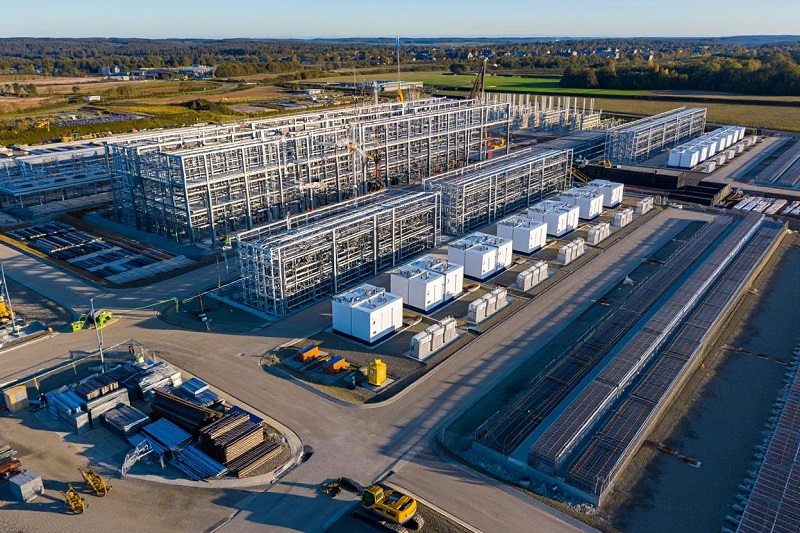
The rapid expansion of AI computing is driving higher data-center power consumption and increasing demand for efficient cooling, power distribution and infrastructure control. ABB has identified data centers as an important growth area and has developed solutions that address energy efficiency and cooling-system requirements.
In industrial facilities, the same principle applies: higher equipment utilization and increasing electrification require better control of energy consumption.
For example, ABB's ACH580-31 drive solution has been positioned for cooling distribution unit applications in data-center environments, combining drive technology with requirements such as low harmonic distortion and high power factor.
Ports and heavy industries represent another important application area because their equipment often operates under demanding load cycles. Cranes, conveyors, pumps and other large motor-driven systems require accurate control, high availability and reliable operation.
Digitalization Extends the Lifecycle of Industrial Equipment
Another important trend is the shift from reactive maintenance toward condition-based and predictive maintenance.
Traditional maintenance programs often depend on fixed schedules. Equipment may be inspected or serviced after a certain number of operating hours, regardless of its actual condition.
Connected drive systems provide another approach.
By monitoring operating information and identifying deviations from normal behavior, digital systems can help maintenance teams prioritize equipment that requires attention. This does not eliminate the need for engineers or physical inspections, but it can provide an additional layer of information for maintenance planning.
ABB's broader industrial automation strategy follows a similar philosophy. In February 2026, ABB introduced its Automation Extended program, describing an approach to modernization that allows companies to introduce advanced analytics, AI and IoT capabilities while protecting existing mission-critical control systems.
For established plants, this is particularly important.
Industrial customers rarely have the option of completely replacing an automation system every few years. A more practical approach is often to modernize gradually, preserving reliable control infrastructure while adding digital capabilities where they provide measurable value.
Local Engineering Will Remain Important in the AI Era
Despite the rapid development of AI, industrial automation remains closely connected to physical equipment.
A software model cannot compensate for incorrect motor sizing, poor installation, unsuitable drive parameters or an improperly designed process.
For this reason, engineering expertise remains essential.
ABB's emphasis on local manufacturing, engineering and application support in China reflects this reality. The company is continuing to expand local capabilities while integrating them with its global technology and service network.
For industrial customers, this combination can provide a more practical route to modernization: global automation technology combined with local application knowledge, commissioning support and lifecycle service.
Looking Ahead: Smarter Drives for More Efficient Industrial Operations
The development of industrial drives is increasingly moving beyond traditional speed control.
The combination of variable frequency drives, high-efficiency motors, PLCs, HMI systems, industrial networks, cloud platforms and AI analytics is creating a more connected automation architecture.
For ABB, the long-term direction is clear: drive technology should contribute not only to machine control but also to energy optimization, asset health, operational intelligence and lifecycle performance.
At the same time, industrial customers are becoming more selective. Investment decisions are increasingly based on measurable improvements in energy consumption, equipment availability, production efficiency and total operating cost.
This means that the next stage of industrial automation will not simply be about adding more digital functions. The real test will be whether those technologies can generate practical value on the production floor.
ABB's combination of drive technology, automation expertise, digital platforms and global service capabilities places it in a strong position to participate in this transition. As AI becomes more deeply integrated with industrial equipment, intelligent drives are likely to become an increasingly important part of the infrastructure connecting physical machines with digital industrial optimization.
For manufacturers seeking to reduce energy consumption while maintaining production performance, the opportunity is no longer limited to installing a more efficient motor or replacing an old variable frequency drive. The larger opportunity is to build an intelligent, connected and continuously optimized motor-driven system.
That is where AI-enabled automation and advanced drive technology can make a practical difference to industrial energy efficiency.
Key Takeaways for Industrial Automation Buyers
- ABB drives are evolving beyond basic motor-speed control toward connected and data-enabled industrial assets.
- AI can help analyze drive and energy data for optimization, predictive maintenance and operational decision-making.
- High-efficiency motors combined with variable speed drives can provide substantial energy-saving opportunities, depending on the application.
- Digital energy management is becoming increasingly important as electricity costs and industrial power demand rise.
- Local engineering and global certification capabilities are important for Chinese OEMs targeting international markets.
- Data centers, ports, process industries and heavy manufacturing are important application areas for advanced drive and automation solutions.
- Lifecycle cost and energy performance are becoming as important as initial equipment price when industrial customers evaluate automation investments.