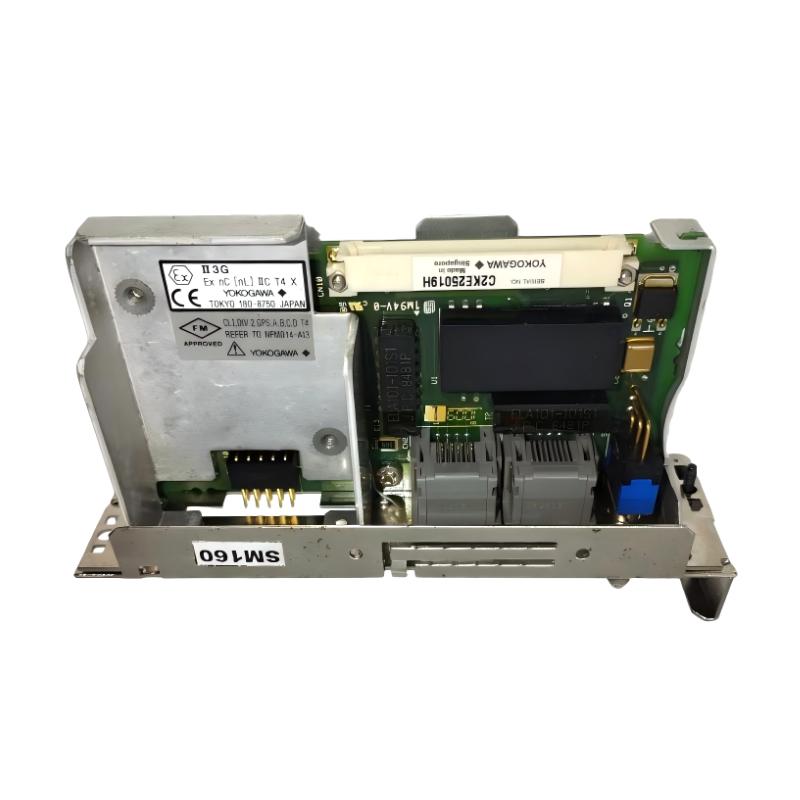
Brand:Yokogawa Electric Item No.:AIP504-11 Product Origin:Japan Product Dimensions:200 × 130 × 40 mm Product Weight:0.5 kg Payment:T/T, Western Union, Credit Card Goods_stock:15 Shipping Port:Xiamen, China Lead Time:1-3 Days Condition:Brand New And Original Warranty:1 Year Certificate:COO
The Yokogawa AIP504-11 V Net Coupler Unit is a communication backbone component developed for advanced Yokogawa control platforms. By bridging field control units with the V net system, it guarantees reliable and secure data transmission across automation layers.Its compact footprint combined with robust industrial construction allows it to integrate seamlessly into control cabinets without compromising performance. Designed for deterministic networking, the AIP504-11 contributes directly to improved operational transparency, faster response times, and enhanced system reliability.
Technical Specifications
Parameter
Description
Model
AIP504-11
Product Type
V Net Coupler Unit
Network Type
Yokogawa V net
Installation
Rack / Cabinet Mount
Application
Distributed Control Systems
Dimensions
200 × 130 × 40 mm
Weight
0.5 kg
Operating Environment
Industrial Indoor Use
Recommended Related Models
Yokogawa AIP502 Control Processor Module
Yokogawa AIP827-2 Processor Module
Yokogawa AEP7D-25 Power Bus Unit
Yokogawa AFV10D-S41151 Duplex Field Control Unit
Yokogawa AAI543 Analog Input Module
Popular Related Models
Yokogawa AIP504-01 V Net Coupler Unit
Yokogawa AIP504-10 V Net Coupler Unit
Yokogawa AEPV7D-215 Power Bus Unit
Yokogawa ADV151 Digital Input Module
Yokogawa AAI143 Analog Input Module
Application Landscape
The Yokogawa AIP504-11 V Net Coupler Unit is designed to serve as a high-reliability communication interface within Yokogawa’s V net architecture. Acting as a critical link between control nodes and network infrastructure, it ensures fast, stable, and deterministic data exchange across distributed control environments.
This unit is typically deployed in:
Large-scale distributed control systems (DCS)
Oil & gas upstream and downstream facilities
Power generation control networks
Petrochemical processing plants
Integrated automation systems requiring redundant communication paths
Operational Advantages
High-Speed Network Coupling – Enables reliable communication between control domains
Deterministic Data Transmission – Supports stable real-time control operations
Compact Industrial Design – Space-efficient integration into control cabinets
Engineered for Redundancy – Suitable for fault-tolerant network architectures
Long-Term System Stability – Built for continuous industrial operation
Technical FAQs
1. What is the main function of the AIP504-11?
It connects control units to the Yokogawa V net communication network.
2. What type of systems use this module?
It is used within Yokogawa distributed control systems.
3. Does it support redundant communication networks?
Yes, it is designed to operate within high-availability network configurations.
4. Is it suitable for mission-critical processes?
Absolutely. It is engineered for industries where stable communication is essential.
5. How is the unit installed?
It is mounted inside standard control cabinets or system racks.
6. What industries commonly use this coupler?
Oil & gas, power generation, petrochemical, and heavy manufacturing.
7. Does it require external configuration hardware?
Configuration is handled within the Yokogawa system environment.
8. What happens if network communication is interrupted?
Redundant architectures can maintain system communication continuity.
9. Is it designed for continuous operation?
Yes, it supports 24/7 industrial control environments.
10. What makes it critical in DCS architecture?
It ensures synchronized communication between distributed control nodes.