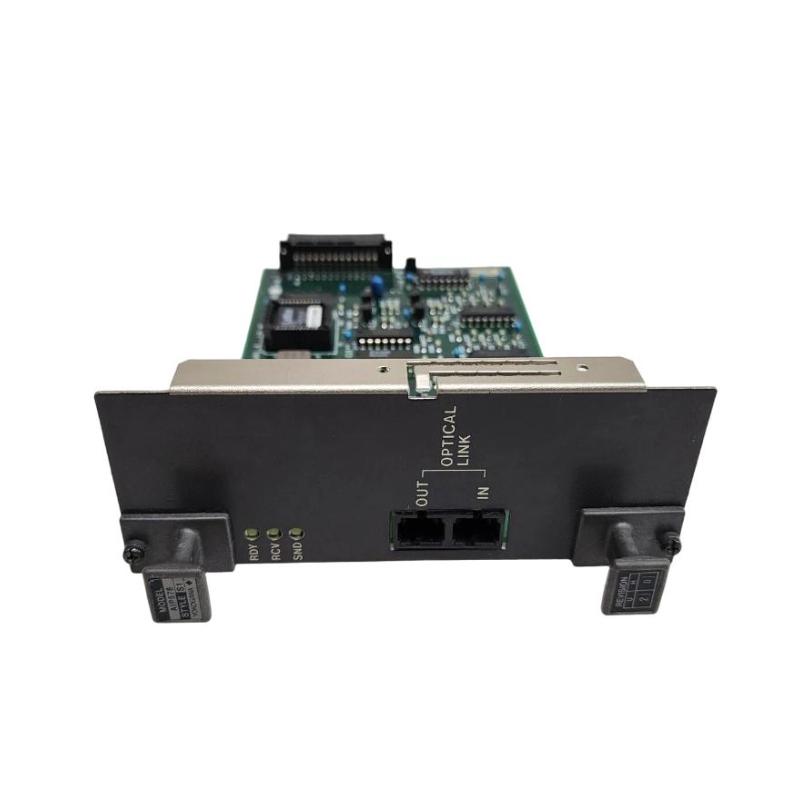
Yokogawa AIP588 Electrical Transceiver RIO I/O Module
Yokogawa AIP588 Electrical Transceiver RIO I/O Module
0.0
Points
Brand:Yokogawa Electric Item No.:AIP588 Product Origin:Japan Product Dimensions:27 × 130 × 160 mm Product Weight:0.45 kg Payment:T/T, Western Union, Credit Card Goods_stock:15 Shipping Port:Xiamen, China Lead Time:1-3 Days Condition:Brand New And Original Warranty:1 Year Certificate:COO
The Yokogawa AIP588 Electrical Transceiver RIO I/O Module provides reliable and accurate signal conversion and transmission for distributed control systems. Its compact and durable design allows seamless integration into industrial networks, supporting real-time process monitoring and control.Designed for both new installations and system expansions, the AIP588 ensures continuous operation and high data integrity, making it ideal for industrial environments that require precise and reliable I/O communication.
Technical Specifications
Parameter
Specification
Product Type
Electrical Transceiver / RIO I/O Module
Manufacturer
Yokogawa
Model
AIP588
Function
Signal Conversion and Transmission
Application
Distributed Control Systems / Industrial Automation
Installation
Control cabinet / I/O rack
Operating Environment
Industrial automation networks
Dimensions
27 × 130 × 160 mm
Weight
0.45 kg
Recommended Related Models
Modules commonly paired with the AIP588:
Yokogawa AIP532 ESB Bus Coupler Unit
Yokogawa AIP504-50 V Net Coupler Unit
Yokogawa AFV30D Duplex Field Control Unit
Yokogawa FCS-AFCI Analog Input Module
Popular Related Models
Frequently used Yokogawa I/O and network modules:
Yokogawa AIP588-01 RIO I/O Module
Yokogawa FCS-AFDI Digital Input Module
Yokogawa FCS-AFDO Digital Output Module
Yokogawa CENTUM VP Main Control Station
Yokogawa AFV30D-A41251 Duplex Field Control Unit
Applications
The Yokogawa AIP588 Electrical Transceiver RIO I/O Module is designed to provide reliable input/output communication between field devices and distributed control systems. It converts and transmits signals across industrial networks, supporting precise process monitoring and automation.
Typical applications include:
Distributed process control in chemical, oil, gas, and power plants
Industrial machinery automation
Networked monitoring of sensors and actuators
Remote I/O integration for process control systems
Modular system expansions and retrofits
Real-time signal acquisition and transmission
Advantages
Reliable Signal Transmission – Ensures stable communication between field devices and controllers.
Compact Form Factor – Ideal for control cabinets and space-constrained installations.
High Data Accuracy – Maintains signal integrity for precise process control.
Industrial-Grade Durability – Designed to withstand vibration, temperature variations, and electrical interference.
Seamless System Integration – Compatible with Yokogawa RIO and CENTUM VP systems.
Simplified Maintenance – Modular design allows easy replacement and service without downtime.
Technical FAQs
1. What is the main function of the AIP588 module?
It transmits electrical signals between field I/O devices and the control system reliably.
2. Which networks is it compatible with?
Primarily Yokogawa RIO and distributed control networks.
3. Can it operate continuously?
Yes, it is engineered for 24/7 industrial operation.
4. Where is it installed?
Typically in control cabinets or modular I/O racks.
5. Does it allow network expansion?
Yes, additional field I/O modules can be added seamlessly.
6. How does it maintain signal accuracy?
Through robust electrical design and industrial-grade transceiver components.
7. Is maintenance complicated?
No, modular design allows simple replacement of faulty units.
8. Can it handle harsh industrial conditions?
Yes, it tolerates vibration, temperature fluctuations, and electrical noise.
9. Is it suitable for retrofitting older systems?
Yes, it can integrate legacy field devices into modern RIO networks.
10. What differentiates it from other I/O modules?
Its combination of compact size, high reliability, and industrial-grade design ensures robust field-to-control communication.