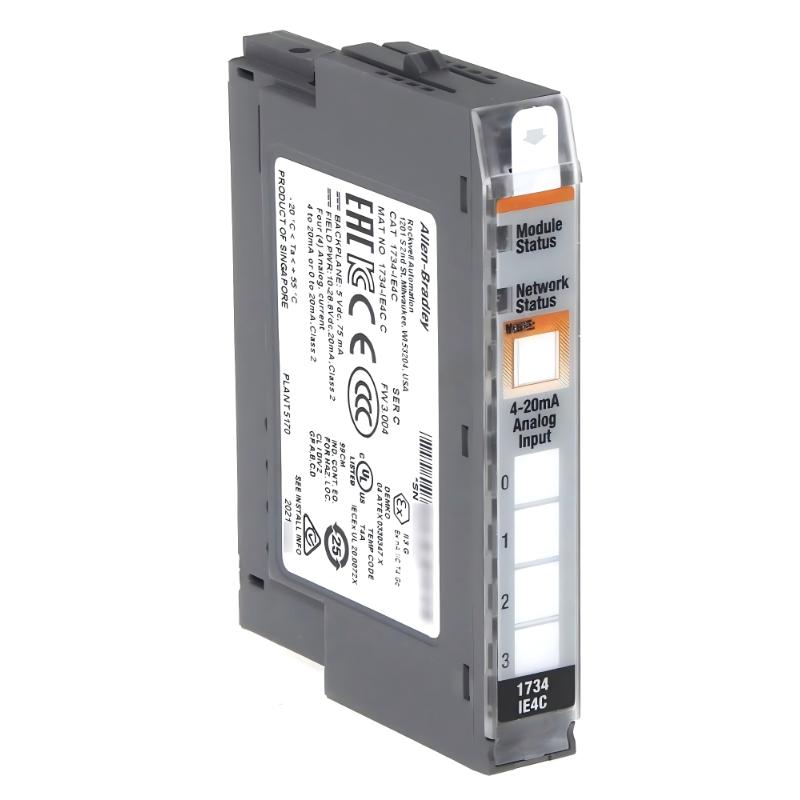
Allen-Bradley 1734-IE4C Point I/O Module Installation Guide in PLC Control Systems
In POINT I/O systems, installation issues related to the Allen-Bradley 1734-IE4C analog input module are rarely caused by hardware defects. In most field applications, problems originate from incorrect controller configuration, unstable 24V DC distribution, or improper integration within the POINT I/O architecture.
During a production line upgrade in a packaging facility, the module was physically installed and correctly wired, yet the PLC continued to show configuration mismatch alarms. The hardware was later confirmed to be fully functional. The root cause was an outdated module profile still referenced in the controller project.
This kind of mismatch is common in retrofit automation projects where old hardware templates are reused without verification.
Installation Considerations in POINT I/O Architecture
In real engineering environments, installation success depends heavily on system-level consistency rather than individual module handling.
The POINT I/O adapter must align with the controller network configuration. If there is a mismatch between adapter type and PLC communication setup, the module may fail to initialize even if all wiring is correct.
Another critical factor is backplane power stability. In high-density racks, multiple modules sharing the same 24V DC source can introduce voltage dips during startup sequences. In one case, intermittent resets were traced back to a shared supply feeding both I/O modules and motor control circuits.
Analog Signal Wiring and Field Experience
The 1734-IE4C module is designed for standard 4–20 mA current inputs from field transmitters such as pressure sensors and flow instruments.
From field experience, wiring issues are rarely about incorrect terminal connections. The real problem is signal integrity across long distances and grounding inconsistencies.
In a wastewater treatment application, analog signals fluctuated significantly under pump startup conditions. Measurements at the transmitter showed stable output, but PLC readings were unstable. The issue was traced to a ground potential difference between field instruments and the control cabinet. Once the grounding reference was corrected, signal stability was restored immediately.
Commissioning in Studio 5000 Environment
During commissioning, correct module identification inside Studio 5000 is essential. If the system uses an incorrect hardware profile, analog channels may behave unpredictably even when wiring is correct.
In one commissioning case, all input channels were fixed around a low current value regardless of process variation. After investigation, the issue was traced to a copied project configuration that referenced a different POINT I/O module type. Once the correct module definition was applied, all channels returned to normal operation.
Field Installation Insight
In real industrial automation systems, successful installation depends on three core factors: stable power design, correct PLC configuration, and proper grounding strategy. The module itself is typically not the source of failure.