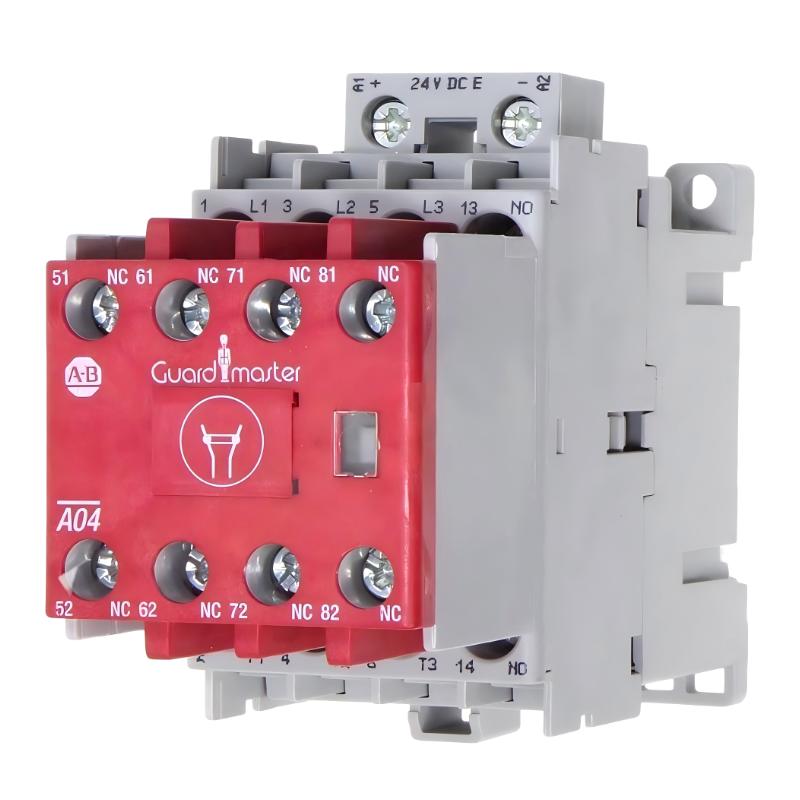
Allen-Bradley 100S-C09EJ14C Fault Troubleshooting Guide (Chattering, Welded Contacts & Safety Trip Issues)
Allen-Bradley 100S-C09EJ14C safety contactor faults are frequently misdiagnosed as mechanical failure. Field data shows most issues originate from coil undervoltage, improper suppression, or excessive switching stress, not internal damage.
Fault Symptoms in Safety Systems
- Contactors chatter during startup
- Failure to fully pull in
- Unexpected safety trip during operation
- Welded contacts after overload event
- Safety PLC reports mismatch between command and feedback
In one automated packaging system, intermittent motor shutdowns were traced to coil voltage dips during multiple machine starts.
Field Diagnostic Logic
1. Coil Voltage Stability Check
- Measure voltage directly across A1/A2 during activation
- Check for voltage dip under load (<20V is critical)
- Inspect shared 24V DC supply capacity
Key insight: Safety contactors are extremely sensitive to transient dips even if average voltage appears correct.
2. Auxiliary Contact Feedback Analysis
- Verify NC feedback loop continuity
- Check mirror contact alignment
- Inspect wiring for loose terminals
A missing NC feedback signal often leads to “false safety fault” alarms even when contactor is functional.
3. Mechanical Wear & Overload Inspection
- Inspect contact pitting or discoloration
- Check thermal overload conditions
- Evaluate switching frequency vs rated duty cycle
Common Failure Modes
Coil Undervoltage (Most Common)
- Symptoms: chatter, weak pull-in
- Fix: improve 24V supply or add buffer power module
Missing Suppression on Coil
- Symptoms: PLC noise, unstable switching
- Fix: add diode or RC snubber
Contact Welding (Severe Fault)
- Symptoms: load remains energized after OFF command
- Cause: overload, arc stress, incorrect protection coordination
- Fix: replace contactor + verify upstream protection
Field Recovery Case Study
Scenario: Safety system failed to shut down conveyor motor during emergency stop.
Diagnosis:
- Coil voltage dropped to 18.9V during E-stop event
- Contact feedback inconsistent with command state
- No suppression diode installed on coil
Corrective Actions:
- Upgraded 24V DC power supply
- Installed coil suppression module
- Rewired safety relay output with proper current margin
Result:
System passed full safety validation; no further chatter or false trips observed.