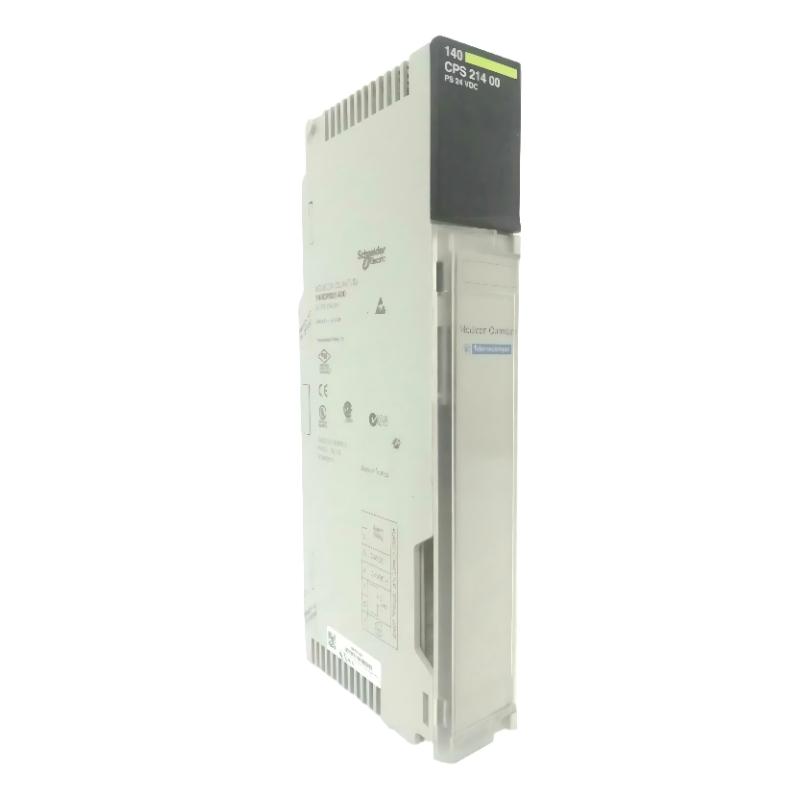
Schneider 140CPS214000 Power Supply Troubleshooting Guide (Rack Power Fault, CPU Reset & Backplane Voltage Drop)
Introduction
Schneider 140CPS214000 troubleshooting cases are frequently misdiagnosed as PSU failure. In real Modicon Quantum systems, most faults are caused by backplane overload, DC input fluctuation, or module-level seating/contact issues, not internal damage.
Because this module powers the entire rack logic rail, even small disturbances can trigger system-wide faults.
Schneider 140CPS214000 Fault Symptoms in Field Systems
Common symptoms include:
- CPU random restart or watchdog reset
- “Power supply fault” relay activation
- I/O modules disappearing intermittently
- Rack fails to initialize after power-up
- System works at idle but fails under load switching
In one chemical dosing system, the rack rebooted every 15–25 minutes during valve actuation cycles.
Schneider 140CPS214000 Diagnostic Thinking Process
Field engineers typically analyze in this order:
- Is DC input stable during load switching events?
- Does backplane voltage collapse under expansion load?
- Are all modules properly seated and latched?
- Is total rack current exceeding design budget?
Observation:
Even though PSU terminals showed stable voltage, backplane 5.1V rail dropped intermittently during analog module scanning peaks.
Schneider 140CPS214000 Case Study: Intermittent Rack Reset
System Configuration:
- Modicon Quantum PLC rack
- CPU + mixed I/O modules
- Single 140CPS214000 power module
- Shared DC supply with solenoid actuators
Symptoms:
- Random CPU reset every 20–40 minutes
- I/O modules temporarily disappearing
- No permanent fault recorded
Diagnostic Findings:
- DC input measured stable at PSU terminals
- Backplane voltage fluctuated during load switching
- Voltage dips correlated with solenoid activation
Root Cause:
- High inrush inductive loads sharing same 24V supply
- DC voltage sag during simultaneous switching events
- Insufficient isolation between control and power loads
Correction:
- Separated solenoid power supply from PLC rack supply
- Added dedicated DC PSU for actuators
- Improved grounding layout
Result:
- Rack stability restored
- No further CPU reset events
- Backplane voltage stabilized under full load
Schneider 140CPS214000 Common Fault Patterns
1. “Rack Power Fault” Alarm
Caused by:
- DC input dips below threshold
- backplane overload
- poor DC wiring resistance
2. Intermittent I/O Dropout
Root causes:
- backplane connector instability
- module seating issues
- transient voltage dips during scan cycle
3. CPU Reset Under Load
Often caused by:
- shared DC supply with inductive loads
- insufficient power budgeting
- simultaneous switching surges
Schneider 140CPS214000 Repair Strategy
Step 1: DC Input Stability Check
Monitor DC input during real load switching, not idle state.
Step 2: Backplane Load Isolation
Remove non-essential I/O modules and test stability incrementally.
Step 3: Mechanical Inspection
Re-seat all modules and verify backplane lock engagement.
Step 4: Power Segmentation Test
Separate control power from actuator power supply lines.
Engineering Insight
In Quantum PLC systems, the 140CPS214000 is rarely the root cause of failure. Most issues originate from system-level DC architecture design flaws, especially when control and power loads are mixed on the same supply.
Final Conclusion
When troubleshooting 140CPS214000 issues:
- Verify DC input stability under dynamic load
- Check backplane voltage behavior
- Inspect module seating and rack integrity
- Evaluate system-level power architecture
In most field cases, stability is restored without replacing the power module.