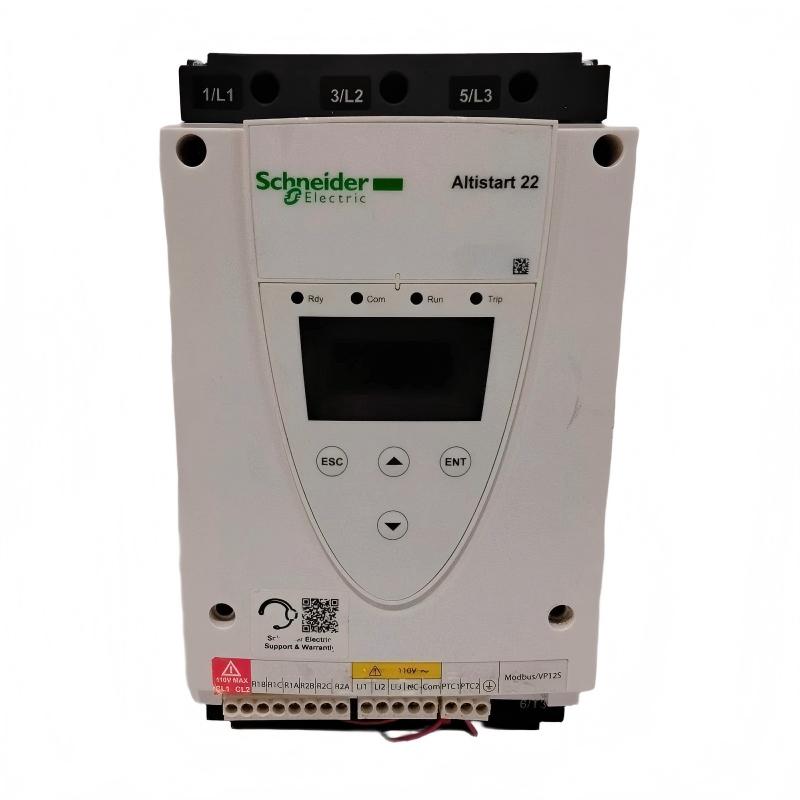
Schneider ATS22D32S6 Fault Troubleshooting Guide (Overcurrent Trip, No Start & Communication Issues)
Schneider ATS22D32S6 faults are frequently misdiagnosed as motor or PLC failures. Field experience shows most issues originate from wiring errors, incorrect parameter settings, or mechanical load problems, not internal device failure.
Fault Symptoms in Field Operation
- Motor does not start after command
- Immediate overcurrent trip at startup
- Excessive acceleration time or stall condition
- Random trip during ramp-up
- Bypass contactor not engaging
In one HVAC system, repeated overcurrent trips were caused by blocked fan blades, not electrical faults.
Field Diagnostic Approach
1. Power Wiring Verification
- Check all three-phase voltages
- Verify phase sequence correctness
- Inspect tightness of terminals
Phase imbalance or loose terminals often cause startup instability.
2. Control Logic Check
- Confirm PLC start signal timing
- Verify 2-wire vs 3-wire configuration
- Check control voltage stability
A misconfigured 2-wire start input caused continuous restart attempts in one conveyor system.
3. Mechanical Load Assessment
- Check motor shaft free rotation
- Inspect pump blockage or valve closure
- Verify coupling condition
Field insight: Many “electrical faults” are actually mechanical overload conditions during startup.
Common Failure Modes
Phase Loss or Incorrect Wiring (Critical)
- Symptoms: instant trip or no start
- Fix: correct wiring and phase sequence
Incorrect Current Setting
- Symptoms: nuisance overload trip
- Fix: set motor In correctly
Mechanical Jam / Overload
- Symptoms: stall during ramp-up
- Fix: reduce load or extend ramp time
Field Recovery Case Study
Scenario: Conveyor motor tripped immediately on every start.
Diagnosis:
- Motor current setting too low
- Phase sequence incorrect after maintenance
- No mechanical fault detected
Corrective Actions:
- Corrected phase wiring
- Updated motor rated current parameter
- Verified startup ramp tuning
Result:
Stable soft start achieved with reduced peak current and no further trips.