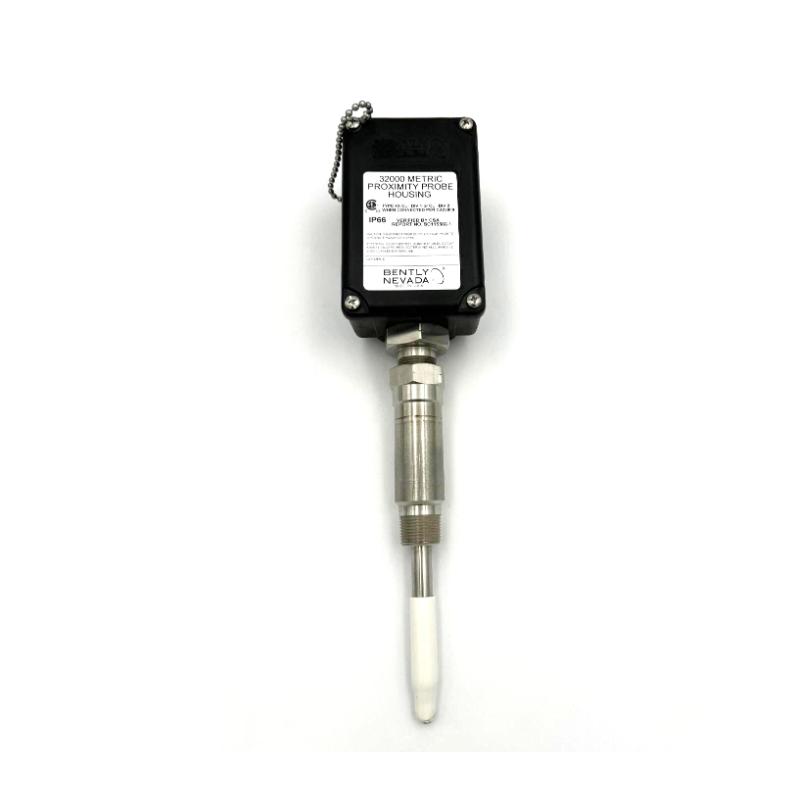
Bently Nevada 32000-28-05-00-100-03-02 Probe Signal Fluctuation Troubleshooting Guide
Bently Nevada 32000-28-05-00-100-03-02 probe signal instability is frequently misdiagnosed as probe failure, while the actual root cause is often mechanical looseness, oil contamination, or improper grounding inside the housing assembly.
Bently Nevada 32000-28-05-00-100-03-02 Fault Symptoms During Machine Operation
Typical field symptoms include:
- Unstable shaft vibration readings
- Sudden gap voltage drift
- Intermittent OK alarm loss
- High-frequency noise spikes
- Startup vibration alarms without actual mechanical vibration increase
One common characteristic is that the monitoring system trend appears unstable while portable vibration analyzers show normal machine behavior.
This mismatch usually indicates a probe housing or signal transmission issue.
Bently Nevada 32000-28-05-00-100-03-02 Fault Diagnosis Logic for Probe Housing Systems
Experienced technicians rarely replace the probe immediately. Instead, they isolate the problem step by step.
First Observation: Trend Characteristics
If the vibration value changes abruptly within milliseconds, electrical interference is more likely.
If the value drifts gradually with temperature rise, mechanical movement inside the housing should be suspected.
Second Observation: Gap Voltage Stability
Measure the probe output directly:
| Condition | Typical Interpretation |
|---|---|
| Stable DC voltage | Probe likely healthy |
| Random fluctuation ±2 V | Cable shielding issue |
| Slow voltage drift | Housing expansion or looseness |
| Output saturation | Probe target too close |
In one refinery compressor system, the gap voltage shifted from -9.8 V to -15.6 V during load increase. The actual cause was not probe failure but thermal movement of the threaded sleeve inside the housing assembly.
Bently Nevada 32000-28-05-00-100-03-02 Mechanical Fault Patterns Found On Site
Several recurring field failure patterns have been observed in proximity probe housing assemblies.
Oil Ingress Inside Housing
Oil contamination can reduce insulation resistance and introduce unstable signals.
Typical indicators:
- Noise spikes during high humidity
- Increased signal instability after shutdown
- Intermittent OK alarm dropout
Recommended action:
- Replace damaged seals
- Clean threaded cavity
- Verify cable gland compression
Probe Sleeve Loosening
High-speed rotating equipment generates continuous micro-vibration.
If locking torque is insufficient:
- Probe gap changes gradually
- Shaft vibration trend slowly increases
- Alarm threshold becomes unstable
In one blower application, vibration rose from 28 μm to 72 μm over three weeks. Inspection revealed slight rotational movement of the probe sleeve caused by repeated thermal cycling.
Improper Ground Shielding
Ground loops remain one of the most common commissioning mistakes.
Typical symptom pattern:
- Noise synchronized with inverter operation
- Stable mechanical vibration but unstable monitor readings
- Multiple channels affected simultaneously
Corrective strategy:
- Ground shield at monitor side only
- Separate signal cable from VFD power cable
- Verify cabinet grounding resistance
After cable rerouting in one turbine control cabinet, peak noise amplitude dropped from 1.8 mils to 0.2 mils immediately.
Bently Nevada 32000-28-05-00-100-03-02 Recovery and Validation Procedure
After corrective actions:
- Recheck probe gap voltage
- Confirm waveform stability
- Observe startup transient behavior
- Compare hot-state and cold-state readings
- Validate monitoring alarms under operating load
Field engineers should avoid closing the work order immediately after signal recovery. Many intermittent faults reappear only after temperature stabilization or load variation.