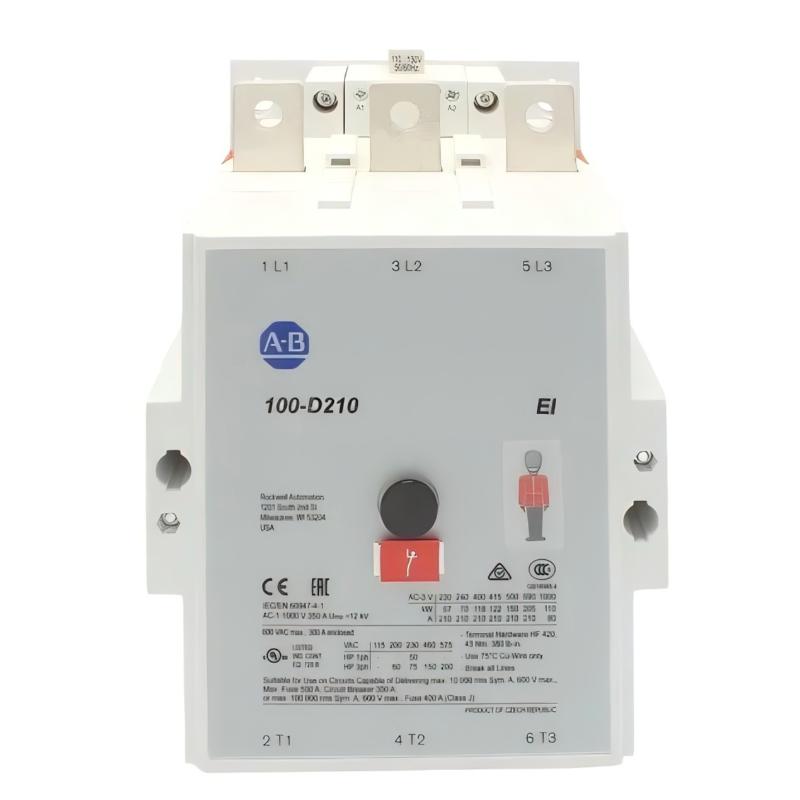
Allen-Bradley 100S-D210EA22BC Fault Troubleshooting Guide (Chatter, Dropout & Safety Trip Issues)
Allen-Bradley 100S-D210EA22BC faults are commonly misdiagnosed as mechanical wear, but field evidence shows most issues come from electrical instability, coil control problems, or feedback loop errors.
Fault Symptoms in Industrial Systems
- Contactor chatter during motor start
- Failure to fully engage (partial pull-in)
- Unexpected safety shutdowns
- Welded contacts after overload
- Safety PLC mismatch between command and feedback
In one mining conveyor system, intermittent shutdowns were traced to voltage dips during multiple motor starts.
Field Diagnostic Method
1. Coil Voltage Behavior Analysis
- Measure voltage directly at A1/A2 during activation
- Look for transient dips below stable threshold
- Check shared DC supply load capacity
A dip of even 10–20% can destabilize large-frame safety contactors.
2. Mechanical Contact Inspection
- Check for pitting or overheating marks
- Inspect contact alignment under wear
- Verify actuation smoothness
3. Safety Feedback Validation
- Confirm NC mirror contact continuity
- Test switching synchronization
- Check wiring integrity in safety loop
A broken NC feedback wire often produces persistent “fault state” in safety PLC even when contactor is healthy.
Common Failure Modes
Coil Undervoltage (Most Frequent)
- Symptoms: chatter, weak engagement
- Fix: improve power supply or isolate loads
Missing Coil Suppression
- Symptoms: electrical noise, unstable switching
- Fix: add diode/RC suppression
Thermal Overload / Contact Wear
- Symptoms: welded contacts or overheating
- Fix: replace contactor and verify load coordination
Field Recovery Case Study
Scenario: Conveyor motor failed to start intermittently under load.
Diagnosis:
- Coil voltage dropped to 18.7V during startup
- Two large motors shared same control transformer
- No suppression installed on coil circuit
Corrective Actions:
- Upgraded control power supply
- Installed suppression module
- Separated motor start sequence
Result:
Stable operation restored; no further chatter or false safety trips.