Humanoid Robots Move Closer to Industrial Applications as Manufacturers Explore Flexible Automation
AI Robotics, Machine Vision and Intelligent Motion Control Could Create a New Generation of Flexible Factory Automation
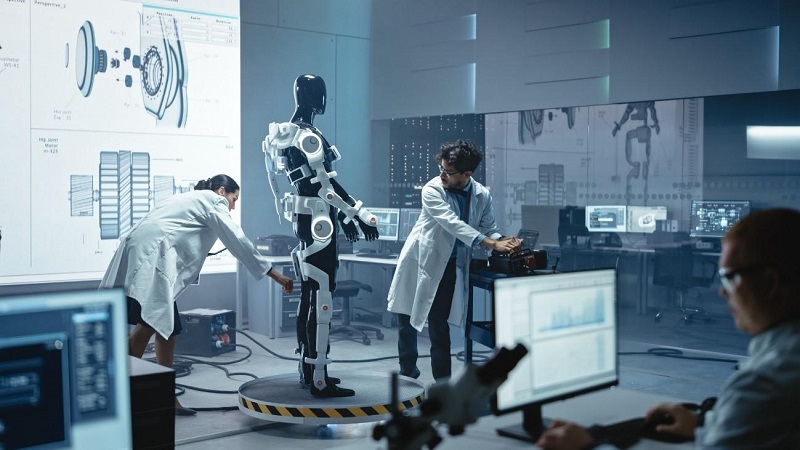
Humanoid robotics is entering a new stage of development as manufacturers and robotics companies increasingly focus on practical industrial applications.
The technology has attracted significant attention because humanoid robots are designed to interact with environments originally created for people.
Instead of requiring completely specialized production infrastructure, humanoid robots could potentially perform certain tasks in existing factories and warehouses.
At the 2026 World Robot Conference in Beijing, more than 300 companies showcased over 2,000 robotics exhibits, including more than 150 product launches. Demonstrations included humanoid robots performing tasks such as parcel sorting and electronics assembly.
The development is important for the industrial automation sector because humanoid robots could eventually become another component of the factory automation ecosystem.
However, significant engineering and commercial challenges remain before large-scale industrial deployment becomes widespread.
Why Humanoid Robots Are Attracting Industrial Interest
Traditional industrial robots are highly effective when operating in structured environments.
A six-axis robot can perform repetitive tasks with high accuracy and speed.
However, traditional robotic systems often require specialized workcells.
The robot, tooling, fixtures and safety systems are designed around a specific application.
Humanoid robots take a different approach.
Their human-like structure could allow them to perform tasks in spaces designed for human workers.
Potential applications include:
- Material handling
- Component transportation
- Warehouse operations
- Assembly support
- Product inspection
- Repetitive manual tasks
The ability to operate in existing environments could become an important advantage.
AI Is Driving Humanoid Robotics Development
Humanoid robots require a high level of environmental awareness.
A conventional industrial robot may operate according to fixed coordinates.
A humanoid robot may encounter changing conditions.
Objects can move.
People can enter the workspace.
Lighting can change.
Materials may appear in different positions.
Artificial intelligence can help robots interpret these environments.
AI technologies can support:
- Object recognition
- Environment perception
- Task planning
- Movement planning
- Decision-making
This makes humanoid robotics closely connected with the development of physical AI.
Machine Vision Is Essential for Flexible Robots
A humanoid robot needs to understand what is around it.
Machine vision provides information about:
- Objects
- Components
- Workers
- Obstacles
- Production areas
Industrial vision can support applications such as:
- Component identification
- Product inspection
- Object picking
- Assembly
- Workspace navigation
The integration of vision and motion control is particularly important.
Recognizing an object is only the first step.
The robot must then determine how to reach, grasp and manipulate it.
PLC Systems Will Continue to Play a Role
The rise of humanoid robotics does not mean that PLC systems will disappear.
Instead, humanoid robots may be integrated into existing automation architectures.
A future production environment could include:
- PLC controllers
- Industrial robots
- Humanoid robots
- Sensors
- Machine vision
- Servo drives
- Safety controllers
- Industrial networks
- Edge computers
PLC systems can continue coordinating machine sequences while intelligent robotic platforms perform flexible tasks.
Communication between the robot and the control system will therefore be important.
Industrial Communication Enables Robot Integration
Humanoid robots operating in factories will need to exchange information with surrounding equipment.
A production system may need to communicate:
- Machine status
- Production requirements
- Component availability
- Safety conditions
- Task completion
Industrial communication technologies can provide the connection between robotic systems and factory control platforms.
This creates new requirements for automation engineers.
They may need to integrate robotic systems with PLCs, HMIs, vision systems and manufacturing software.
Safety Is One of the Biggest Challenges
Industrial environments contain moving machinery and heavy equipment.
Workers may operate close to automated systems.
Humanoid robots therefore need sophisticated safety capabilities.
Potential technologies include:
- Collision detection
- Human detection
- Emergency stopping
- Safe motion control
- Real-time environment monitoring
The ability to operate safely around people will be critical for industrial adoption.
A robot that performs a task accurately but cannot operate safely in a real factory will have limited commercial value.
Humanoid Robots Could Complement Traditional Robots
The development of humanoid robotics should not necessarily be viewed as a replacement for conventional industrial robots.
Different technologies are suitable for different tasks.
Traditional industrial robots may remain highly effective for:
- High-speed welding
- Precision assembly
- Repetitive pick-and-place
- Painting
- High-volume production
Humanoid robots may be more useful where flexibility is important.
This could result in factories using multiple types of robotic systems.
Logistics Could Become an Early Application
Material handling and logistics are potential areas for humanoid robot deployment.
Factories and warehouses contain many repetitive activities.
Workers may need to:
- Move containers
- Sort products
- Deliver components
- Load materials
- Transfer items between workstations
Some of these tasks are repetitive but occur in environments designed for humans.
Humanoid robots could potentially perform selected operations without requiring major changes to the surrounding environment.
The Commercial Challenge Remains Significant
Strong interest in humanoid robotics does not guarantee rapid industrial adoption.
Manufacturers need measurable benefits.
A production robot must demonstrate:
- Reliable operation
- Competitive cost
- High availability
- Safe operation
- Simple maintenance
- Efficient deployment
Industrial customers typically evaluate equipment based on long-term performance.
A successful demonstration is different from operating reliably for thousands of hours in a production environment.
The transition from demonstration to dependable industrial operation will therefore be one of the most important stages in humanoid robotics development.
China Is Becoming an Important Robotics Market
The 2026 World Robot Conference in Beijing demonstrated the scale of China's robotics industry.
More than 300 companies participated and showcased thousands of robotics exhibits.
The event included numerous product launches and demonstrations of humanoid robots performing practical tasks.
China's large manufacturing base provides a major environment for robotics development and industrial testing.
If humanoid robots can demonstrate reliable performance in Chinese manufacturing environments, industrial deployment could accelerate.
New Opportunities for Automation Suppliers
Humanoid robotics could create opportunities beyond robot manufacturers.
Future robotic systems may require:
- Servo motors
- Servo drives
- Encoders
- PLC controllers
- Industrial communication modules
- Safety systems
- Machine vision sensors
- Edge computing hardware
This means the growth of humanoid robotics could also influence the wider industrial automation supply chain.
Suppliers of control components and motion technologies may become part of the new robotic ecosystem.
The Role of Edge Computing
Humanoid robots may need to process large amounts of information.
Some decisions can be handled locally through onboard computing.
Other information may be processed through industrial edge systems.
Edge computing can support:
- Real-time data analysis
- Machine vision
- Equipment monitoring
- Production optimization
Local processing can also reduce communication delays.
This is particularly important for applications where rapid response is required.
Future Factory Automation Could Become More Flexible
Traditional automation is often optimized for repeatability.
The next generation of automation may place greater emphasis on flexibility.
Humanoid robots could potentially support production environments where:
- Products change frequently
- Workstations are shared
- Production volumes vary
- Manual tasks remain difficult to automate
Combined with AI, machine vision and industrial control systems, humanoid robots could become another tool for flexible manufacturing.