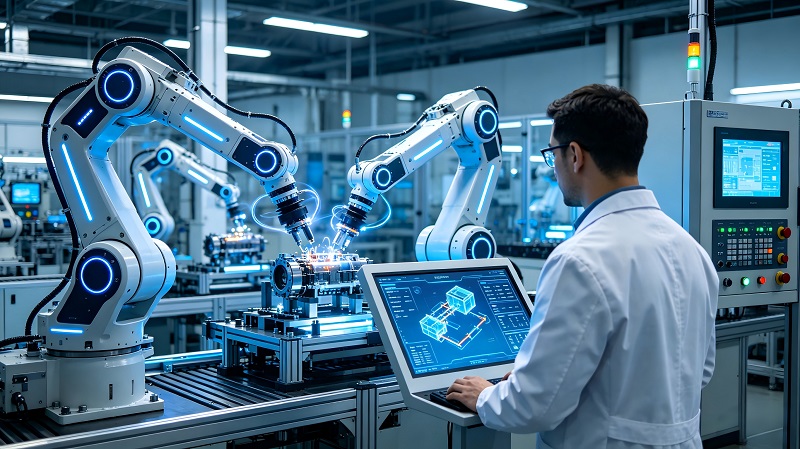
ABB Robotics and Automation Technologies Support Flexible Manufacturing Transformation
Industrial Robots, Motion Control Systems and Intelligent Automation Solutions Improve Factory Efficiency
The manufacturing industry is experiencing rapid transformation as companies search for more flexible, efficient and intelligent production methods.
Traditional production models based on fixed automation are gradually changing.
Manufacturers increasingly require systems that can quickly adapt to new products, changing market demands and shorter production cycles.
ABB continues developing robotics and automation technologies that support flexible manufacturing.
The combination of industrial robots, motion control systems, digital monitoring platforms and intelligent automation technologies is helping companies improve productivity while maintaining high levels of quality.
Modern factories require automation solutions that can provide:
- High production efficiency
- Flexible operation
- Reliable performance
- Data visibility
- Reduced downtime
Robotics and automation are becoming essential technologies for future manufacturing.
Industrial Robots Become More Flexible
Industrial robots have traditionally been used for repetitive manufacturing tasks.
Common applications include:
- Welding
- Painting
- Assembly
- Material handling
- Packaging
However, modern manufacturing requires greater flexibility.
Factories increasingly produce multiple product versions and smaller production batches.
This requires robots that can be easily programmed and integrated into changing production environments.
Advanced robotic systems provide:
- Faster programming
- Improved accuracy
- Better communication
- Higher flexibility
Motion Control Improves Manufacturing Precision
Motion control technology plays a critical role in industrial automation.
Servo systems allow machines to achieve:
- Accurate positioning
- Smooth movement
- High-speed operation
- Better synchronization
Applications include:
- Packaging machinery
- Electronic assembly
- Precision manufacturing
- Robotics
The combination of PLC systems and motion control creates highly coordinated automation solutions.
Digital Automation Improves Equipment Monitoring
Modern factories generate large amounts of operational data.
Automation systems collect information from:
- Robots
- Controllers
- Sensors
- Drives
- Production equipment
This information helps companies understand:
- Machine performance
- Production efficiency
- Maintenance requirements
Digital monitoring improves decision-making and helps reduce production risks.
Predictive Maintenance Reduces Downtime
Unexpected equipment failures can significantly affect manufacturing operations.
Predictive maintenance uses equipment data to identify potential problems.
Monitoring systems analyze:
- Operating conditions
- Motor performance
- Temperature
- Machine cycles
Benefits include:
- Reduced downtime
- Lower maintenance costs
- Improved reliability
Predictive maintenance is becoming a standard strategy in modern factories.
Robotics Integration Requires Advanced Control Systems
Industrial robots are not independent systems.
They must communicate with:
- PLC controllers
- HMIs
- Safety systems
- Sensors
- Manufacturing software
Automation engineers must design systems where different technologies work together.
This requires knowledge of:
- Industrial communication
- Programming
- Motion control
- Safety engineering
Flexible Manufacturing Becomes More Important
Market conditions are changing rapidly.
Manufacturers need production systems that can adapt quickly.
Flexible automation allows companies to:
- Change products faster
- Reduce setup time
- Improve efficiency
Robotics technology provides an important solution for flexible manufacturing.
Future Development of Industrial Robotics
Future industrial robots will become more intelligent through:
- Artificial intelligence
- Machine vision
- Advanced sensors
- Digital connectivity
Robots will become easier to program and more capable of handling complex tasks.
The combination of robotics and automation software will shape future factories.