IMI Expands Industrial Asset Monitoring With SolidRed Cloud for Predictive Maintenance
IMI has expanded its SolidRed asset monitoring platform with a new cloud-based offering designed to make industrial asset condition monitoring more accessible to sites where traditional on-premises deployment may not be practical.
The new SolidRed Cloud offering, announced in September 2026, provides a centralized environment for monitoring data from IMI TWTG NEON IIoT sensors. The platform is designed to help industrial operators gain greater visibility into equipment condition, investigate potential faults and support predictive maintenance decisions.
The development reflects a broader transformation in industrial maintenance. Instead of relying only on scheduled maintenance intervals or responding after equipment failure, manufacturers are increasingly using continuous condition data to identify changes in equipment behavior before they develop into major problems.
From Preventive Maintenance to Condition-Based Maintenance
Traditional preventive maintenance is generally based on time or operating hours.
A pump might be serviced every six months. A valve might be inspected according to a predefined maintenance schedule. A rotating machine might be checked after a certain number of operating hours.
This approach is straightforward, but it has limitations.
Equipment does not necessarily degrade according to a fixed schedule.
One machine may operate for years without significant deterioration, while another exposed to harsher operating conditions may develop problems much earlier.
Condition-based maintenance approaches the problem differently.
Instead of assuming when maintenance will be required, the system monitors actual equipment condition.
Changes in vibration, temperature, pressure or other measurable parameters can provide information about developing equipment problems.
SolidRed Cloud Brings Condition Data Into One Environment
IMI says SolidRed Cloud provides a consolidated environment for managing and visualizing data from its TWTG NEON IIoT sensors.
This is important because industrial condition monitoring can become complicated when sensor data is distributed across multiple systems.
A maintenance team may have separate information sources for pumps, valves, compressors, motors and other equipment.
A centralized monitoring environment can make it easier to compare information and identify equipment requiring further investigation.
The objective is not simply to collect more data.
The real value comes from turning condition data into useful maintenance information.
IIoT Sensors as the Data Collection Layer
Industrial IoT sensors form the foundation of many modern condition-monitoring systems.
A sensor can continuously measure a physical characteristic of equipment and transmit the resulting information to a monitoring platform.
Depending on the equipment and sensor type, relevant parameters may include vibration, temperature or other indicators of operating condition.
The sensor therefore becomes the connection between the physical asset and the digital maintenance system.
For a pump, for example, changes in vibration may indicate mechanical deterioration.
For a rotating machine, temperature changes can provide another indication of abnormal operation.
For other equipment, different parameters may be more useful.
The important point is that condition monitoring should be based on measurements that have a meaningful relationship with equipment health.
Cloud Monitoring Reduces Infrastructure Requirements
One of the key objectives of SolidRed Cloud is to reduce the infrastructure, installation and integration requirements associated with traditional on-premises deployment.
Traditional industrial monitoring systems can require dedicated servers, local software installation, network infrastructure and engineering resources.
For large plants, these investments may be justified.
For smaller sites or facilities with limited IT resources, however, the infrastructure requirement can become a barrier to implementing advanced asset monitoring.
A cloud-based architecture can reduce some of these requirements by moving parts of the software and infrastructure environment away from the individual plant.
This can make condition monitoring easier to deploy across sites with different levels of technical infrastructure.
Predictive Maintenance Depends on Data Quality
Cloud technology alone does not create predictive maintenance.
The quality and relevance of the collected data remain fundamental.
A predictive maintenance system needs reliable measurements, appropriate sampling strategies and sufficient historical information to understand normal equipment behavior.
Maintenance teams also need operational context.
For example, vibration measurements from a pump can vary according to speed, load, flow rate and operating condition.
An increase in vibration may be significant under one operating state but normal under another.
Therefore, industrial asset monitoring should not treat every change in sensor data as a failure prediction.
Contextual interpretation is essential.
Fault Investigation Becomes More Data-Driven
Condition monitoring is useful not only for predicting future failures.
It can also support fault investigation.
When an equipment problem occurs, maintenance engineers need to understand what changed and when.
Historical sensor data can provide a timeline of equipment behavior.
A maintenance team may be able to identify whether a parameter gradually changed over several weeks or whether an abnormal event occurred suddenly.
This information can help engineers determine the likely sequence of events.
It can also improve communication between operations and maintenance departments because discussions can be based on measured equipment behavior rather than assumptions alone.
Supporting Remote Industrial Operations
Cloud-based monitoring is particularly relevant to industrial sites where maintenance teams are not permanently located next to every asset.
Large industrial organizations may operate multiple plants, remote facilities or geographically distributed equipment.
A centralized monitoring environment can allow authorized personnel to review equipment condition without physically visiting every location.
This can be valuable for facilities where travel is difficult or where specialist engineers are shared across multiple sites.
Remote visibility does not eliminate the need for physical inspection and maintenance, but it can help maintenance teams prioritize where their attention is required.
Asset Monitoring and Maintenance Prioritization
Not every asset in a plant has the same criticality.
A failure in a non-critical auxiliary pump may have limited consequences.
A failure in a critical process compressor could result in major production losses.
Condition monitoring can help organizations prioritize maintenance resources by providing information about equipment condition.
If multiple assets are being monitored, maintenance teams can focus on equipment showing abnormal trends rather than inspecting every machine with the same frequency.
This can make maintenance programs more targeted.
Integration With Existing Industrial Automation
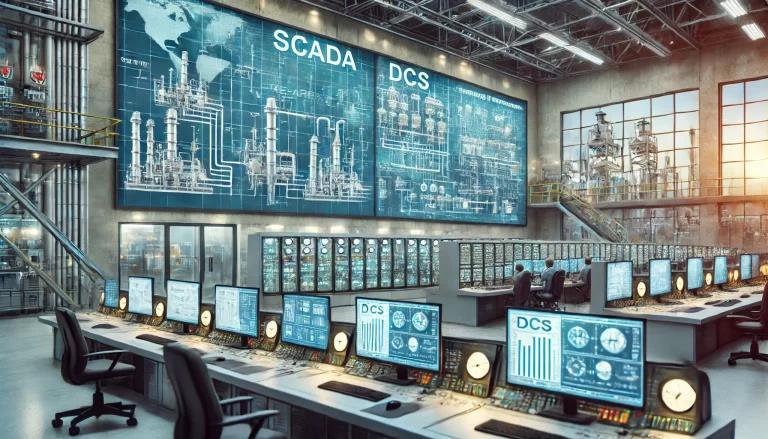
Asset monitoring systems do not necessarily need to replace existing PLC, DCS or SCADA infrastructure.
In many applications, condition monitoring can operate alongside the primary control system.
The PLC or DCS continues performing deterministic process control, while IIoT sensors provide additional information for equipment health analysis.
This separation can be useful because maintenance analytics often require a different data resolution and time horizon from process control.
A control system may need a sensor value every second or faster for operational control.
A condition-monitoring application may need high-frequency vibration data for a completely different purpose.
Using specialized monitoring infrastructure can therefore complement the existing automation architecture.
Cybersecurity and Cloud Connectivity
Moving industrial condition data into cloud environments also introduces cybersecurity considerations.
Industrial operators need to understand what data leaves the plant, how communications are protected, who can access the information and how cloud services are managed.
Network architecture should separate critical control functions from external services where appropriate.
The monitoring system should also follow organizational policies regarding authentication, access control, software updates and data management.
Cloud monitoring can simplify infrastructure requirements, but it does not remove the responsibility for secure industrial connectivity.
Why Asset Monitoring Is Becoming More Important
Modern industrial facilities are under pressure to improve equipment availability while controlling maintenance costs.
Unplanned downtime can be expensive, especially for continuous-process industries.
At the same time, excessive preventive maintenance can increase labor requirements and result in unnecessary replacement of components that still have useful service life.
Condition monitoring provides a way to make maintenance decisions based more directly on actual equipment behavior.
This is one reason IIoT-based monitoring is becoming increasingly common in industrial environments.
The objective is not simply to install more sensors.
The objective is to create a maintenance process in which equipment data supports better engineering decisions.
The Future of Predictive Maintenance
The combination of IIoT sensors, cloud platforms, analytics and industrial expertise is creating a more connected maintenance model.
In the future, maintenance systems are likely to become increasingly capable of identifying abnormal trends automatically and prioritizing assets based on risk.
However, human engineering expertise will remain important.
An algorithm can identify a change in vibration, but an experienced engineer still needs to determine whether that change represents bearing deterioration, imbalance, misalignment, process variation or another condition.
The strongest predictive maintenance programs therefore combine automated monitoring with practical equipment knowledge.
Conclusion
IMI's expansion of SolidRed with a cloud-based asset monitoring offering demonstrates how industrial condition monitoring is becoming easier to deploy across different types of facilities.
By consolidating data from TWTG NEON IIoT sensors into a cloud environment, SolidRed Cloud is designed to provide greater visibility into asset condition while reducing some of the infrastructure requirements associated with traditional on-premises systems.
For industrial operators, the value lies in using equipment data to support earlier fault detection, better maintenance prioritization and more informed decisions.
As factories and process plants continue to adopt IIoT technologies, cloud-based condition monitoring is likely to become an increasingly important part of predictive maintenance strategies.