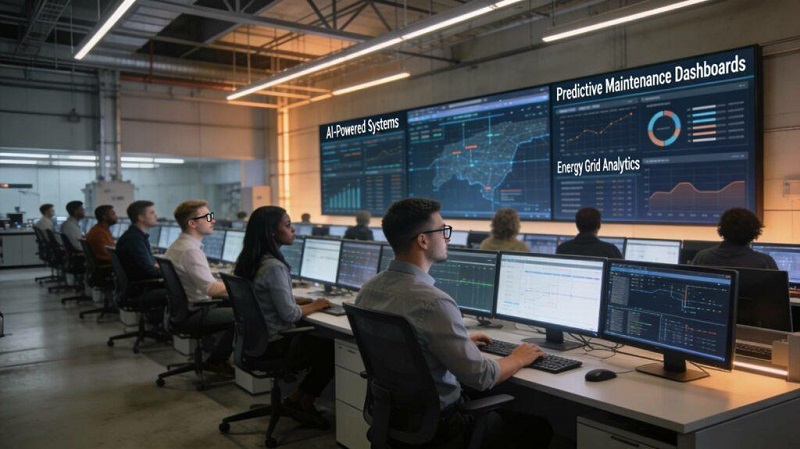
# Schneider Electric Emerges as an Industrial AI Dark Horse with Its $22.6 Billion PTC Acquisition Schneider Electric is making a bold move to strengthen its position in industrial software, artificial intelligence, and next-generation manufacturing. The company's announced acquisition of PTC, a US-based industrial software provider, marks a major strategic step that could reshape how manufacturers connect product design, factory automation, and operational intelligence. For years, Schneider Electric has been widely recognized for its expertise in energy management, electrical distribution,
HIMA Group is strengthening its position in industrial safety automation as manufacturers, energy companies, and railway operators face growing demands for operational reliability, cybersecurity, and digital transformation. With its established expertise in functional safety and an expanding portfolio of digital solutions, the German company is evolving beyond traditional safety controllers toward a broader role as a technology partner for safety-critical industries.
In 2026, HIMA announced several important developments, including the launch of HIMA Digital, continued international expansion, and new railway safety solutions presented at InnoTrans 2026. These initiatives demonstrate how the company is connecting its established safety engineering capabilities with digital platforms, secure industrial communications, and modern infrastructure requirements.
For process industries operating oil and gas facilities, chemical plants, power generation systems, and other safety-critical installations, this evolution reflects an important market trend: industrial safety is increasingly being managed as a complete lifecycle rather than as an isolated hardware function.
HIMA Expands Beyond Traditional Safety Controllers
Functional safety has long been central to HIMA's business. Its technologies are designed to help industrial operators reduce risks associated with hazardous processes, protect personnel and equipment, and support safe plant operation.
In a conventional industrial architecture, a safety instrumented system (SIS) monitors defined process conditions and initiates protective actions when predetermined safety limits are reached. These actions may include shutting down equipment, isolating a process section, or moving a system to a defined safe state.
Safety instrumented systems are particularly important in industries where equipment failures or abnormal process conditions can have serious consequences.
However, industrial requirements are changing. Operators increasingly need safety systems that can integrate with plant monitoring, maintenance workflows, asset management, and cybersecurity infrastructure while maintaining the independence and reliability required for safety functions.
HIMA's strategy addresses this shift by combining safety-related automation with digital services, lifecycle support, and operational technology security.
Its portfolio includes established safety system families such as HIMax and HIMatrix, alongside engineering and digital solutions intended for different industrial applications. These technologies support the company's broader focus on functional safety across the process and rail sectors.
The opportunity is to help customers modernize existing installations while maintaining the operational continuity expected from critical infrastructure.
HIMA Digital Supports the Company's Digital Transformation Strategy
One of HIMA's notable developments in 2026 was the introduction of HIMA Digital, a business unit focused on expanding the group's digital capabilities.
Announced in connection with the development of HIMA's Scandinavian operations, HIMA Digital builds on digital platform expertise associated with Origo Solutions, including SCADA+ technology, together with HIMA's long-standing safety engineering experience.
The initiative supports the company's broader strategy of connecting safety-related information, digital applications, and services across the safety lifecycle.
For industrial operators, digitalization can improve the accessibility of operational information and help maintenance teams identify potential problems earlier. It can also support more structured management of engineering changes, system documentation, and long-term asset performance.
A digital safety strategy may include centralized information management, improved system diagnostics, secure access to relevant operational data, and tools for supporting maintenance and lifecycle planning.
These capabilities can be particularly valuable for organizations managing multiple plants, geographically distributed infrastructure, or equipment installed over several decades.
Nevertheless, digitalization must be implemented carefully. Safety-related control functions cannot simply be treated like ordinary business software. Any changes to a safety system must follow appropriate engineering, validation, configuration management, and cybersecurity procedures.
HIMA's challenge—and opportunity—is to deliver digital capabilities that improve industrial visibility without compromising the integrity of safety-critical functions.
Industrial Safety and OT Cybersecurity Are Increasingly Connected
Operational technology cybersecurity has become a major concern for industrial organizations.
Modern plants depend on increasingly interconnected networks that link controllers, engineering workstations, supervisory systems, remote maintenance tools, and enterprise applications. These connections can improve efficiency, but they also introduce additional security considerations.
A cybersecurity incident affecting an industrial environment may disrupt production, interfere with equipment monitoring, or prevent operators from accessing essential information. In safety-critical facilities, the potential consequences can extend beyond financial losses.
HIMA therefore emphasizes the relationship between functional safety and OT security.
Functional safety focuses on reducing unacceptable risks arising from hazardous system behavior. Cybersecurity focuses on protecting systems against unauthorized access, manipulation, disruption, and other malicious activity. Although they address different risks, they must be considered together in modern industrial architectures.
Practical measures can include network segmentation, controlled remote access, secure engineering practices, account management, change control, and continuous review of system configurations.
Industrial operators should also consider the relationship between safety controllers and surrounding systems. A safety controller may be designed to perform a specific protective function, but the wider architecture—including engineering tools, communication paths, and maintenance procedures—still requires appropriate protection.
HIMA's cooperation with cybersecurity specialists, including genua, reflects the growing demand for solutions that address both safety and secure connectivity.
For customers, the objective is not simply to add more security products. It is to develop an architecture in which cybersecurity measures support safe, reliable, and maintainable plant operation throughout the equipment lifecycle.
HIMax and HIMatrix Remain Relevant to Process Automation
Despite the growing emphasis on digital solutions, safety controllers remain essential components of many industrial systems.
HIMA's HIMax and HIMatrix product families serve different safety automation requirements. Their suitability for a specific application depends on factors such as system architecture, required safety integrity, I/O requirements, application logic, environmental conditions, and integration constraints.
HIMax is associated with high-availability safety automation applications, including demanding process industry installations. HIMatrix provides safety-related automation options for applications where its configuration and capabilities meet the project's requirements.
Typical applications for safety controllers include emergency shutdown systems, burner management, turbine protection, compressor protection, and other functions where an independently engineered safety response is required.
The correct design depends on a formal risk assessment and the applicable safety lifecycle requirements. A controller should never be selected solely on the basis of its product family name or nominal processing capabilities.
Engineers must verify the required Safety Integrity Level (SIL), hardware and software configuration, approved application conditions, communication interfaces, and system compatibility.
For existing installations, long-term availability of spare parts and engineering support is also important. A replacement controller or module must be checked against the installed system's hardware revision, firmware, configuration, and certification requirements.
As industrial facilities adopt more digital technologies, established safety platforms will continue to play an important role in protecting critical processes.
HIMA Strengthens Its Position in Digital Railway Systems
HIMA's expertise extends beyond process automation into railway safety.
At InnoTrans 2026, held in Berlin in September, HIMA Group presented solutions covering rolling stock, signalling, railway infrastructure, SCADA, and cybersecurity. The portfolio demonstrates the group's efforts to support the digital modernization of railway systems.
One of the featured developments was TrackLink 4, introduced by HIMA's rail competence center, Sella Controls.
TrackLink 4 is designed for safety-related communication between trains and trackside infrastructure. According to HIMA, the platform supports SIL 2-certified applications and includes Ethernet connectivity, modular protocol integration, expanded safety I/O, and operation at speeds exceeding 200 km/h.
The system is intended for applications such as selective door operation, power changeover, and overspeed prevention, subject to the specific application design and certification requirements.
HIMA also highlighted its wider railway safety capabilities, including technologies supporting signalling, traction power control, infrastructure monitoring, and SCADA applications.
These developments reflect a wider trend across the railway industry. Operators are seeking to modernize existing infrastructure while improving availability, operational efficiency, cybersecurity, and long-term maintainability.
Digital railway systems require more than communication connectivity. They also need dependable safety architectures, clearly defined system boundaries, and engineering processes that support safe integration between onboard equipment and trackside infrastructure.
HIMA's combination of industrial safety expertise and railway technology positions it to address these requirements across several parts of the railway lifecycle.
International Expansion Supports Long-Term Growth
HIMA continued to expand its international presence in 2026, reinforcing its ambition to serve customers across a wider range of industrial markets.
The group reported that 2025 revenue increased by 2.4% to €190.5 million despite challenging market conditions. International business contributed significantly to this performance, while subdued investment in parts of the process industry affected order intake.
In March 2026, HIMA announced the official opening of new entities in Colombia and Peru, strengthening its presence in Latin America. The company also expanded its regional infrastructure in Australia, announcing a new regional head office in Perth in September 2026.
These developments are relevant because safety automation projects often require more than equipment supply. Customers may need application engineering, commissioning assistance, technical training, spare parts, lifecycle services, and support for local regulatory requirements.
A stronger regional presence can help suppliers respond more effectively to these needs.
HIMA's expansion also reflects opportunities associated with energy infrastructure, process plant modernization, renewable energy, pipeline development, and railway investment.
At the same time, international growth brings challenges. Industrial projects can be affected by investment delays, exchange-rate movements, geopolitical uncertainty, and differences in local technical requirements. Continued growth will depend on the company's ability to maintain technical quality and provide reliable customer support across different markets.
What HIMA's Strategy Means for Industrial Buyers
For industrial buyers, HIMA's development highlights several considerations when evaluating safety automation solutions.
First, functional safety should be treated as a lifecycle responsibility. The initial controller purchase is only one part of the overall investment. Engineering, validation, documentation, proof testing, maintenance, and future modifications all influence long-term system performance.
Second, cybersecurity requirements should be included early in project planning. Remote access, network architecture, user permissions, and configuration management need to be addressed alongside safety requirements.
Third, compatibility must be verified when maintaining existing installations. Buyers should confirm exact product numbers, hardware revisions, firmware versions, approved configurations, and replacement requirements before ordering safety-related components.
Fourth, digital integration should be based on clearly defined operational objectives. Improved diagnostics, centralized information access, and more efficient maintenance can provide value, but integration must not introduce unacceptable risks to independent safety functions.
Finally, suppliers should be evaluated on their ability to support the complete installation lifecycle. Technical documentation, spare-part availability, engineering expertise, and a clear modernization path can be just as important as the capabilities of a new product.
For system integrators and industrial equipment suppliers, these requirements create opportunities to support customers with verified components, engineering coordination, lifecycle planning, and carefully managed upgrades.
The Future of HIMA in Industrial Automation
The industrial safety market is changing as digitalization, cybersecurity, and infrastructure modernization become increasingly interconnected.
HIMA's recent initiatives show a strategy built around established functional safety expertise while expanding into digital services, OT security, and railway technology.
The introduction of HIMA Digital, the development of its international operations, and the TrackLink 4 launch demonstrate how the group is seeking to respond to evolving customer requirements.
However, digital transformation in safety-critical industries must be measured by practical results. New platforms and connected services need to demonstrate that they can improve maintenance, operational visibility, and lifecycle efficiency while preserving the reliability and independence of safety functions.
For process industry operators, the continued development of safety controllers and digital lifecycle tools could support more structured modernization strategies. For railway operators, certified safety technologies and secure communication solutions may help enable the next generation of connected rail infrastructure.
HIMA's long-term opportunity lies in combining these capabilities into dependable, interoperable solutions for industries where safety cannot be compromised.
Conclusion
HIMA is strengthening its position in industrial safety automation through a combination of functional safety engineering, digitalization, OT cybersecurity, and railway technology.
Its 2026 developments highlight a broader shift in the automation industry: safety systems are becoming part of more connected industrial environments, but their essential requirements for reliability, validation, and controlled operation remain unchanged.
For customers operating PLC-based safety systems, safety instrumented systems, or railway infrastructure, HIMA's strategy is worth watching as the company expands its digital portfolio and international reach.
As industrial organizations modernize critical infrastructure, demand for dependable safety automation, secure connectivity, and lifecycle support is likely to remain an important part of long-term investment planning.