ABB Highlights International Standards and AI Innovation to Accelerate Industrial Transformation
ABB has highlighted the importance of international standards and artificial intelligence (AI) in accelerating industrial innovation and supporting the global development of advanced manufacturing. The company shared its perspectives at a sub-forum of the 9th Hongqiao International Economic Forum, held in Shanghai on November 5, 2026.
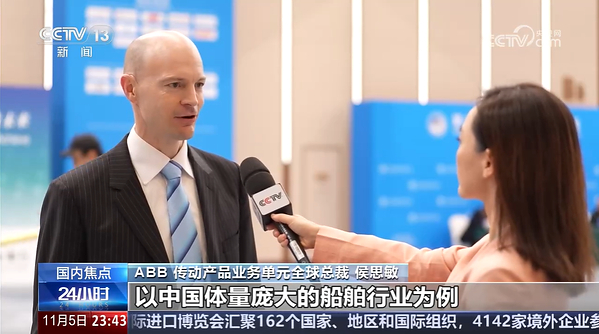
Tuomo Hoysniemi, President of ABB's Drive Products business, participated in a roundtable discussion titled "Strengthening International Standards Cooperation and Empowering Industrial Upgrading Through Artificial Intelligence."
The discussion focused on how international standards can support technological innovation, facilitate industrial cooperation, and accelerate the practical application of emerging technologies such as AI.
For industrial automation manufacturers and equipment suppliers, the discussion highlights two increasingly important factors in global competition: compliance with internationally recognized technical standards and the ability to translate digital innovation into reliable industrial applications.
International Standards Build Bridges for Global Industrial Cooperation
As industrial supply chains become increasingly interconnected, international standards play a critical role in ensuring product compatibility, safety, reliability, and regulatory compliance across different markets.
For automation equipment manufacturers, compliance with relevant standards is particularly important when supplying products to overseas customers.
Electrical drives, motors, control systems, and industrial equipment must often meet different certification and technical requirements depending on their intended markets and applications.
During the forum, ABB emphasized that international standards provide a common technical language for manufacturers, customers, and partners across different countries. They help reduce technical barriers, establish confidence in product performance, and create a more predictable environment for international cooperation.
ABB Drive Products has developed products for global markets with certifications covering several major international requirements, including:
CE: Conformity with applicable European Union product legislation.
UL: Certification and safety requirements relevant to the North American market.
ATEX: Requirements for equipment intended for use in potentially explosive atmospheres.
These certifications and compliance capabilities are important for Chinese original equipment manufacturers (OEMs) seeking to expand internationally.
By selecting appropriately certified automation components, OEMs can better address destination-market compliance requirements and reduce the additional engineering and certification work that may otherwise be necessary.
However, certification requirements remain dependent on the specific product model, configuration, intended application, and target market. Manufacturers must verify the applicable certificates and technical documentation before exporting equipment.
ABB Strengthens Digital Verification in Industrial Product Inspection
In addition to product certification, ABB is applying digital technologies to improve industrial inspection and verification processes.
One example comes from the marine industry.
In June 2026, ABB obtained China's first Level 3 (L3) recognition certificate for a digital application in the inspection of marine electrical drive products, issued by the China Classification Society (CCS).
The digital application enables production and testing data to connect directly with the classification society's official system.
This approach supports automated inspection workflows and end-to-end data traceability, helping improve the transparency and efficiency of product inspection and verification.
For marine electrical equipment manufacturers, digital inspection processes can reduce reliance on traditional paper-based documentation while providing a more structured way to manage technical records.
The development also demonstrates how industrial digitalization can extend beyond production operations into quality assurance, certification, and product lifecycle management.
As industrial equipment becomes more connected, the integration of manufacturing data, inspection records, and certification systems is expected to become increasingly important.
AI Creates New Opportunities for Industrial Automation
Artificial intelligence is becoming an important driver of industrial transformation, with potential applications ranging from engineering design and equipment configuration to fault diagnosis and predictive maintenance.
In industrial automation, engineers frequently work with complex equipment and control systems, including variable frequency drives (VFDs), programmable logic controllers (PLCs), motors, sensors, and industrial communication networks.
Configuring these systems, commissioning equipment, and identifying operational problems often require extensive technical experience.
AI-assisted engineering tools could help simplify these processes by improving access to technical documentation, assisting with programming tasks, and supporting the analysis of equipment faults.
ABB has been actively exploring AI applications through cooperation with customers, technology partners, and startups.
In 2026, ABB held its first China edition of the ABB Startup Challenge, inviting local technology startups to develop AI-powered solutions for industrial automation engineering.
Seven finalist companies presented their solutions, with Beijing Wasome Intelligent Technology Co., Ltd. selected as the winner.
The winning proposal focused on using AI to make automation engineering more efficient and accessible. ABB specialists plan to work with the startup to jointly develop a solution for potential future application among ABB customers and partners.
This initiative illustrates ABB's approach to connecting emerging AI technologies with real industrial engineering requirements.
Rather than treating AI as an isolated software capability, the focus is on identifying practical applications that can support engineers and improve industrial workflows.
Local Innovation Supports Global Industrial Competitiveness
Another important topic raised during the forum was the role of local capabilities in international cooperation.
For multinational industrial technology companies, global technical standards need to be combined with local research, manufacturing, engineering, and service capabilities.
ABB continues to strengthen its presence in China under its "In China, For China" strategy.
According to ABB, approximately 85% of its sales revenue in China comes from products manufactured locally, services provided locally, and solutions delivered locally.
The company has established research, manufacturing, and service capabilities across multiple locations in China, enabling it to respond more closely to the requirements of local industrial customers.
This localized operating model also creates opportunities to connect Chinese engineering and manufacturing capabilities with ABB's global technology resources.
For Chinese OEMs and industrial equipment manufacturers, cooperation with suppliers that combine international standards expertise and local technical support can be valuable when developing products for both domestic and overseas markets.
Why Standards and AI Matter to the Future of Industrial Automation
The integration of international standards and AI is becoming increasingly relevant as manufacturers pursue digital transformation and expand into global markets.
Standards provide the technical foundation for equipment safety, interoperability, quality management, and market compliance. AI, meanwhile, offers new opportunities to improve engineering efficiency, optimize production processes, and enhance equipment maintenance.
These two areas are closely connected.
For example, AI-assisted engineering tools must work with accurate product specifications, validated technical documentation, and clearly defined operating requirements. Standardized information and consistent technical procedures can help make digital solutions more reliable and easier to apply across different industrial environments.
For equipment manufacturers, this combination could support more efficient product development, smoother commissioning, improved maintenance workflows, and better preparation for international market requirements.
Nevertheless, AI-generated engineering recommendations still require technical validation, particularly when they involve electrical safety, control parameters, machine protection, or critical production systems.
ABB Connects Global Standards with Local Industrial Innovation
ABB's participation in the 9th Hongqiao International Economic Forum reflects the growing importance of international standardization and AI-driven innovation in the industrial sector.
Through its work in product certification, digital inspection, local manufacturing, and AI innovation partnerships, ABB is demonstrating how established industrial technologies can evolve alongside emerging digital capabilities.
For the global industrial automation market, the broader message is clear: technological innovation must be supported by reliable standards, practical engineering experience, and effective cooperation across markets.
As manufacturing continues to move toward greater digitalization and intelligence, the combination of international standards and AI-enabled industrial solutions will play an increasingly important role in improving productivity, supporting global trade, and accelerating industrial upgrading.